In this article
What you’ll learn
- Mental load is the cognitive work of planning and organizing, distinct from physical labor.
- Using the CPE (Conception, Planning, Execution) model ensures true task ownership.
- Open communication and "Minimum Standards of Care" reduce household friction and burnout.
In many modern homes, the kitchen might look clean and the laundry might be folded, but one partner is often still drowning. This is the reality of the mental load household dynamics that many families struggle to balance. While physical chores are visible, the cognitive labor—the constant "running list" of what needs to be done, when, and how—is invisible. As we move through 2025, understanding and redistributed this mental load is no longer just a "nice to have" for relationship health; it is a necessity for preventing burnout and ensuring domestic efficiency.
Defining the Mental Load in 2025
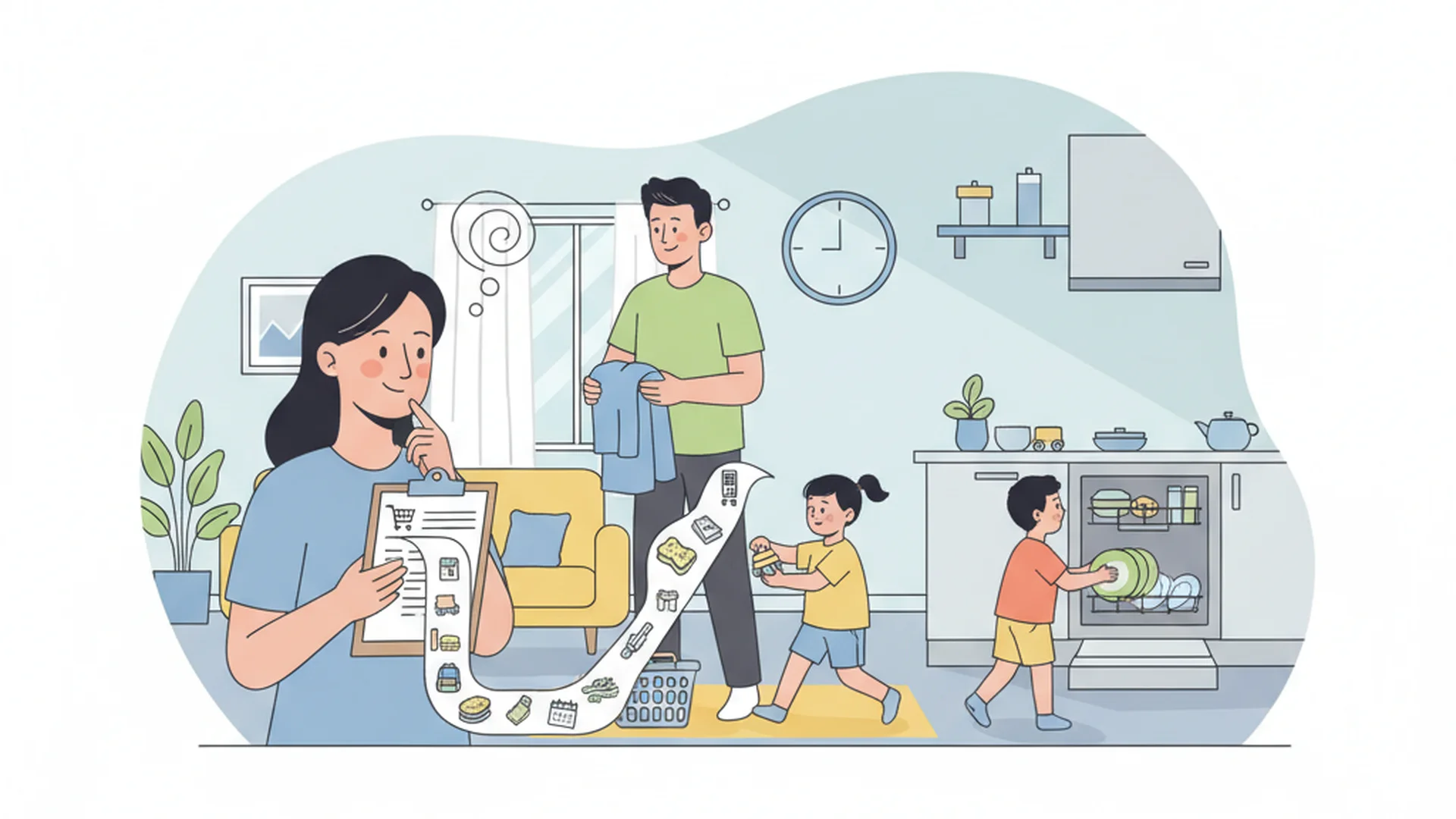
The "mental load"—also known as cognitive labor—refers to the invisible work of anticipating needs, planning, and organizing a household. It is the behind-the-scenes management that makes a home function. While physical chores are the "doing," the mental load is the "thinking."
Researchers studying family life keep finding a persistent gender gap. Mothers tend to carry the larger share of the household mental load, while fathers carry noticeably less of it. This disparity exists even in households where physical chores are split 50/50.
Note: If U.S. parents were compensated for their mental labor, such as scheduling and managing, it would represent an estimated $3.8 trillion in economic value.
The Difference Between Chores and Load
To manage the mental load household members must first distinguish between a task and the management of that task.
| Physical Chore | Mental Load (The Invisible Work) |
|---|---|
| Washing the dishes | Noticing the dish soap is low and adding it to the list. |
| Driving to a birthday party | Researching a gift, checking the RSVP date, and wrapping the present. |
| Vacuuming the floor | Remembering that the guest coming over is allergic to pet dander. |
| Folding laundry | Checking if the children’s clothes still fit for the upcoming season. |
The CPE Model: A Path to Equity
One of the most effective mental load household tips is the implementation of the CPE model: Conception, Planning, and Execution.
Most household imbalances occur because one partner handles the "Conception" and "Planning" while the other only handles "Execution." For example, if a husband washes the dishes but only because his wife pointed out the sink was full, the wife has still performed the mental labor.
1. Conception
This is the "noticing" phase. It involves realizing that a need exists. Example: Noticing that the dog is running low on heartworm medication.
2. Planning
This involves the logistics. Example: Checking the vet's hours, finding the prescription number, and deciding which day to go pick it up.
3. Execution
This is the final physical act. Example: Driving to the vet and buying the medication.
Tip: True partnership means one person "owns" a task from Conception through Execution. If you are "helping" by waiting for instructions, you aren't reducing the mental load.
Managing Mental Load Household Trends for 2025-2026
As we look toward the future of home management, several trends are emerging that change how we view cognitive labor.
The Rise of AI-Assisted Management
In 2025, Large Language Models (LLMs) are being used to automate meal planning and scheduling. However, experts warn against "DIY Mental Health AI." While AI can generate a grocery list, the responsibility of checking the pantry to see what is actually in stock still falls on a human. The goal is to use tech to reduce the planning phase, not to replace communication between partners.
"Quiet Cracking" and Burnout
A term gaining traction in 2025 is "Quiet Cracking." This describes parents who are technically functioning but are internally "surviving" rather than "parenting." This level of burnout is often the direct result of an unsustainable mental load. Recognizing "Quiet Cracking" early is essential for maintaining both personal well-being and family harmony.
The "Magic" Category
There is a growing focus on the "Magic" of the household. This refers to the extra effort put into birthdays, holidays, and family traditions. While these seem like "extras," they are high-stress branches of mental labor. Sharing the "Magic" means both partners are involved in creating the memories, not just one person acting as the "Director of Fun" while the other just shows up.
Warning: "Maternal Gatekeeping"—criticizing how a partner completes a task—often leads the other partner to stop trying, further increasing the primary carrier's load.
Best Practices for Redistributing the Load
To successfully manage the mental load, families need structured systems.
The Fair Play Method
Popularized by Eve Rodsky, this method involves using a "deck of cards" to visually represent household tasks. Each card represents a "Total Conception, Planning, and Execution" responsibility. By "dealing" the cards, partners can see exactly how much they are carrying and adjust until the weight feels fair.
Minimum Standard of Care (MSC)
A common source of friction is differing standards. If one partner cleans the kitchen but leaves crumbs on the counter, the other partner feels the job isn't "done."
- The Solution: Agree on a "Minimum Standard of Care." If the MSC for "Kitchen" includes wiped counters and an empty sink, both partners must adhere to that standard. This eliminates the need for "nagging" or re-doing work.
Weekly "State of the Union" Meetings
Schedule a 20-minute weekly check-in. Use this time to:
- Review the upcoming calendar.
- Discuss "Magic" events (birthdays, school plays).
- Re-evaluate task ownership for the week.
Success: Regular communication prevents mid-week "emergency" mental labor and ensures no one is surprised by a deadline.
Common Mistakes to Avoid
Even with the best intentions, families often fall into the same traps when trying to balance the mental load household requirements.
Mistake: "Just tell me what to do"
This is the most frequent pitfall. When a partner asks for a list, they are essentially asking the other person to remain the "Manager." The Manager role is the mental load. True equity is achieved when a partner sees the work and takes ownership without being prompted.
Mistake: The Efficiency Trap
Often, the person who is "better" or "faster" at organizing ends up doing everything. This "efficiency trap" punishes the organized partner with more work, eventually leading to resentment.
Mistake: Comparing Work Hours to Home Labor
Mental load is often dismissed if one partner works more hours outside the home. However, mental labor is 24/7. Even at the office, the primary carrier of the load is thinking about childcare, dinner, and school forms. Equity should be measured by "Total Rest Time," not just "Total Work Hours."
Note: Workplace recognition for "Cognitive Load" is increasing in 2026, with some HR policies offering "life-management" days to combat this specific type of burnout.
Frequently Asked Questions
What is the difference between mental load and emotional labor?
How do I explain mental load to a partner?
Is mental load just a "mom thing"?
Can technology fix the mental load?
What should I do if my partner refuses to acknowledge the mental load?
Conclusion
Managing the mental load household dynamics is a continuous process of communication and recalibration. By moving away from the "Manager/Helper" dynamic and toward a model of "Full Ownership" through the CPE method, families can find a balance that prevents burnout and fosters a more supportive home environment. Remember, the goal isn't just a clean house—it's a home where both partners have the mental space to thrive.
Success: Reducing the mental load leads to improved relationship satisfaction, lower stress levels, and more "Magic" in your family life.
Cleaning that keeps score
Every task earns points, every streak multiplies them, and Premium adds a household leaderboard plus a monthly Dustagorgon to beat.
- Free forever
- 30 badges to earn
- Up to 6 in a household
No card needed. Set up your rooms in a couple of minutes.