In this article
What you’ll learn
- Moving from "helping" to "full ownership" is essential for long-term success.
- Perceived fairness is more important for relationship satisfaction than a literal 50/50 split.
- Utilizing AI and digital apps can significantly reduce the "mental load" of household management.
Entering a long-term relationship often feels like a fairytale until the first sink full of dirty dishes appears or a mountain of unfolded laundry becomes a permanent fixture on "the chair." Learning how to split chores with partner effectively is more than just a home maintenance strategy; it is a vital survival skill for modern romance. In 2025, the conversation has shifted away from simply "helping out" toward a model of "shared ownership."
When one partner feels like the "manager" and the other like a "volunteer," resentment begins to brew. This guide will walk you through the latest psychological methods, technological tools, and communication strategies to ensure your home runs smoothly without sacrificing your connection.
The Real Cost of "Chore Wars"
Before we dive into the logistics of managing how to split chores with partner, it is important to understand why this matters. Household labor is rarely just about the labor itself; it is about respect, visibility, and equity.
Arguments over housework are one of the most commonly cited sources of serious conflict in relationships, sitting alongside money and trust as a reason couples come apart. There is also a stubborn gender gap: women still shoulder more of the domestic workload than men in most households, often by several hours a week.
Perhaps most surprisingly, the "chore war" extends into the bedroom. An unequal split of household chores has a habit of draining desire and affection. When one partner carries the weight of the home, the resulting burnout and resentment leave little room for intimacy.
Note: Relationship satisfaction isn't tied to a perfect 50/50 clock-split. It is tied to "perceived fairness." If both partners feel the division is equitable based on their current life circumstances, the relationship thrives.
Moving to the Full Ownership (CPE) Model
The most common mistake couples make is focusing only on the physical execution of a task. To truly master how to split chores with partner tips, you must adopt the CPE Model: Conceive, Plan, and Execute.
Understanding the Mental Load
The "mental load" or "invisible labor" is the cognitive energy required to manage a household. It’s not just buying the toilet paper; it’s noticing we are low, remembering which brand doesn't clog the pipes, and adding it to the list before we run out.
- Conceive: Noticing that a task needs to be done (e.g., the dog needs a vet appointment).
- Plan: Doing the research and logistics (e.g., checking the calendar, finding a vet, calling to book).
- Execute: The physical act of doing the task (e.g., driving the dog to the vet).
When you split chores, one person should own all three stages. If you "own" the kitchen, you shouldn't have to ask your partner what's for dinner or if there are clean pans. You own the conception, the planning, and the execution.
Real-World Example: The Grocery Cycle
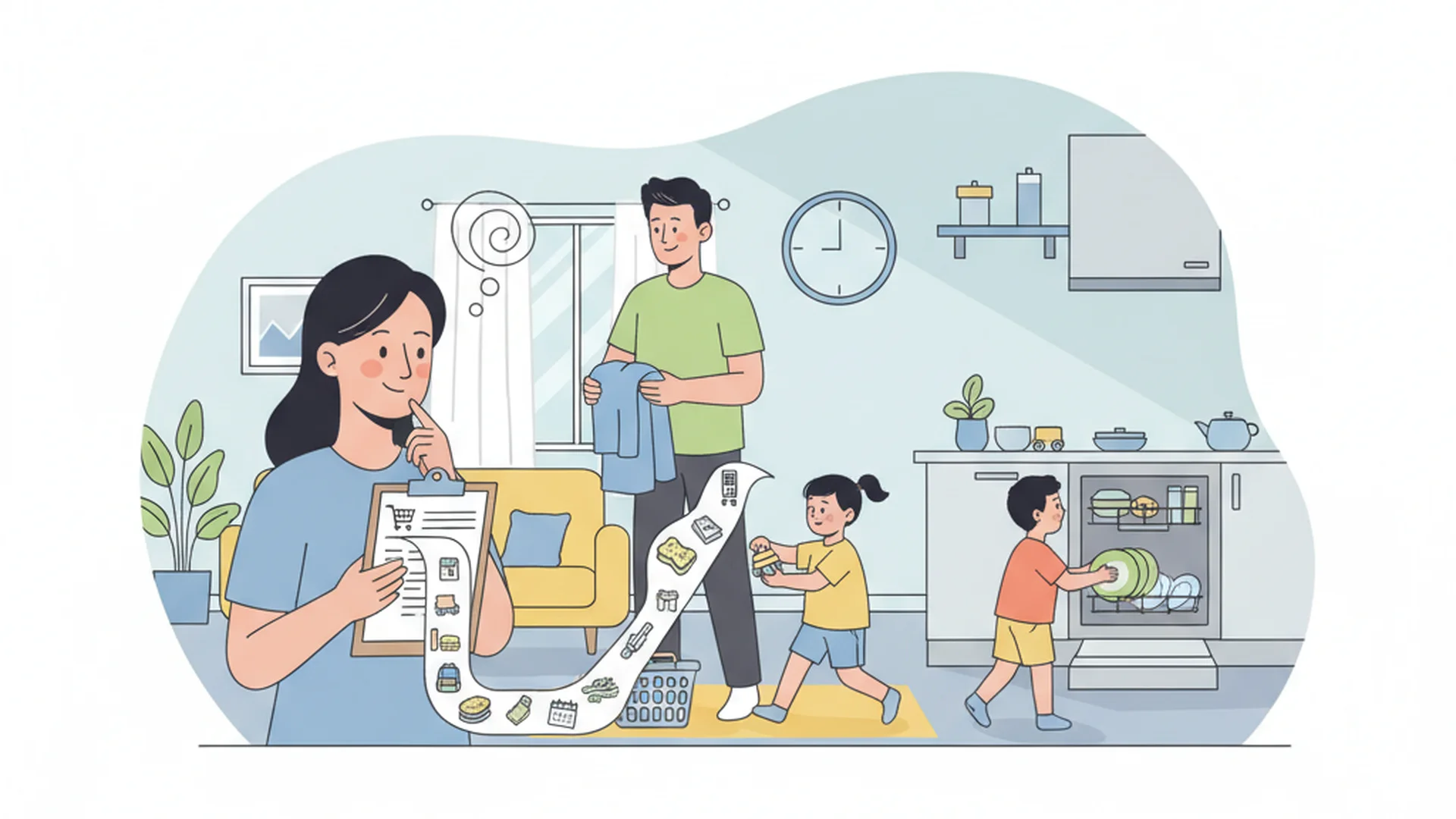
Instead of Partner A making a list and Partner B going to the store (which leaves the mental load on Partner A), Partner B takes full ownership of "Groceries." Partner B checks the pantry, plans the meals, creates the list, and does the shopping. Partner A is completely removed from the process, freeing up their mental space for a different "owned" task.
Tip: If your partner owns a task, let them own it completely. Resisting the urge to "check in" or "remind" them is essential for the CPE model to work.
Modern Strategies for 2025 and 2026
As we move further into the mid-2020s, technology and new psychological frameworks are changing how we manage our homes.
AI-Assisted Domestic Management
One of the biggest trends for 2026 is using AI to bridge the gap in invisible labor. Couples are now using tools like ChatGPT to handle the "Plan" phase of the CPE model.
- Meal Planning: "Generate a 7-day meal plan for two people using these ingredients, including a grocery list."
- Task Breakdown: "I need to organize the garage. Break this into 10 manageable steps that take 15 minutes each."
- Administrative Help: Drafting emails to landlords, researching the best-rated vacuum cleaners, or comparing insurance rates.
The "80/80" Method
While many strive for 50/50, the "80/80" method is gaining traction as a more realistic approach. In this model, both partners strive to do 80% of the work. This "generosity-first" mindset creates a buffer. If one partner has a brutal week at work or gets sick, the other partner’s 80% effort covers the slack without the "scorekeeping" that leads to resentment.
Tech-Enabled Accountability
Relying on memory is a recipe for failure. Shared apps like Coexist or Tody allow couples to gamify chores. These apps provide visual reminders of when a task was last completed and by whom, making the invisible work visible.
| Strategy | Best For | Level of Effort |
|---|---|---|
| CPE Model | Reducing Mental Load | High (Initial) |
| 80/80 Method | High-Stress Seasons | Medium |
| AI Integration | Admin/Planning Tasks | Low |
| App Tracking | Visual Accountability | Medium |
How to Start the Conversation
Discussing housework can feel like stepping into a minefield. To successfully implement managing how to split chores with partner, work through these steps:
1. Define the "Minimum Standard of Care"
One person’s "clean" is another person’s "tidy." Before assigning tasks, agree on what "done" looks like. If one partner thinks the kitchen is clean when the dishes are in the dishwasher, but the other thinks it includes wiping the counters and the sink, conflict is inevitable. Establish a shared standard beforehand to avoid "gatekeeping."
2. Assign by Preference and Strength
Start by listing every household task. Each partner should "claim" the chores they hate the least. If one person finds folding laundry therapeutic but hates scrubbing toilets, and the other feels the opposite, you’ve already solved 20% of your problems.
3. The Weekly Chore Check-In
Set aside a 15–20 minute weekly meeting. This isn't a time for nagging; it’s a time for logistics.
- What is the schedule for next week?
- Which "owned" tasks might need a hand due to a busy work schedule?
- What went well this week?
Success: Couples who hold weekly check-ins tend to argue far less about household management, because issues get addressed before they become "resentment mountains."
Common Mistakes to Avoid
Even with the best intentions, it is easy to fall into old patterns. Watch out for these relationship-killers:
- Asking for "Help": This is the most common mistake. When you ask for "help," you are reinforcing the idea that the chore is your responsibility and the other person is just a volunteer. Use language like "sharing responsibility" or "our home."
- Weaponized Incompetence: This occurs when a partner pretends to be bad at a task (like "accidentally" shrinking a wool sweater) so they are never asked to do it again. This is a major trust-killer and should be addressed immediately.
- Gatekeeping or Redoing Work: If your partner cleans the windows and you immediately go behind them with a cloth to "fix" it, you are gatekeeping. This discourages ownership and makes the other partner feel inadequate.
- Ignoring the Cognitive Load: Dividing physical tasks (vacuuming vs. mopping) is easy. Dividing cognitive tasks (knowing when the car needs an oil change) is harder but more important for preventing burnout.
Warning: Weaponized incompetence is often a subconscious habit. If you catch yourself thinking "I'll just do it myself because they'll mess it up," you are participating in a cycle that will eventually lead to burnout.
Frequently Asked Questions
How do we split chores if one partner works much longer hours?
What should I do if my partner says they’ll do it, but then forgets?
How can we avoid falling into traditional gender roles?
How do I explain the ‘mental load’ without sounding like I’m complaining?
Conclusion
Sharing a life means sharing the mundane. While dividing the laundry might not seem romantic, creating a system where both partners feel seen, valued, and rested is the ultimate act of love. By moving toward a model of full ownership, utilizing 2026 tech trends, and maintaining open lines of communication, you can transform your home from a source of stress into a sanctuary of mutual support.
Success: A clean home is a mental health tool. By reducing the clutter in your living space, you simultaneously reduce the cortisol levels in your brain, leading to better sleep and a more harmonious relationship.
Cleaning that keeps score
Every task earns points, every streak multiplies them, and Premium adds a household leaderboard plus a monthly Dustagorgon to beat.
- Free forever
- 30 badges to earn
- Up to 6 in a household
No card needed. Set up your rooms in a couple of minutes.