In this article
What you’ll learn
- Focus on low-friction systems like hooks and open bins to reduce executive load.
- Prioritize visual transparency to solve "out of sight, out of mind" issues.
- Use "Laundry Purgatory" baskets to prevent floor piles and doom piles.
For many, the morning routine begins with a simple trip to the wardrobe. But for those of us with neurodivergent brains, adhd closet organization is rarely simple. It’s a battlefield of executive dysfunction, decision fatigue, and the dreaded "doom pile." You open the door, and instead of seeing options, you see a chaotic mountain of fabric that triggers an immediate spike in cortisol. If you’ve ever felt like a failure because you can't keep your socks paired or your shirts hung, it is time to stop blaming your character and start looking at your system.
Traditional organizing advice tells you to "just put it away" or "follow a strict folding routine." For the ADHD brain, these high-friction tasks are the equivalent of climbing Mount Everest before breakfast. Effective adhd closet organization help isn't about making your closet look like a Pinterest board; it’s about reducing the number of steps between you and a functional morning.
The Science of Why ADHD Closets Stay Messy
To fix the problem, we have to understand the neurobiology behind the mess. ADHD is fundamentally a disorder of executive function. This means the "manager" part of the brain—responsible for task initiation, working memory, and emotional regulation—often goes on strike.
Object Permanence and Working Memory
One of the most significant hurdles in adhd closet organization is the concept of "out of sight, out of mind." In the ADHD community, we often joke about our lack of object permanence. If a shirt is tucked away in a deep, opaque drawer or hidden behind three other layers of clothing, the brain effectively forgets it exists. This leads to "closet blindness," where you feel like you have nothing to wear despite a bursting wardrobe, leading to over-purchasing and further clutter.
The Cortisol Connection and Decision Fatigue
There is a direct link between how stressed you feel and how densely packed with clutter your home is. For a neurotypical person, a messy closet is a nuisance. For the ADHD brain, it’s a source of sensory overload that can lead to "task paralysis."
Every one of us makes an enormous number of small decisions each day, and ADHD brains reach "decision fatigue" significantly faster. Every morning, a cluttered closet forces you to make dozens of micro-decisions: Is this clean? Does this match? Where is the other sock? By the time you’ve picked an outfit, your executive energy for the day is already depleted.
Note: Your closet isn't messy because you are lazy; it's messy because your current system requires more executive function than you have available in the morning.
The "Low-Friction" Rule for Closet Setup
If a system takes more than two steps to maintain, an ADHD brain will eventually abandon it. This is the "Low-Friction Rule." To achieve lasting adhd closet organization, we must move away from complex rituals and toward "drop-and-go" solutions.
Use Hooks Instead of Hangers
Hanging clothes on a traditional hanger involves: 1) Finding an empty hanger, 2) Navigating the garment onto the hanger, 3) Ensuring it doesn't slip off, and 4) Sliding it into a crowded rack. This is four steps—too many. The ADHD fix: Install a row of sturdy hooks. Taking a jacket or a pair of jeans and looping them over a hook takes exactly one second and one step.
Remove the Doors
It sounds radical, but closet doors are a physical and mental barrier. They allow you to hide the mess, which feeds the "out of sight, out of mind" cycle. Removing doors (or replacing them with a simple curtain) forces visual accountability and removes the "step" of opening a door to put things away.
Open Bins and Visual Transparency
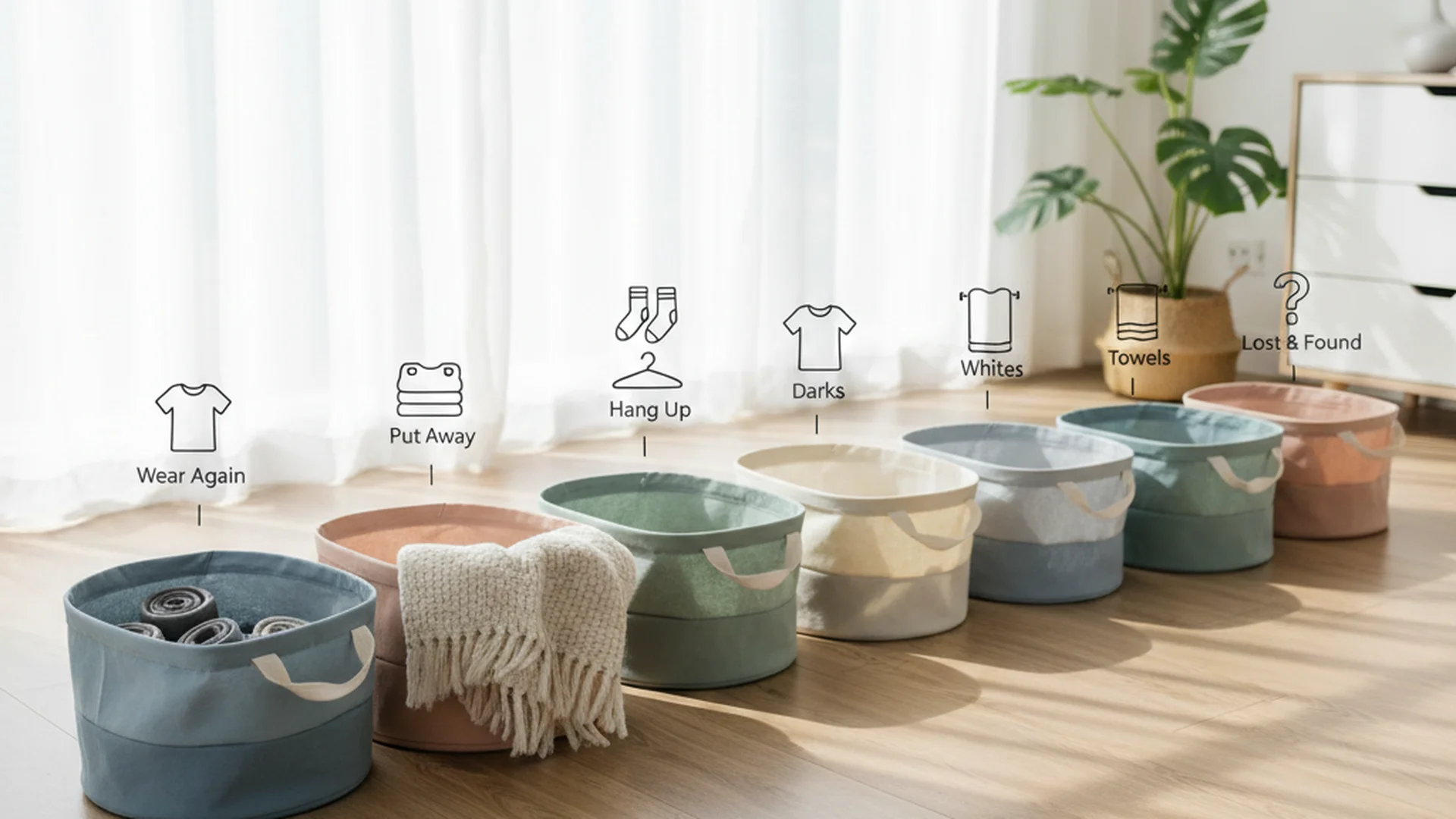
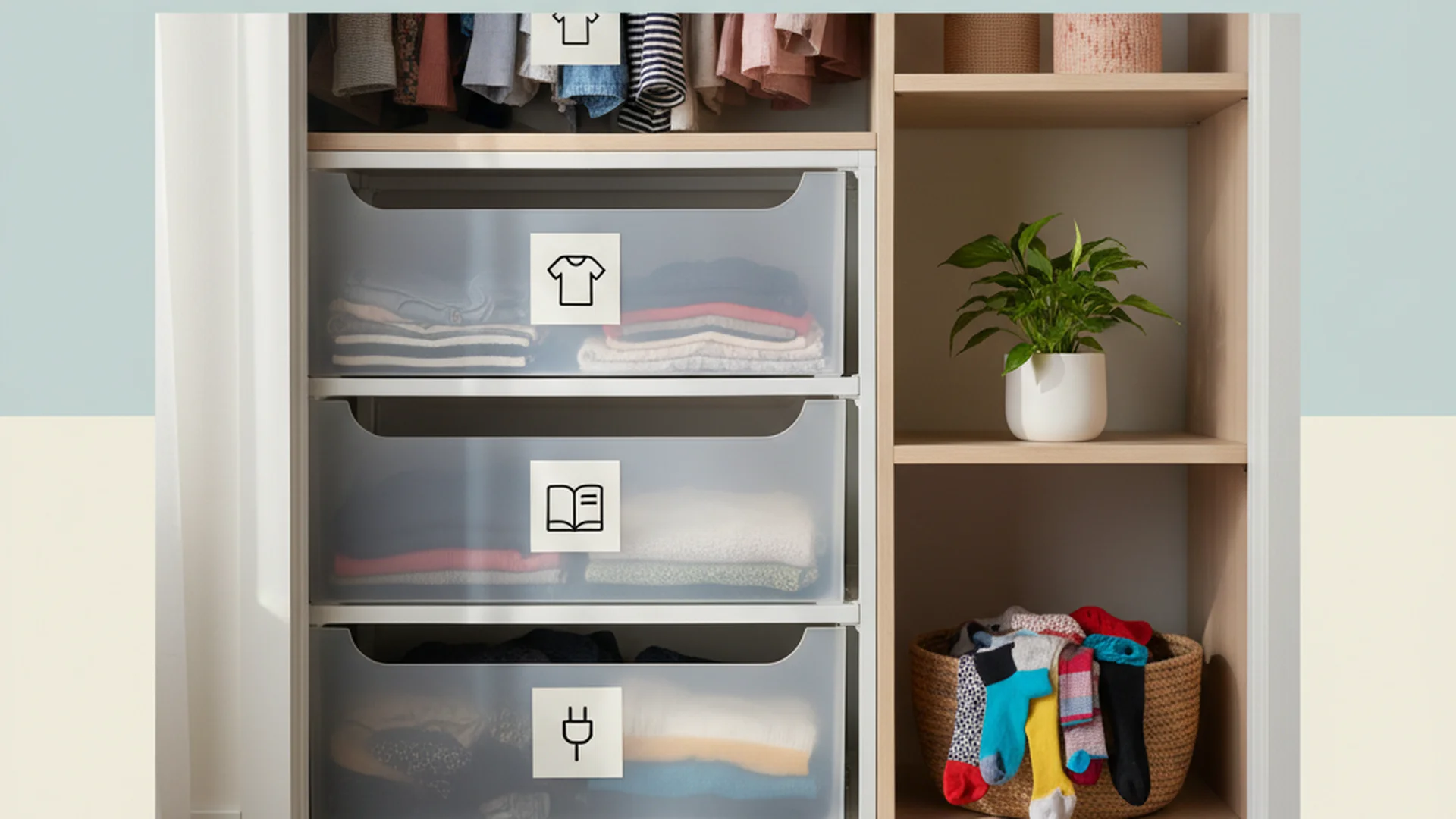
Replace wicker baskets or solid plastic bins with clear acrylic containers or wire baskets. If you can see your leggings through the side of the bin, you won't throw everything on the floor while looking for your favorite pair.
Tip: If you can't replace your opaque bins yet, use large, high-contrast labels with both words and icons (e.g., a picture of a sock next to the word "SOCKS"). This helps the brain process the category instantly, even during morning brain fog.
Real-World Examples of Functional Systems
To see how these adhd closet organization tips work in practice, let's look at three common scenarios.
Example 1: The "Laundry Purgatory" Solution
The Problem: Sarah finds her closet floor covered in clothes that aren't "dirty" (worn for two hours) but aren't "crisp clean" either. The ADHD Fix: Sarah placed a dedicated, open-top basket labeled "Mostly Clean" or "Wear Again" in the corner of her closet. Instead of the "chair" or the floor, her "purgatory" clothes have a designated home that requires zero folding.
Example 2: The Zone-Based Wardrobe
The Problem: Mark gets overwhelmed by his 50 shirts and ends up wearing the same three things because he can't process the options. The ADHD Fix: Mark stopped organizing by "type" (all shirts together) and started organizing by "activity." He has a "Work Zone," a "Gym Zone," and a "Weekend Zone." Now, he only looks at 10 items instead of 50, drastically reducing decision fatigue.
Example 3: The Uniform/Capsule Method
The Problem: Jessica spends 20 minutes every morning trying to match colors and textures, often ending up late. The ADHD Fix: Jessica switched to a "Capsule Wardrobe" where everything she owns fits a specific color palette (navy, grey, and white). Since everything matches everything else, the "decision" part of dressing is virtually eliminated.
Success: One client reported saving 15 minutes every morning simply by switching to clear shoe boxes, eliminating the "box shuffle" to find the right pair.
2025 Trends: Tech and Dopamine in the Closet
As we move through 2025, the world of organization is shifting toward "functional neuro-inclusion." Here are the latest trends specifically benefiting the ADHD community.
Dopamine Decorating
Instead of a sterile, white closet, use bright colors, peel-and-stick wallpaper, or motion-activated LED strip lighting. When the closet provides a "dopamine hit" (a small burst of joy or visual stimulation), the brain is more likely to engage with the space and maintain the order.
Smart Labels and QR Codes
Tech-savvy organizers are now using QR codes on bins. For seasonal items (like "Winter Coats" or "Holiday Sweaters"), you can scan the code with your phone to see a photo of every item inside the bin. This prevents you from digging through boxes and creating a mess just to find one specific item.
Body Doubling Apps
"Body doubling" is a productivity strategy where you work alongside someone else. Apps like Focusmate or Flow Club are being used for "Closet Resets." Knowing someone else is "with you" (even virtually) provides the external accountability needed to finish a decluttering session without getting distracted by an old photo album you found in the back of the closet.
Comparison: Traditional vs. ADHD-Friendly Organization
| Feature | Traditional Method | ADHD-Friendly Method |
|---|---|---|
| Storage | Opaque, matching bins | Clear bins or wire baskets |
| Folding | Marie Kondo "File" Folding | "The Flop" (Tossing into bins) |
| Hanging | Uniform velvet hangers | Heavy-duty hooks |
| Categorization | By garment type (e.g., all pants) | By activity (e.g., all work clothes) |
| Maintenance | Daily "tidying up" | Weekly "5-minute reset" |
Warning: Avoid the "Pinterest Trap." Buying 20 matching wicker baskets might look beautiful for a photo, but if you can't see what's inside, your ADHD brain will treat those baskets as if they've vanished into a black hole.
Common Mistakes to Avoid
Even with the best intentions, it is easy to fall into traps that set you up for failure. Here is what to avoid when seeking adhd closet organization help:
- Organizing Before Decluttering: You cannot organize your way out of having too much stuff. If you have 100 shirts and space for 50, no system in the world will save you. You must reduce the volume first.
- Complex Folding Systems: Many people try to adopt the Marie Kondo style of folding. While beautiful, it requires high fine-motor persistence and time. Most ADHD individuals find that after a week, the "folding mountain" becomes an insurmountable obstacle. If you can't fold, don't. Use bins for "rolling" or just "flopping."
- Buying "Stuff" to Fix the Problem: Do not go to the container store before you have a plan. ADHD brains often get a dopamine hit from buying organizers, but the organizers themselves don't create the habit.
- The "All or Nothing" Mentality: You don't have to organize the whole closet in one day. Doing so often leads to a "hyperfocus crash," leaving you with a gutted closet and no energy to put things back. Use the "One-Category-at-a-Time" method (e.g., today is just socks).
Frequently Asked Questions
How do I start when I’m completely overwhelmed?
Why does my closet get messy again within three days?
Is the KonMari method good for ADHD?
How do I handle "doom piles" in my closet?
Should I organize by color?
Conclusion
At the end of the day, adhd closet organization is not about aesthetics; it is about accessibility. A "perfect" closet that you can't maintain is a failure. A "messy-looking" closet filled with open bins and hooks that allows you to get dressed in five minutes without a meltdown is a resounding success.
Be kind to your brain. If a system isn't working, it isn't because you aren't trying hard enough—it's because the system isn't designed for your unique wiring. Strip away the friction, embrace visual transparency, and give yourself permission to do things "the easy way."
Success: By implementing a "Low-Friction" closet, you are reclaiming your morning energy for the things that actually matter in your life.
Cleaning that keeps score
Every task earns points, every streak multiplies them, and Premium adds a household leaderboard plus a monthly Dustagorgon to beat.
- Free forever
- 30 badges to earn
- Up to 6 in a household
No card needed. Set up your rooms in a couple of minutes.