In this article
What you’ll learn
- Use "Tolerable Ten" sprints to lower the barrier to task initiation.
- Traditional Pomodoro (25/5) often fails ADHD brains; try 10/3 or 15/5 instead.
- Visual timers are superior to digital ones for overcoming time blindness.
If you have ever spent three hours sitting on your couch, staring at a basket of unfolded laundry and feeling physically unable to move, you aren't lazy. You are likely experiencing "task paralysis," a hallmark of the ADHD experience. For the neurodivergent brain, the simple instruction to "just clean the kitchen" feels like an insurmountable mountain. This is where an adhd cleaning timer becomes more than just a tool—it becomes an external executive function.
An adhd cleaning timer strategy works by bypassing the brain's struggle with initiation and providing a clear, visible "finish line." Instead of facing an ambiguous, never-ending chore, you are facing a discrete, timed event. In this guide, we will explore the science of why these methods work and provide the latest 2025–2026 techniques to help you regain control of your living space without the burnout.
The Science of Time Blindness and Cleaning
To understand why a timer is so effective, we have to look at how the ADHD brain perceives the world. Executive function deficits are a core feature of ADHD, and for most people they persist well into adulthood. One of the most debilitating of these is "time blindness."
Time blindness is the inability to "feel" the passage of time or accurately estimate how long a task will take. When you look at a sink full of dishes, your brain might estimate that it will take two hours of agonizing labor. In reality, it might only take eight minutes. Because your internal clock is miscalibrated, the perceived effort outweighs the perceived reward, leading to total paralysis.
Recent 2025 neuroimaging studies suggest that productivity tools like timers don't just "organize" us; they actually help activate the brain’s reward and alertness systems. By setting a visible countdown, you create a "micro-deadline" that triggers a small spike in dopamine and norepinephrine, the very chemicals the ADHD brain lacks. This external "brain" tracks the progress that your internal brain cannot, making the invisible visible.
3 Timer Methods That Actually Work
When looking for adhd cleaning timer help, it is important to realize that traditional productivity methods, like the standard Pomodoro Technique, often backfire. A 25-minute work block can feel like an eternity to a brain craving novelty. Here are the refined methods that experts currently recommend.
1. The "Tolerable Ten" Method
The "Tolerable Ten" is designed specifically for those days when the "Wall of Awful" feels too high to climb. The goal is not to finish a project, but simply to "touch" the task.
- How it works: Set your timer for exactly 10 minutes.
- The Rule: You can do anything you want for those 10 minutes, as long as it pertains to the room you are in. You can pick up three socks, or you can deep-clean the baseboards.
- The Exit: When the timer goes off, you have full permission to stop.
Success: Most people find that once the 10-minute barrier is broken, they are willing to set the timer for another 10 minutes. However, the "permission to stop" is the psychological safety net that makes the initiation possible.
2. The Modified Pomodoro (10/3 or 15/5)
Standard 25/5 intervals are often too long for neurodivergent focus. By shortening the "sprint," you keep the dopamine levels high and the boredom levels low.
- The Sprint: 10 to 15 minutes of high-intensity cleaning.
- The Dopamine Break: 3 to 5 minutes of a low-stakes reward (like stretching, a quick snack, or listening to one favorite song).
Warning: Avoid "High-Dopamine" traps during your breaks, such as checking TikTok or starting a video game. These activities make "re-initiation" almost impossible for the ADHD brain.
3. Natural Timers
If the ticking of a mechanical clock or the countdown of a digital timer causes you "clock-watching" anxiety, natural timers are your best friend. This method uses a real-world event as your countdown.
- The Kettle Method: Start the kettle. Your goal is to clear the kitchen counters before the whistle blows.
- The Podcast Sprint: Clean only for the duration of one 20-minute podcast episode. When the episode ends, the cleaning ends.
- The Laundry Cycle: Use the time it takes for your washing machine to run its "Quick Wash" cycle (usually 15-20 minutes) to tidy the laundry room and adjacent hallway.
Beyond the Clock: Using AI and Body Doubling in 2026
As we move into 2026, the technology surrounding adhd cleaning timer tips has evolved. We are no longer limited to simple kitchen timers; we now have "Agentic AI" and virtual accountability partners.
Agentic AI Assistants
New tools like Dume.ai and Saner.AI are changing the game. These are not just timers; they are task-architects. Instead of you having to figure out how to "Clean the Living Room," these AI tools break the task down into micro-steps based on your current reported energy levels.
Tip: If you tell the AI, "I have 10% energy and 15 minutes," it might suggest: "Just clear the trash from the coffee table and put the remote in its holder." This removes the "decision fatigue" that often stops cleaning before it starts.
The Power of Body Doubling
Body doubling is a practice where you perform a task in the presence of another person. It provides a level of "social friction" that keeps the ADHD brain on track. In 2025, apps like Dubbii and Focusmate have become mainstream.
- Virtual Doubling: You join a video call where someone else is also cleaning. You don't have to talk; you just need to know they are there.
- The Race: 2026 updates to apps like Habitica allow you to "race" against a friend’s timer. If you both finish your 10-minute sprint, you both earn points to defeat a "clutter monster" in the app.
| Method | Best For | Tech Required |
|---|---|---|
| Tolerable Ten | High Paralysis | Any Timer |
| Modified Pomodoro | High Energy | Visual Timer |
| AI Micro-steps | Decision Fatigue | Smartphone/AI App |
| Body Doubling | Accountability | Video Call/App |
The "House Purse" and Other Viral Hacks
One of the most effective adhd cleaning timer tips to emerge recently is the "House Purse" or "Cleaning Caddy" hack.
Note: A common reason ADHD cleaning sessions fail is the "side-quest" loop. You go to the kitchen to put a dish away, see a lightbulb is out, go to the garage for a bulb, and thirty minutes later, you are organizing your toolbox while the kitchen remains messy.
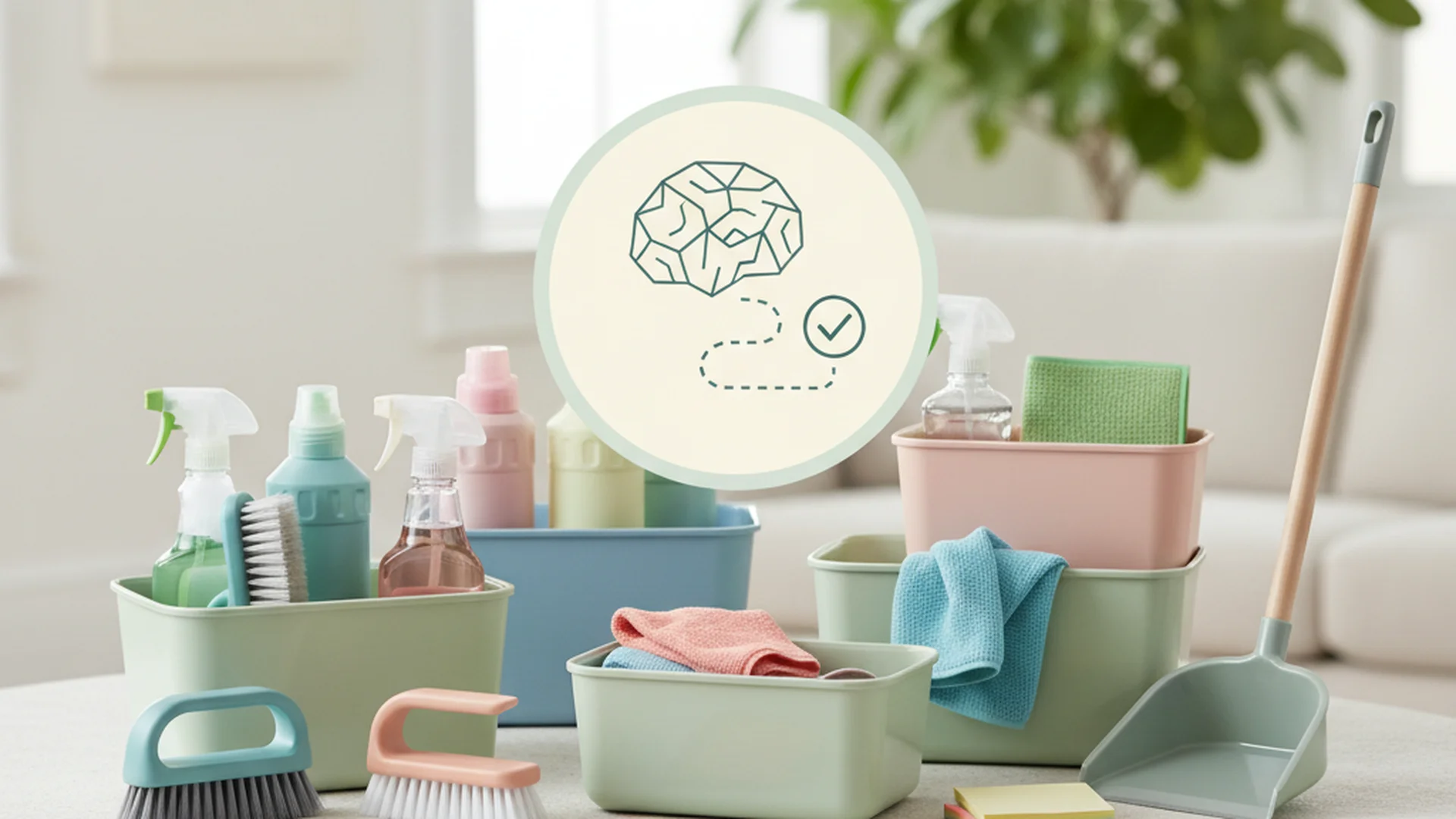
The "House Purse" involves wearing a small cross-body bag or carrying a caddy that contains:
- Your phone (running your timer).
- A microfiber cloth and multi-purpose spray.
- A pair of glasses (if needed).
- Your headphones.
By carrying your tools with you, you eliminate the need to leave the room, which is the primary trigger for getting distracted and "breaking" your timer sprint.
Common Mistakes to Avoid
Even with the best adhd cleaning timer, you can fall into productivity traps that leave you feeling more frustrated than when you started.
The Perfectionism Trap
Many people with ADHD struggle with "all-or-nothing" thinking. They believe that if the house isn't spotless, the cleaning "didn't count." Experts emphasize "Progress, not Perfection." If your timer goes off and the room is 20% better, that is a massive win. A functional home is better than a "perfect" home that causes a mental breakdown.
Using Rigid Systems
The ADHD brain thrives on novelty. A system that works this week might feel incredibly boring next week. One of the biggest mistakes is trying to force yourself to use the same timer method forever.
Tip: Rotate your systems. Use the "Tolerable Ten" for a week, then switch to a "Podcast Sprint" the next week. Keep it "shiny" and interesting for your brain.
The "Timer Stress" Overload
For some, the sound of a ticking clock or a loud alarm creates physical anxiety. This can lead to "clock-watching," where you spend more time looking at the timer than cleaning. If this is you, switch to a silent visual timer (like the Time Timer) where a red disk disappears as time passes, or use a "Focus Music" playlist that is exactly 15 minutes long.
Frequently Asked Questions
Why can't I just start cleaning without a timer?
Which timer is better: Digital or Analog?
What if I get distracted during the timer?
Is the traditional Pomodoro (25/5) good for ADHD?
How do I clean when I’m completely overwhelmed?
Conclusion
Cleaning with ADHD isn't about having more discipline; it’s about having better systems. Using an adhd cleaning timer allows you to work with your brain instead of against it. By breaking the "time blindness" spell and lowering the barrier to entry with methods like the "Tolerable Ten," you can maintain a functional home without the shame.
Remember, your home exists to serve you; you do not exist to serve your home. It is okay to be messy—just give that mess a "home" and a 10-minute timer to help you manage it.
Success: Implementing just one of these timer methods today can take a real bite out of your cleaning-related anxiety. Start small, stay visual, and be kind to your brain.
Cleaning that keeps score
Every task earns points, every streak multiplies them, and Premium adds a household leaderboard plus a monthly Dustagorgon to beat.
- Free forever
- 30 badges to earn
- Up to 6 in a household
No card needed. Set up your rooms in a couple of minutes.