In this article
What you’ll learn
- Task-by-task cleaning is 20-40% faster due to reduced context switching.
- Room-by-room cleaning is superior for focus, mental clarity, and small spaces.
- Hybrid "Zone Cleaning" is the top recommendation for busy 2025 households.
When it comes to maintaining a modern home, the room vs task cleaning debate is more than just a preference—it is a choice between two entirely different psychological and physical workflows. Whether you are a minimalist living in a city studio or managing a sprawling suburban household, how you approach your chores determines how much of your weekend is "stolen" by housework. In this comprehensive room vs task cleaning guide, we will break down the science of efficiency, the latest 2025 trends, and help you decide which method aligns with your lifestyle.
Choosing the right strategy isn't just about a sparkling floor; it’s about reclaiming your time. As we navigate a world of dual-income pressures and "micro-cleaning" habits, understanding the nuances of room vs task cleaning explained can be the difference between burnout and a balanced home life.
Defining the Methods: Room vs Task Cleaning Explained
Before diving into the data, let’s clarify what we mean by these two dominant philosophies.
Room-by-Room Cleaning
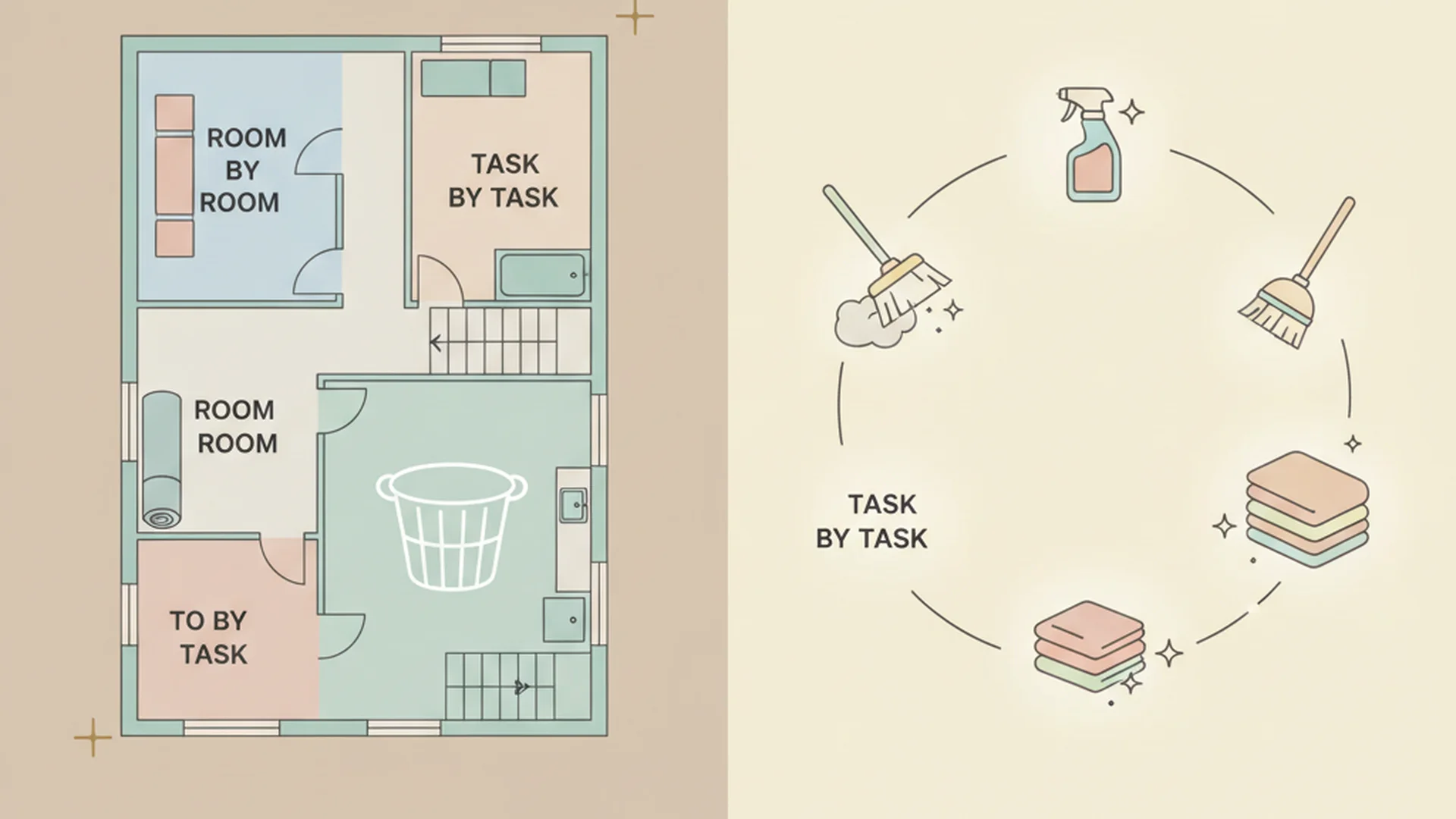
This is the traditional approach. You pick a room—let's say the kitchen—and you don’t leave until every surface is wiped, the floor is mopped, and the trash is taken out. You finish one "container" of space completely before moving to the next.
Task-by-Task Cleaning
Also known as "The Assembly Line Method," this involves performing one specific chore throughout the entire house. For example, you grab your duster and dust every single room. Then, you grab the vacuum and hit every floor. You focus on the action rather than the location.
Note: Professional cleaning services almost exclusively use the task-by-task method because it minimizes the "reset" time required to switch tools and mental focus.
The Science of Efficiency: Why Task-By-Task Often Wins
If speed is your primary goal, the data is clear. Research shows that "context switching"—the act of stopping one type of work to start another—carries a heavy cognitive penalty. In a cleaning context, this means that every time you stop vacuuming to scrub a toilet, or stop dusting to wash a window, your brain and body experience a "re-start" lag.
Studies indicate that this penalty can increase the total time taken for a project by 20–40%. When you stay in "vacuuming mode," you move faster, your body maintains a specific rhythm, and you don't waste time walking back and forth to the supply closet to swap your vacuum for a spray bottle.
The Breakdown of Movement
In a large home, the "travel time" associated with room-by-room cleaning adds up. Imagine carrying a heavy vacuum up and down stairs multiple times, or returning to the kitchen five times to rinse a cloth. Task-based cleaning streamlines this by ensuring you only move through the house with a specific tool once.
Tip: If you choose the task-by-task method, use a cleaning caddy. Keeping all your sprays and cloths in one portable bucket ensures you never have to "run back" to get a specific cleaner.
The Psychological Edge: Why Room-By-Room Still Matters
While task-based cleaning is faster on paper, it isn't always the best for the human brain, particularly for those who struggle with focus or the "unfinished" feeling of a house in transition.
The "Completion High"
There is a distinct hit of dopamine that comes from looking at a room that is 100% finished. In the task-by-task method, your house often looks worse before it looks better. You might have dust kicked up in every room and piles of laundry on every bed simultaneously. For many, this creates a sense of "cleaning chaos" that can lead to anxiety.
Managing ADHD and Focus
For individuals with ADHD, the room-by-room method acts as a physical "container." It provides clear boundaries. By staying within the four walls of the bathroom, you are less likely to wander into the hallway, notice a stray shoe, follow that shoe into the bedroom, and suddenly realize you are organizing a closet instead of finishing the bathroom.
Success: Using the room-by-room method can be a form of "mindful cleaning." By focusing on one space, you can appreciate the transformation of that specific environment, which supports mental clarity.
Comparative Overview: Room vs Task
| Feature | Room-by-Room | Task-by-Task |
|---|---|---|
| Speed | Slower (More switching) | Faster (Flow state) |
| Mental Load | Low (Focus on one area) | High (Requires tracking progress) |
| Best For | Small Apartments / ADHD | Large Homes / Families |
| Tool Usage | Frequent swapping | Sequential usage |
| Satisfaction | High (Instant finish) | Delayed (Finish at the end) |
Real-World Examples: Which One Fits You?
To better understand how these methods play out in everyday life, let's look at three common scenarios.
Example 1: The "Small Apartment" Dweller
Sarah lives in a 700-square-foot one-bedroom apartment. For her, task-based cleaning is often overkill. Because her "travel time" between the kitchen and living room is only five steps, the context-switching penalty is negligible. She prefers room-by-room cleaning because she can finish her kitchen in 20 minutes and feel a sense of total accomplishment before she even touches her bedroom.
Example 2: The "Large Suburban" Household
The Miller family has a four-bedroom home with three children. For them, task-by-task is the only way to survive. On Saturday mornings, they divide tasks: one person does all the bathrooms, one does all the dusting, and the robot vacuum handles the floors. By focusing on tasks, they avoid the "looping trap" where they spend all day cleaning but never seem to finish the whole house.
Example 3: The "Deep Cleaning" Specialist
When Emma (our author) does her annual Spring Cleaning, she switches to room-by-room. Why? Because deep cleaning requires attention to detail—cleaning inside the oven, wiping down baseboards, and organizing the "junk drawer." These details are easily missed in a task-based workflow where the goal is speed.
Warning: Never mix bleach with ammonia-based cleaners, regardless of which method you choose. Always ensure proper ventilation when using heavy-duty chemicals.
2025–2026 Trends in Home Maintenance
The landscape of cleaning is changing. We are moving away from the "Saturday Morning Slog" and toward more integrated, tech-assisted habits.
1. AI-Enhanced Scheduling
The rise of smart home sensors means that "scheduled" cleaning is becoming "responsive" cleaning. Modern apps can now track which rooms have seen the most foot traffic. Instead of cleaning every room, the AI might suggest a task-based vacuuming of just the "high-opportunity areas" (entryways and kitchens), leaving the guest room for another time.
2. Eco-Minimalism and Single-Bottle Cleaning
The 2025 market shift toward sustainable concentrates is making task-switching easier. By using one high-quality, pH-neutral multi-surface cleaner, you eliminate the need to swap bottles between the glass, the counter, and the wood furniture. This "single-bottle" approach makes task-by-task cleaning even faster.
3. Robot-Assisted Tasking
With robot vacuums and mops becoming standard in most households, the "Floor Task" is increasingly being removed from the human to-do list. This allows humans to focus on higher-level tasks like decluttering and sanitizing, often favoring a room-by-room focus for the manual work while the robots handle the house-wide task.
Common Mistakes to Avoid
Whether you are a task-master or a room-rotator, avoid these common pitfalls that drain your time and energy.
1. The "Looping" Trap
In room-by-room cleaning, people often leave the room to put an item away (e.g., taking a toy to the playroom), get distracted by a mess in the new room, and never return.
- The Fix: Place a "transition basket" at the door. Put everything that doesn't belong in the room into the basket. Only distribute those items once the room is 100% finished.
2. Cleaning Floors First
This is the cardinal sin of cleaning. If you vacuum or mop before you dust the ceiling fans or countertops, gravity will simply pull the new dust onto your clean floors.
- The Fix: Always work Top-to-Bottom, Left-to-Right.
3. The "Product Per Surface" Myth
Many people believe they need a different chemical for every square inch of their home. This marketing myth slows you down, especially in task-based cleaning.
- The Fix: Invest in a high-quality microfiber cloth set and a single multi-surface concentrate. You can handle 90% of your home with these two tools.
4. Aiming for an "A+" Every Time
Trying to achieve perfection every week leads to burnout.
- The Fix: Aim for a "B+" for weekly maintenance. Save the "A+" effort for your deep-cleaning sessions.
Frequently Asked Questions
Which is faster: room or task cleaning?
Which method is better for small apartments?
Can I mix both methods?
What is the best order for task-based cleaning?
How does cleaning as "self-care" fit into this?
Conclusion: Finding Your Flow
There is no "right" answer in the room vs task cleaning debate—only the answer that works for your specific home and headspace. If you are feeling overwhelmed and can't seem to finish what you start, try the Room-by-Room method to build momentum through small wins. If you feel like your cleaning routine is taking up too much of your life, switch to Task-by-Task to harness the power of the assembly line.
In 2025, with the help of AI scheduling and multi-surface eco-cleaners, the most effective approach is often a hybrid one. Clean your high-traffic zones room-by-room, and let your robot vacuum handle the house-wide tasks.
Success: By choosing a method intentionally rather than cleaning at random, you can reduce your housework time by hours each month, leaving more time for what truly matters.
Cleaning that keeps score
Every task earns points, every streak multiplies them, and Premium adds a household leaderboard plus a monthly Dustagorgon to beat.
- Free forever
- 30 badges to earn
- Up to 6 in a household
No card needed. Set up your rooms in a couple of minutes.