In this article
What you’ll learn
- Efficiency is built on "wasted motion reduction" rather than rushing.
- The 13 Rules of Speed Cleaning prioritize a systematic, top-to-bottom approach.
- Professional-grade tools and "dwell time" are essential for high-quality results.
In an era where our schedules are more packed than ever, the dream of maintaining a pristine home without sacrificing every weekend is becoming a reality. Enter the speed cleaning method—a systematic approach to housekeeping that prioritizes efficiency, logic, and professional-grade results. Unlike "emergency cleaning" where you shove clutter into closets before guests arrive, speed cleaning is a codified discipline designed to get the job done right the first time, every time.
Originally popularized by Jeff Campbell and his team in the late 1970s, this methodology has evolved into the gold standard for both professional cleaning services and busy homeowners. As we navigate the home-life balance of 2026, understanding how to clean with precision is no longer just a chore; it is a vital life skill. Whether you are a busy professional, a parent, or someone looking to reclaim their free time, this speed cleaning guide will provide the framework you need to transform your cleaning routine from a marathon into a sprint.
Speed Cleaning Explained: The Philosophy of Efficiency
The speed cleaning method is often misunderstood as simply moving faster. In reality, it is a system of "wasted motion reduction." The core philosophy, established by Jeff Campbell and The Clean Team in San Francisco, centers on the idea that most people spend 50% of their cleaning time walking back and forth to get supplies, deciding what to do next, or re-cleaning spots they already touched.
By 2026, the cleaning industry has seen a massive shift toward this systematic approach. Speed cleaning works because it treats your home like a professional workspace, utilizing specific movements and tools to ensure no effort is wasted.
The 13 Rules of Speed Cleaning
To master this method, you must internalize the foundational rules. These aren't just suggestions; they are the laws of the system:
- Don't clean what isn't dirty: This is the most important rule. If a guest bathroom hasn't been used all week, don't scrub it out of habit.
- Work from top to bottom: Dirt follows gravity. Start high so dust falls onto uncleaned surfaces.
- If it’s not broken, don't fix it: Focus on the cleaning task, not reorganizing the pantry.
- Use the right tools: Carry everything you need in a caddy.
- Don't backtrack: Move around the room once and finish as you go.
- Work in a circle: Always start at the door and move clockwise (or counter-clockwise) until you return to the start.
- Use both hands: One hand wipes while the other moves an object or holds the spray.
- If you're not sure, don't use it: Avoid damaging surfaces with unknown chemicals.
- Keep your tools in reach: Use a cleaning apron or a portable caddy.
- Don't over-clean: If a surface is clean after one wipe, stop.
- Let the chemicals do the work: This is the "dwell time" principle.
- Don't get distracted: Leave the phone in another room.
- Think "System," not "Hack": Follow the steps every time to build muscle memory.
Note: Speed cleaning is particularly effective for neurodivergent individuals, specifically those with ADHD. The structured, repeatable sequence reduces "executive function" load, making it easier to start and finish the task without getting overwhelmed by choices.
The Ultimate Speed Cleaning Guide: Step-by-Step
To implement a successful speed clean, you need to move through your home with a plan. Here is how a professional approaches a standard residential cleaning session.
Phase 1: Preparation and The Caddy Strategy
Before you start the clock, you must be prepared. The biggest time-waster in cleaning is leaving a room to find a specific brush or spray. Professionals use a cleaning apron or a heavy-duty caddy.
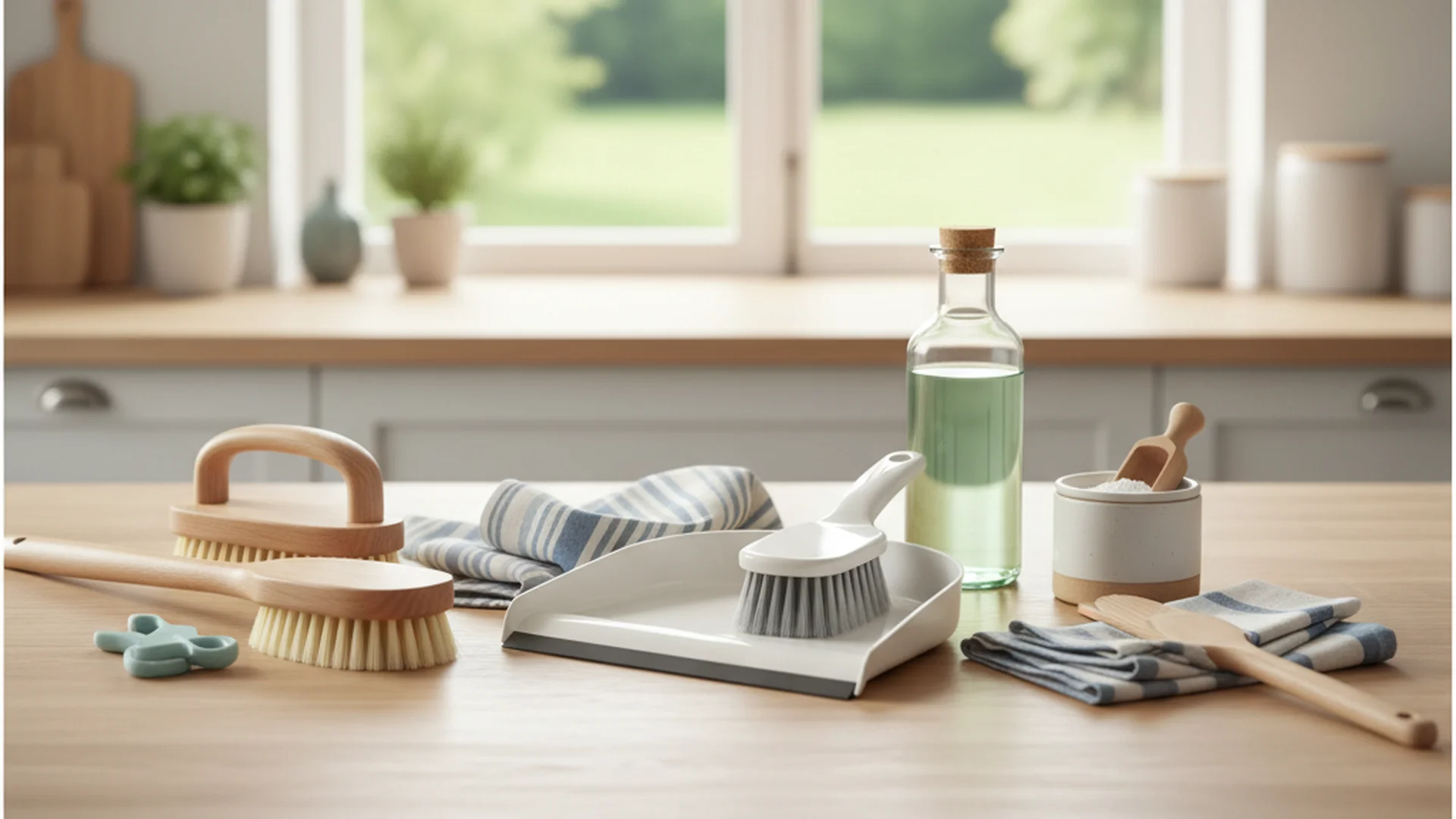
Your Essential 2026 Tool Kit:
- Microfiber Cloths: Color-coded for different rooms (e.g., blue for glass, red for bathrooms).
- All-Purpose Cleaner: A pH-neutral, eco-friendly solution.
- Abrasive Cleaner: For tough grime in sinks.
- Glass Cleaner: Or a high-quality "streak-free" microfiber cloth and water.
- Vacuum with HEPA Filter: Essential for 2026 indoor air quality standards.
- Scrub Brush and Old Toothbrush: For detail work.
Tip: By 2026, sustainable cleaning products make up over 52% of the market. Look for concentrated refills to reduce plastic waste and save space in your cleaning caddy.
Phase 2: The Three-Direction Rule
When you enter a room, you must follow the three directions of motion to ensure total coverage without re-contamination:
- Top to Bottom: Dust the ceiling fans and tops of frames first.
- Back to Front: In a bathroom or kitchen, start at the furthest corner from the door and work your way out.
- Left to Right: This ensures your eyes and hands cover every square inch of a surface.
Phase 3: The "S" Pattern and Dwell Time
Two technical skills separate the novices from the pros: the "S" pattern and dwell time.
- The "S" Pattern: Instead of rubbing in circles (which just redistributes dirt), wipe in a continuous "S" shape from the top of the surface to the bottom. This "plows" the dirt off the edge.
- Dwell Time: This is the secret to cleaning without scrubbing. Spray your shower, your sinks, and your stove. Then, walk away and clean something else for 5 minutes. The chemicals break down the oils and mineral deposits for you.
| Task | Dwell Time Required | Tool Recommended |
|---|---|---|
| Shower/Tub | 5–10 Minutes | Alkaline Cleaner |
| Kitchen Counters | 1–2 Minutes | All-Purpose Spray |
| Microwave Interior | 3 Minutes (Steam) | Water + Lemon |
| Toilet Bowl | 5 Minutes | Disinfectant |
Warning: Never mix different cleaning chemicals, especially bleach and ammonia-based products, as this creates toxic chloramine gas.
Real-World Examples of Speed Cleaning in Action
Example 1: The "42-Minute" Family Challenge
The Rodriguez family (no relation to the author!) implemented the Jeff Campbell method for their 3-bedroom home. By using the "human + robot" hybrid model—where their robotic vacuum handled the floors while the parents focused on vertical surfaces and high-touch zones—they reduced their total cleaning time from 3 hours on Saturday morning to just 42 minutes. They used a shared digital checklist to ensure the "Left to Right" rule was followed in every room.
Example 2: Managing Executive Dysfunction
Alex, a freelance designer with ADHD, struggled with the "vague" nature of cleaning. By adopting the speed cleaning method, Alex replaced the question of "What should I clean?" with a physical sequence. Starting at the front door and moving clockwise, Alex used the "both hands" rule to stay physically engaged, preventing the mental "drifting" that usually leads to unfinished chores.
Example 3: The Sustainable Minimalist
Maya, an environmental advocate, adapted the 2026 speed cleaning trends by using self-disinfecting antimicrobial coatings on her countertops. This reduced her "dwell time" requirements. She paired this with high-performance microfiber cloths that require only water, proving that speed cleaning can be both incredibly fast and environmentally friendly.
Success: Practicing the "S" wipe pattern and top-to-bottom rule consistently creates "muscle memory," eventually allowing you to clean your home almost on autopilot.
Common Mistakes to Avoid
Even with a guide, it is easy to fall back into old habits. Avoid these common pitfalls to keep your speed cleaning sessions effective:
- Dry Dusting: Using a feather duster or dry cloth often just launches dust into the air, where it settles back down an hour later. Always use a slightly damp microfiber cloth to trap and remove particles.
- Over-Cleaning: Jeff Campbell famously said, "If it isn't dirty, don't clean it." Don't waste three minutes scrubbing a baseboard that was cleaned last week and has no visible dust.
- Using Too Much Product: Most people use 3x more detergent than necessary. This leaves a sticky residue that attracts more dirt, making your next clean twice as hard.
- Circular Wiping: Buffing in circles is for cars, not counters. It moves dirt around in a loop. Stick to the "S" stroke.
- Dirty Tools: If your microfiber cloth is saturated or your vacuum bag is full, you are fighting a losing battle. Clean your tools after every session.
Warning: Household tap water rarely reaches the 140°F (60°C) required to sanitize surfaces. Don't rely on "hot water" alone; rely on dwell time and appropriate disinfectants for high-germ areas like the toilet.
Recent Trends: Speed Cleaning in 2026
The landscape of home maintenance has changed significantly since the 1980s. Today, we integrate technology to enhance the speed cleaning method:
- AI-Enhanced Scheduling: Modern smart homes now track room usage. Your home system might suggest a "speed clean" for the kitchen after a large meal, while skipping the guest room entirely based on motion sensor data.
- Hybrid Cleaning Models: The 2026 standard is the "Human + Robot" partnership. Robots excel at repetitive floor maintenance, while humans excel at "detail" zones and vertical surfaces. A speed clean now focuses almost entirely on the areas robots can't reach.
- Mindful Speed Cleaning: There is a growing movement toward using the 20-minute daily speed clean as a "digital detox." By focusing on the physical rhythm of the "S" pattern and the clockwise movement, homeowners use the routine as a mental reset.
- HEPA and IAQ Focus: Speed cleaning in 2026 isn't just about how things look. It’s about Indoor Air Quality (IAQ). Modern speed cleaners prioritize HEPA-filtered vacuums to remove allergens that are invisible to the eye.
Frequently Asked Questions
Does speed cleaning mean "cutting corners"?
Is the speed cleaning method suitable for people with ADHD?
Do I need to buy expensive professional equipment?
How does the "S" pattern help with speed?
Can I really clean my whole house in 42 minutes?
Conclusion
The speed cleaning method is more than just a way to tidy up; it is a sophisticated system designed to give you back your most precious resource: time. By adopting Jeff Campbell’s 13 rules, utilizing the "S" pattern, and leveraging the latest 2026 home technologies, you can maintain a professional level of cleanliness with a fraction of the effort. Remember, efficiency isn't about rushing—it's about moving with purpose and logic.
Stop cleaning harder and start cleaning smarter. By focusing on wasted motion reduction and following a consistent system, you’ll find that a spotless home is well within your reach every single week.
Success: By implementing these rules, you can reduce your weekly cleaning time by up to 50%, allowing more time for family, hobbies, and relaxation.
Cleaning that keeps score
Every task earns points, every streak multiplies them, and Premium adds a household leaderboard plus a monthly Dustagorgon to beat.
- Free forever
- 30 badges to earn
- Up to 6 in a household
No card needed. Set up your rooms in a couple of minutes.