In this article
What you’ll learn
- A clean room reduces cortisol levels and anxiety.
- Organization boosts focus and professional productivity.
- Regular cleaning significantly improves indoor air quality and sleep.
For many, the act of tidying up feels like a never-ending chore, a repetitive task that ranks low on the priority list. However, the benefits of cleaning your room go far deeper than simply having a space that looks good for guests. Our living environments are an externalization of our internal mental states, and conversely, the state of our room directly influences our cognitive function, mood, and physical health. Whether you are a busy professional or a student feeling the weight of academic pressure, understanding the psychological and physiological advantages of a clean space can transform a mundane chore into a vital act of self-care.
The Mental Health Revolution: Clarity Through Order
The connection between our environment and our minds is profound. When we talk about the benefits of cleaning your room, we are primarily talking about the reduction of "cognitive load." Visual clutter acts as a constant, low-grade distraction. Every stray sock, unorganized stack of papers, and dusty shelf competes for your brain's attention, leading to a state of mental exhaustion.
Plenty of people feel anxious or on edge when living in a cluttered home. This isn't just a feeling; it’s biology. Cluttered environments keep cortisol—the body’s primary stress hormone—running higher than it needs to. Tidy the space and the mood tends to lift almost immediately. This phenomenon is often referred to as "the mastery effect." By taking control of your physical environment, you send a signal to your brain that you are capable of managing your life.
The Dopamine Reward System
Cleaning provides immediate feedback. Unlike long-term projects at work that may take months to bear fruit, cleaning a corner of your room offers an instant visual transformation. This triggers a release of dopamine, the "feel-good" neurotransmitter. For those struggling with low motivation, starting with a small "win"—like making the bed—can create the momentum needed to tackle larger challenges throughout the day.
Tip: If you feel overwhelmed, use the "Five-Minute Rule." Tell yourself you will only clean for five minutes. Often, the hardest part is starting; once you begin, the dopamine kick will likely keep you going.
Boosting Productivity and Focus
If you've ever found yourself staring at a pile of laundry instead of focusing on a work report, you've experienced how clutter sabotages productivity. Visual clutter overloads the brain’s ability to process information. Most professionals find they focus better and get more done in an organized environment.
When your room is clean, your brain doesn't have to filter out irrelevant visual stimuli. This is particularly important in the era of remote work, where the bedroom often doubles as an office. A "benefit cleaning room guide" wouldn't be complete without mentioning that a dedicated, tidy workspace within your room lifts your output noticeably.
| Environment Type | Focus Level | Stress Marker |
|---|---|---|
| High Clutter | Poor | High Cortisol |
| Minimalist | Strong | Low Cortisol |
| "Refined Layer" | Good | Balanced |
Physical Health and the Science of Sleep
The benefits of cleaning your room aren't limited to your mind; your body reaps the rewards as well. The average home collects roughly 40 pounds of dust per year. This dust is a cocktail of dead skin cells, pet dander, pollen, and microscopic mites. For those with asthma or allergies, a dirty room is a minefield of respiratory triggers.
The Sleep Connection
There is a direct link between bedroom cleanliness and sleep quality. People who make their beds every morning tend to sleep better, and fresh sheets are one of the most commonly named ingredients of a comfortable night. A clean room signals to your brain that it is time to wind down, whereas a messy room keeps the brain in a state of "alertness," scanning the environment for unfinished tasks.
Note: Dusting high surfaces first is essential. Because dust follows gravity, cleaning top-to-bottom ensures you aren't settling new dust on freshly cleaned floors.
A Step-by-Step Guide to Efficient Room Cleaning
To maximize the benefits cleaning room tips provide, you need a systematic approach. Many people fail because they try to "organize" before they "clean."
Phase 1: The Trash Sweep and Declutter
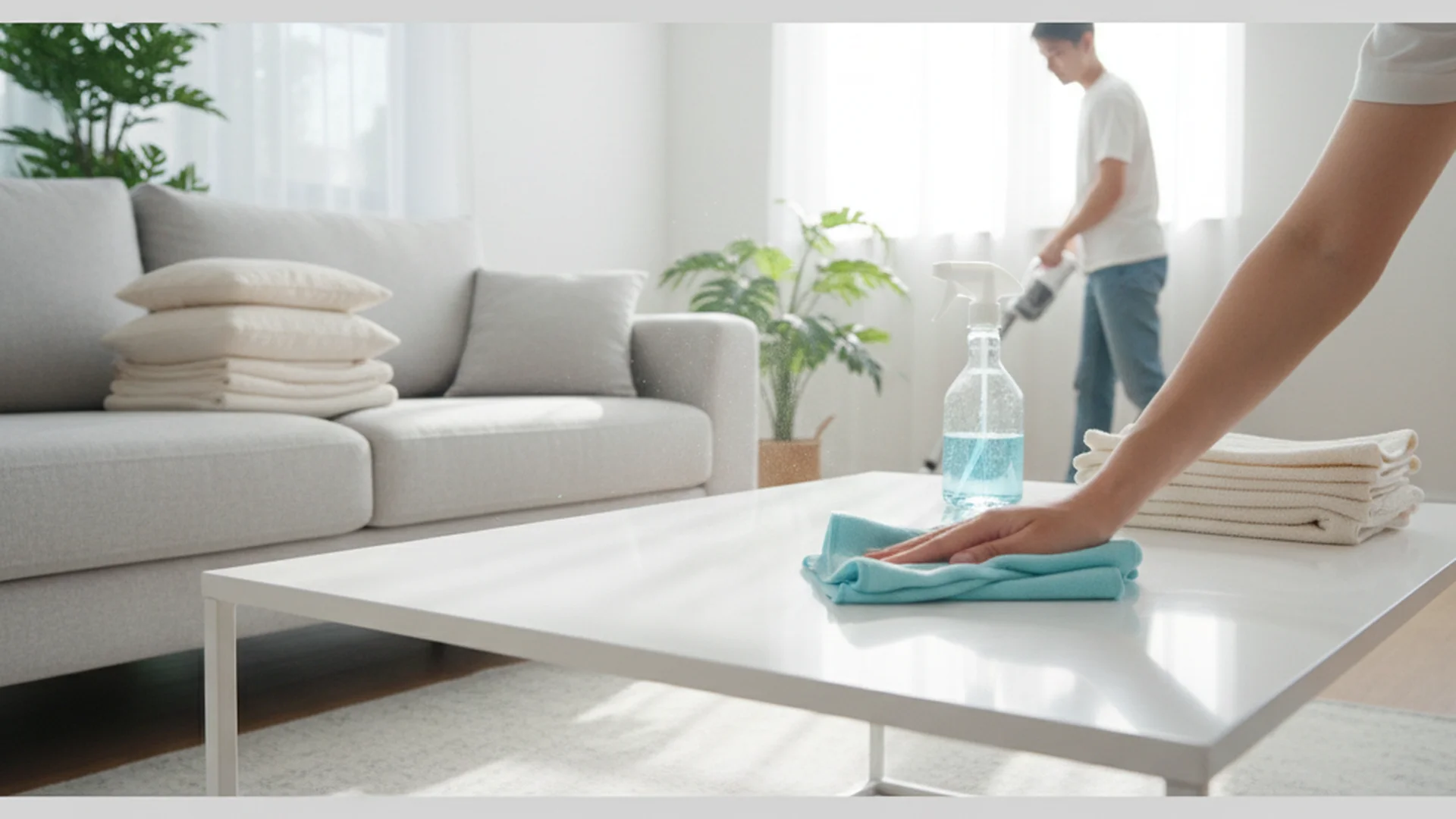
Before you touch a microfiber cloth, you must remove what doesn't belong. Walk through the room with a trash bag. Dispose of food wrappers, old receipts, and broken items. Next, use the "Container Concept" popularized by K.C. Davis. View every shelf and closet as a container with a finite capacity. If the container is overflowing, you don't need a better organization system; you need fewer items.
Phase 2: The Top-to-Bottom Method
Start at the ceiling and work your way down.
- Ceiling Fans and Lighting: Dust these first.
- Walls and Shelves: Wipe down surfaces and picture frames.
- The Mid-Level: Clean desks, nightstands, and dressers.
- The Bed: Strip the sheets and replace them with fresh linens.
- Floors: Vacuum or mop last.
Warning: Never mix bleach with ammonia-based cleaners, as this creates toxic chloramine gas. Always ensure proper ventilation when using chemical cleaners.
2025-2026 Trends in Room Maintenance
The way we clean is changing. We are moving away from the clinical, sterile "minimalism" of the 2010s toward more human-centric approaches.
AI-Assisted Organizing
In 2026, many households are utilizing AI to manage their domestic lives. Tools like ChatGPT can now generate custom cleaning schedules based on your specific room dimensions and lifestyle. AI can break down a massive deep-clean into "low-demand" steps for days when your energy is low, ensuring that the benefits cleaning room habits offer remain accessible even during busy weeks.
Refined Layering and Sustainability
The current trend is "Refined Layering." This emphasizes a curated, lived-in look that balances personality with order. It’s about having a space that feels warm and personal but lacks unnecessary "noise." Simultaneously, there is a shift toward "Bio-Hacking Your Air." Smart-home sensors now alert residents when dust or VOC levels rise, prompting a cleaning session before physical symptoms like headaches or sneezing occur.
Neurodivergent-Friendly Cleaning Hacks
For individuals with ADHD or autism, traditional cleaning advice can feel dismissive. "Just do it" doesn't work when executive dysfunction is at play.
- Body Doubling: This involves cleaning while on a video call with a friend or having someone else in the room. Their presence helps you stay on task without them needing to say a word.
- Dopamine Stations: Create "dump zones" or "doom boxes." If you don't know where an item goes, put it in the box. This clears the visual space quickly, reducing the immediate stress of the mess while allowing you to sort the items when you have more mental energy.
- Micro-Cleaning: Set a timer for 15 minutes. High-intensity, short-burst cleaning is more sustainable than "marathon cleaning," which often leads to burnout and a week-long recovery period.
Real-World Examples of Transformation
Example 1: The Remote Professional
Sarah, a software engineer, worked from her bedroom. She suffered from chronic "Mess Blindness," a phenomenon where the brain ignores chronic clutter. After taking a photo of her room, she realized how chaotic her environment was. By implementing a weekly cleaning guide, she found her billable hours climbed and the work-related Sunday scaries eased off.
Example 2: The Allergy Sufferer
James struggled with morning congestion for years. By switching to a schedule where he changed his sheets every four days and vacuumed under the bed weekly, his reliance on antihistamines dropped by half. The physical benefits of cleaning his room were life-changing for his respiratory health.
Example 3: The "Nesting Party"
A group of university students in London started a trend called the "Nesting Party." Once a month, they gather at one friend's house to help them declutter and deep-clean. By turning a chore into a social event, they eliminated the stigma of "mess" and reinforced community bonds.
Common Mistakes to Avoid
- Organizing Before Decluttering: Buying expensive storage bins is a waste of money if you are just storing things you don't need. You cannot organize your way out of having too much stuff.
- Ignoring "Dwell Time": Most people spray a surface and wipe it immediately. To actually disinfect, the cleaner must stay wet on the surface for the "dwell time" specified on the label (usually 30 seconds to 10 minutes).
- Overusing Products: Using too much floor cleaner or surface spray leaves a sticky residue. This residue acts like a magnet for new dust, making your room get dirty faster.
- The "All or Nothing" Mentality: If you can't clean the whole room, you do nothing. Remember: picking up just five items off the floor has a measurable impact on your cortisol levels.
Frequently Asked Questions
Where do I even start when I'm overwhelmed?
Does cleaning actually help with depression?
How often should I change my sheets?
What if I have 'Mess Blindness'?
Conclusion
The benefits of cleaning your room extend far beyond the surface. By maintaining a tidy environment, you are actively investing in your mental clarity, your physical health, and your overall productivity. Whether you use AI-assisted schedules, host a "Nesting Party," or simply commit to a 15-minute micro-clean, the impact on your quality of life is undeniable. A clean room is not just about discipline; it’s about creating a sanctuary where your best self can thrive.
Success: Consistent, small cleaning habits are more effective than infrequent deep cleans. Start small, and watch your mental well-being transform.
Cleaning that keeps score
Every task earns points, every streak multiplies them, and Premium adds a household leaderboard plus a monthly Dustagorgon to beat.
- Free forever
- 30 badges to earn
- Up to 6 in a household
No card needed. Set up your rooms in a couple of minutes.