In this article
What you’ll learn
- Focus on functional cleaning over moral perfection
- Use the 'Five Things' method to prevent task paralysis
- Implement point-of-performance storage to work with your brain, not against it
If you have ADHD, staring at a messy room isn’t just a matter of "having a lot to do." It often feels like a physical wall standing between you and your floor. You know you need to clean, you want the room to be tidy, but your brain refuses to provide the "start" button. This phenomenon, known as task paralysis, is the primary hurdle in adhd bedroom cleaning.
Traditional cleaning advice—like "just spend fifteen minutes a day" or "start in one corner"—often fails neurodivergent individuals because it doesn't account for executive dysfunction. For an ADHD brain, a messy bedroom isn't one task; it’s a thousand tiny decisions that lead to immediate mental exhaustion. In this guide, we will move past the shame of "being messy" and look at practical adhd bedroom cleaning tips that actually work with your brain’s unique wiring.
Why the ADHD Mess Happens
Before we dive into the "how," we must understand the "why." ADHD is fundamentally a difficulty with executive function. That means prioritizing, initiating tasks, and holding things in working memory all take far more effort than they "should."
When you look at a pile of clothes, a neurotypical brain sees "laundry." An ADHD brain sees a shirt that needs a button, a pair of pants that might be clean, a sock that lost its partner, and the sudden realization that you forgot to buy detergent. This "omni-focus" leads to total shutdown.
And when you perceive your home as cluttered, you tend to feel more stressed in it. This creates a vicious cycle: the mess causes stress, and the stress further impairs the executive functions needed to clear the mess.
Note: Messiness is not a moral failing. It is a sign that your environment does not currently have the "scaffolding" required to support your executive functions.
The "Five Things" Tidying Method
Popularized by KC Davis and widely discussed in adhd bedroom cleaning reddit communities, the "Five Things" method is a game-changer for reducing overwhelm. Instead of seeing a thousand items, you only see five categories. You do not move on to the next category until the current one is finished.
1. Trash
Walk around with a large trash bag. Do not look at anything else. Do not pick up a book and put it on the shelf. Only pick up things that are literal trash.
2. Dishes
Collect every mug, plate, and water bottle. Take them to the kitchen. Do not wash them yet—just get them out of the bedroom.
3. Laundry
Gather all clothes. Do not worry about sorting "clean" from "dirty" if it’s too overwhelming right now. Put them all in a hamper or one giant pile. The goal is to clear the floor and surfaces.
4. Things That Have a Place
Pick up items that have a clearly defined home (e.g., your hairbrush goes in the top drawer) and put them there. If you have to think for more than three seconds about where it goes, it belongs in the next category.
5. Things That Don’t Have a Place
These are the items that cause "doom piles" (Did Organize, Only Moved). Put these into a single basket or box to be dealt with later. Clearing them from your visual field takes the pressure off immediately.
Tip: If the Five Things feel too big, start with "The One-Foot Rule." Only clean what is within one foot of your current position, then stop.
Point of Performance: Designing for Success
One of the biggest adhd bedroom cleaning tips involves "Point of Performance." This means storing items exactly where you use them, rather than where "traditional" organization says they should go.
- The Bedside Hamper: If you always strip off your socks next to the bed and they end up on the floor, put a small, open-top hamper right there.
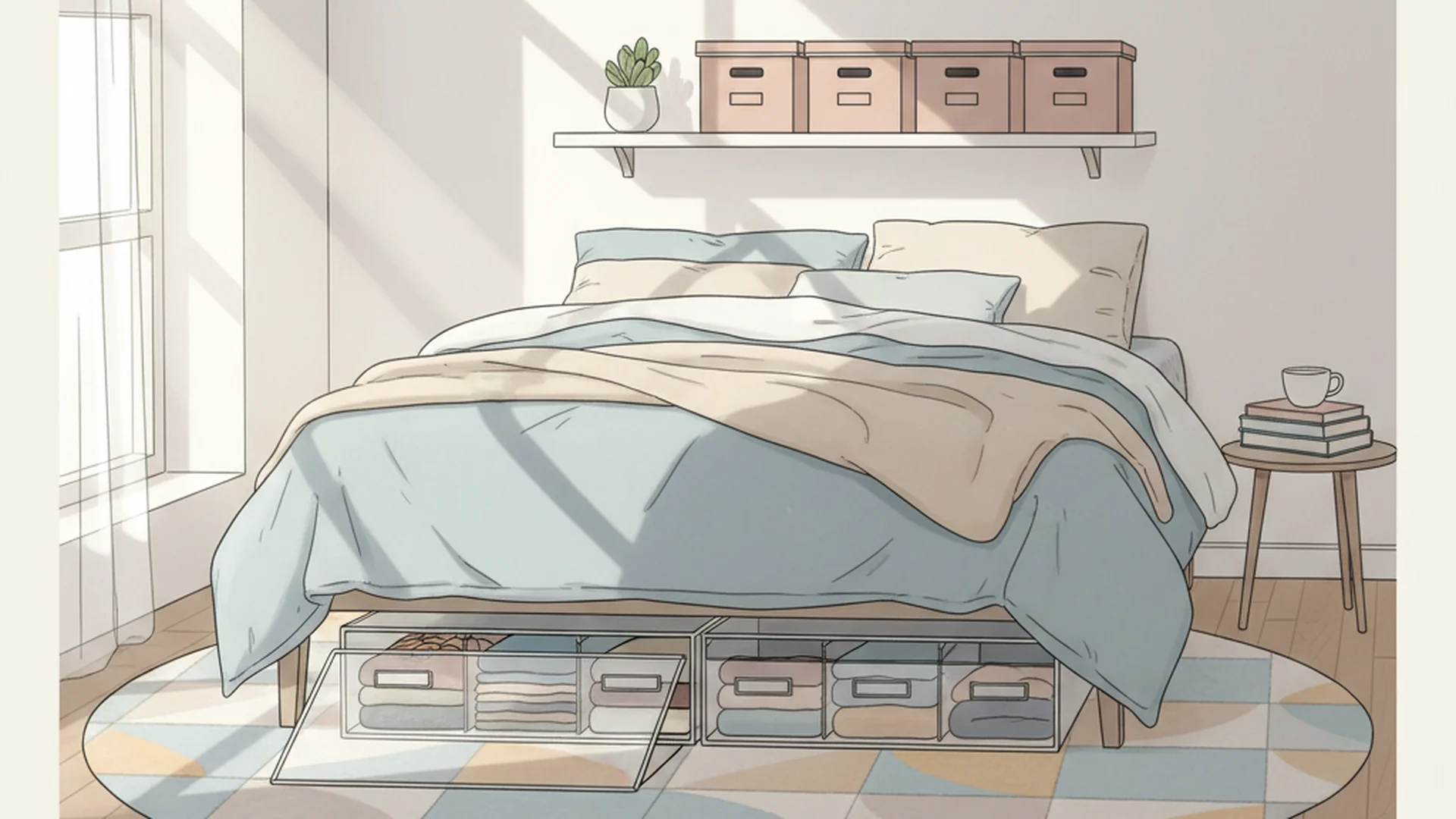
- Visible Storage: Many ADHD individuals struggle with "object permanence." If a sweater is in a closed drawer, it effectively stops existing. This leads to buying duplicates and more clutter. Use clear acrylic bins or open shelving so you can see your belongings.
- The "Clean Laundry" Basket: If folding clothes is your kryptonite, stop trying to force it. Use three open baskets: one for socks/undies, one for tops, and one for bottoms. It is better to have "organized" unfolded clothes than a "clean" pile that sits on the floor for three weeks.
Success: A "functional" room that stays 70% tidy is far superior to a "perfect" room that you can only maintain for two days after a hyperfocus session.
Leveraging 2026 Tech and Trends
We are entering a new era of "low-demand" lifestyle management. In 2025 and 2026, new tools have emerged to provide the external "scaffolding" the ADHD brain lacks.
AI-Generated Cleaning Blueprints
If "clean the bedroom" feels too big, use an AI tool like ChatGPT. Give it this prompt: "I have ADHD and I am overwhelmed. Break down 'cleaning my bedroom' into 15 micro-tasks that take less than 3 minutes each. Give them to me one by one." This bypasses the need for you to do the "sorting" and "prioritizing" work yourself.
Asynchronous Body Doubling
Body doubling—working while someone else is present—is a long-standing favourite ADHD strategy. In 2026, apps like Dubbii and Gogh offer virtual body doubling. These aren't just timers; they feature real people cleaning alongside you in a pre-recorded, "walk-through" style that reduces the feeling of isolation.
The "Houdini Hack"
This 2026 trend involves "disappearing" everything from a surface (like a nightstand or dresser) into a box. You only allow an item back onto the surface once you have used it. After one week, anything left in the box clearly doesn't belong on that surface and should be relocated or discarded.
Warning: Avoid "Productivity Porn." Spending four hours researching the perfect labeling system is often just "procrasti-cleaning." Start with a trash bag, not a label maker.
Real-World Examples of ADHD Cleaning Solutions
Example 1: The "Cleaning Shoes" Strategy
Mark, a graphic designer with ADHD, found he could never stay on task. He would start cleaning, see his bed, sit down "for a second," and lose two hours to his phone. He started keeping a pair of dedicated, indoor-only sneakers by his door. Putting them on signals to his brain that he is in "work mode." He does not allow himself to sit on the bed or sofa while the shoes are on.
Example 2: The Trash Can Multiplier
Sarah realized her bedroom mess was 40% snack wrappers and tissues. Instead of one small, hidden trash can under a desk, she placed three large, open-top bins: one by the bed, one by the door, and one by her vanity. Removing the "friction" of having to walk across the room to throw something away ended her floor-trash problem instantly.
Example 3: Dopamine Decor
Instead of trying to achieve a minimalist, "sterile" look (which can be under-stimulating for ADHD brains), Jessica embraced "Dopamine Decor." She used bright colors and textures that she loved. Because the room felt like a "sensory treat" rather than a chore, she felt more motivated to keep the floor clear so she could enjoy the aesthetic.
Common Mistakes to Avoid
- Organizing Before Decluttering: You cannot organize clutter. If you have 50 shirts and a closet that fits 20, no amount of "ADHD organization" will fix the mess. You must discard items first.
- The "Should" Trap: Don't organize your room based on how your mother, your partner, or Pinterest thinks it "should" look. If you need your shoes on a hanging rack in the middle of the wall to remember they exist, do it.
- Waiting for Motivation: Motivation is a feeling; discipline is a system. ADHD brains rarely "feel" like cleaning. Rely on external triggers (like a specific "cleaning playlist" or a body doubling app) rather than waiting for a burst of energy.
- The Marathon Mentality: Don't wait for a free Saturday to "deep clean" everything. This leads to burnout. Aim for the "Sunday Shakedown"—a 20-minute reset that prepares you for the week.
| Strategy | ADHD Challenge Addressed | 2026 Tool/Method |
|---|---|---|
| Five Things | Task Paralysis | KC Davis Method |
| Body Doubling | Lack of Motivation | Dubbii / Gogh Apps |
| Micro-Tasks | Executive Dysfunction | AI Prompting |
| Visual Storage | Object Permanence | Clear Acrylic Bins |
Frequently Asked Questions
Where do I even start when my room is a disaster?
Why can't I keep my room clean after a deep clean?
How do I deal with "Doom Piles"?
Is it okay to not have a "perfect" room?
Conclusion
Cleaning a bedroom with ADHD isn't about finding more willpower; it's about building a better system. By utilizing the "Five Things" method, embracing point-of-performance storage, and leveraging 2026 technology like AI blueprints and body doubling apps, you can break the cycle of clutter and stress. Remember to release the shame—your brain works differently, and your cleaning routine should too.
Success: By shifting your focus from "cleaning" to "care tasks," you transform the chore into an act of kindness for your future self.
Cleaning that keeps score
Every task earns points, every streak multiplies them, and Premium adds a household leaderboard plus a monthly Dustagorgon to beat.
- Free forever
- 30 badges to earn
- Up to 6 in a household
No card needed. Set up your rooms in a couple of minutes.