In this article
What you’ll learn
- Use the "Empty Everything" method to reset your space completely.
- Implement "Spa-Core" trends like refillable glass stations and natural materials.
- Follow the 20/20 rule to eliminate "just in case" clutter.
The bathroom is often the smallest room in the house, yet it carries the heaviest functional burden. It is where we prepare for the day and where we decompress before sleep. However, for many homeowners, the dream of a relaxing sanctuary is buried under expired prescriptions, half-empty shampoo bottles, and tangled hair tools. Decluttering your bathroom is not just about aesthetics; it is a vital step in reclaiming your mental clarity and physical health. As we look toward the design trends of 2025 and 2026, the shift is moving away from clinical perfection and toward "Spa-Core"—a movement that prioritizes wellness, sustainability, and intentionality.
The High Cost of Bathroom Chaos
Before we dive into the "how-to," we must understand the "why." Physical clutter isn't just an eyesore; it’s a cognitive drain. Physical mess competes for your brain’s resources, pushing your stress levels up before the day has even started. When you begin your morning in a cluttered bathroom, you are essentially beginning it in a state of low-level fight-or-flight.
Furthermore, "spa-like design" has become the dominant bathroom trend, and you cannot achieve a spa-like environment if your counters are crowded with "ghost products"—those empty or near-empty bottles you keep "just in case."
Beyond mental health, there is a significant financial incentive. Depersonalizing and decluttering the bathroom is widely treated as the single most critical step before listing a home. Whether you are staying or selling, a decluttered bathroom is an investment in your property and your peace of mind.
The Professional Strategy: The "Empty Everything" Method
As a professional cleaning consultant, I often see people make the mistake of tidying drawer by drawer. This is a recipe for failure because it allows you to shuffle clutter from one spot to another without ever confronting the total volume of your belongings.
Instead, I recommend the "Empty Everything" Method.
Phase 1: The Total Clear-Out
To truly reset the energy of the room, you must remove every single item from the cabinets, drawers, and countertops. Place them all on a neutral territory, like a foldable table in the hallway or even your bed (on a clean sheet).
Tip: While the shelves are empty, take the opportunity to wipe down the "gunk" that inevitably accumulates at the bottom of drawers. A mixture of warm water and mild dish soap is usually all you need for a fresh start.
Phase 2: The Ruthless Purge
This is where most people stall. Almost everyone hangs on to expired products far longer than they should. In 2026, we are leaning into the "20/20 Rule": If you can replace an item for under $20 in under 20 minutes, and you haven't used it in six months, let it go.
| Category | Shelf Life (General) | When to Toss |
|---|---|---|
| Mascara | 3 Months | Changes in smell or texture |
| Sunscreen | 1 Year | Past expiration date (SPF fails) |
| Loofahs | 3-4 Weeks | Always—they harbor bacteria |
| Towels | 2-5 Years | When they become "scratchy" or thin |
| Medicine | Varies | Check date; never keep "leftover" antibiotics |
Warning: Never dispose of expired medications down the toilet or in the trash. Some can be toxic to the water supply. Always use a pharmacy "take-back" program for safe disposal.
Real-World Example: The "Guest Bathroom" Trap
Consider my client, Sarah. She had a guest bathroom filled with "travel-sized" shampoos she had collected over a decade. She felt guilty throwing them away because they were "perfectly good." However, the plastic was degrading, and the contents had separated. By applying the 20/20 rule, she realized she could buy a fresh, high-quality set for a guest for less than $10. We cleared two entire shelves by letting go of the "free" clutter.
Organizing by Frequency: The Three-Zone System
Once you have purged the unnecessary, you must return items to the bathroom with intention. In 2026, professional organizers use "Zoning" to ensure the most-used items are the easiest to reach.
Zone 1: The Daily Essentials (Vanity & Top Drawer)
This area is reserved for the 20% of products you use 80% of the time. This includes your daily cleanser, toothbrush, deodorant, and morning skincare.
- The Goal: Keep the countertop 90% clear.
- The Tool: Use bespoke drawer dividers. Moving away from large, deep bins toward custom-fitted inserts prevents the "junk drawer" effect.
Zone 2: The Weekly Rituals (Lower Drawers & Under Sink)
These are items used 1–3 times a week, such as hair masks, exfoliants, or specialized styling tools.
- The Goal: Accessibility without crowding the daily flow.
- The Tool: Use "micro-categorization." Group hair tools in one heat-safe bin and weekly skincare in another.
Zone 3: The Deep Storage (High Shelves & Linen Closet)
This is for bulk backups (the extra toilet paper and toothpaste) and your first aid kit.
- The Goal: Clear floor space and future-proof for accessibility.
- The Tool: Homeowners are increasingly prioritizing "accessibility-ready" spaces. Ensure Zone 3 isn't so high that it requires a dangerous ladder climb.
Note: A "Countertop Reset" is the best way to maintain this. Every night, clear everything off the vanity to create an immediate visual "win" for your future self the next morning.
2025-2026 Trends: Aesthetics Meets Function
Decluttering in the modern era isn't just about removing things; it's about replacing "visual noise" with "visual calm."
Sustainable Refill Stations
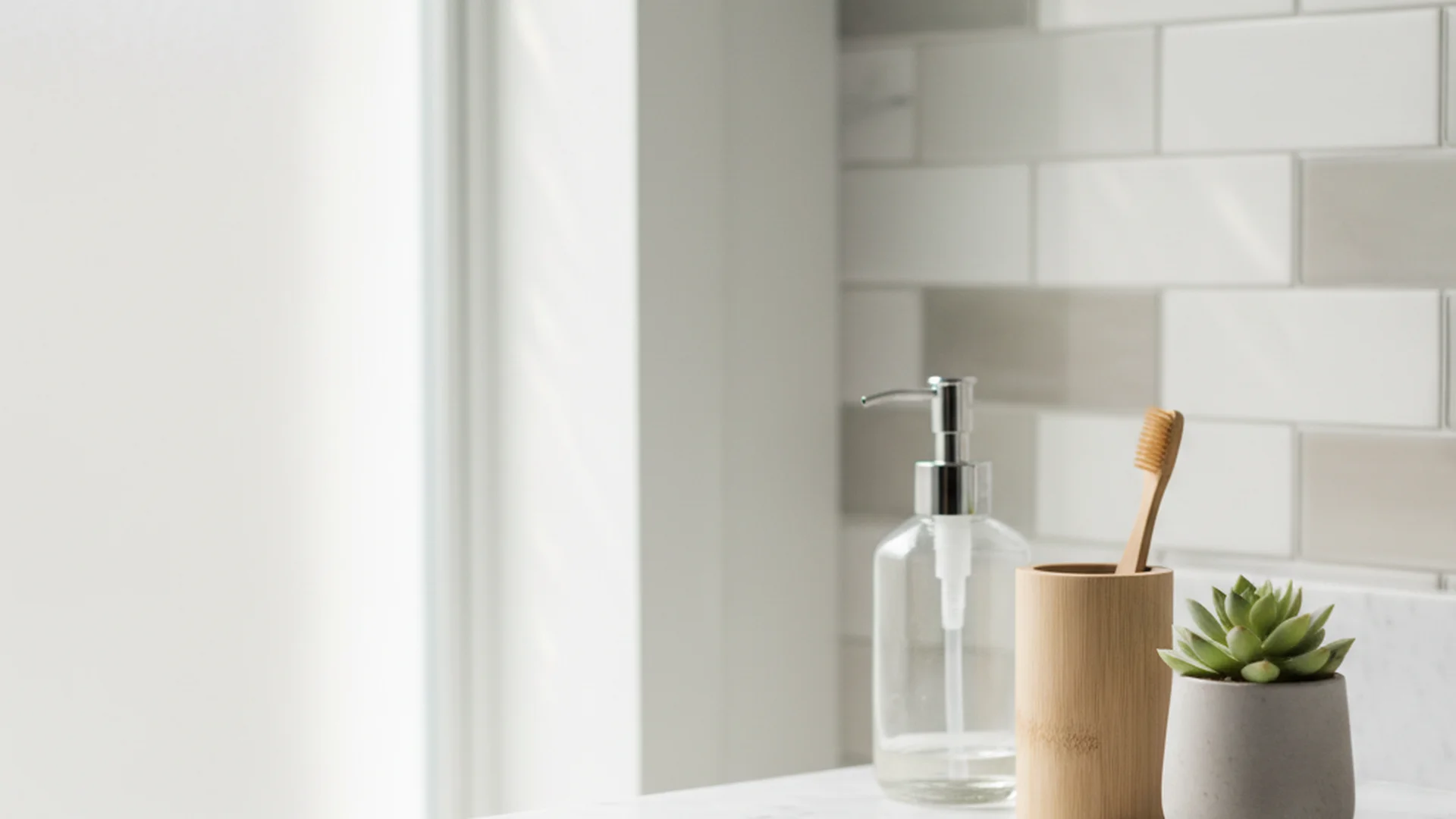
One of the biggest contributors to bathroom clutter is "brand clutter"—the clashing colors and logos of various plastic bottles. The current trend involves ditching plastic for weighted glass or ceramic dispensers. Not only does this look like a high-end hotel, but it also encourages buying in bulk, which is more sustainable.
Discreet Labeling
The era of oversized, "loud" labels is over. In 2026, we are seeing a shift toward minimalist, tone-on-tone tags or etched glass. The goal is to provide order without adding to the visual chaos.
Biophilic Design
As part of the Spa-Core movement, there is a move away from acrylic and plastic organizers toward natural materials.
- Bamboo: Naturally water-resistant and warm.
- Seagrass: Adds texture to linen closets.
- Stone: Perfect for heavy items like soap dispensers.
Success: Transitioning to glass bottles and bamboo dividers not only organizes the space but significantly reduces the "stress signals" your brain receives when looking at the room.
The Ultimate Decluttering Bathroom Checklist
To ensure you don't miss a single corner, follow this professional decluttering bathroom checklist:
- The Medicine Cabinet: Toss any medication past its date.
- The Shower Floor: Remove "ghost products" (bottles with less than a teaspoon of product).
- The Towel Audit: Check for fraying or loss of absorbency. Replace every 2–5 years.
- The "Small Stuff": Use small dividers for bobby pins, hair ties, and cotton swabs.
- Vertical Check: Install adhesive hooks on the back of the door for robes or wet towels.
- The Makeup Purge: Check for changes in smell or color in foundations and lipsticks.
Common Mistakes to Avoid
Even with the best intentions, many people fall into these common traps:
- Buying Bins First: This is the most common error. People buy beautiful containers before they know what they are keeping. This leads to "organized clutter," where you keep useless items simply because they fit in a pretty box. Always purge before you shop.
- Neglecting Vertical Space: In small bathrooms, the space above the toilet or the back of the door is prime real estate. Forgetting to use this leads to overcrowded counters.
- The "Someday" Mindset: Keeping a hair curler you haven't used since 2019 "just in case" you go to a gala is a waste of space. Refer back to the 20/20 rule.
- Ignoring the Visual Noise: Keeping products in their original cardboard packaging takes up 20% more space and looks messy. Decant items into glass jars or remove them from the outer boxes immediately.
Real-World Example: The Small Apartment Reset
My client, Marcus, lived in a studio with a tiny bathroom. He had no floor space for cabinets. We solved his clutter by installing a sleek, wooden over-the-toilet shelving unit and using uniform glass jars for his essentials. By focusing on verticality, we cleared 100% of his countertop, making his 40-square-foot bathroom feel like a luxury suite.
Frequently Asked Questions
How often should I declutter my bathroom?
What should I throw away immediately?
How do I declutter a small bathroom without much storage?
Where do I start?
Conclusion
Decluttering your bathroom is a journey from chaos to calm. By implementing the "Empty Everything" method and adhering to the 2026 "Spa-Core" trends, you turn a functional necessity into a personal sanctuary. Remember the One-In, One-Out Rule: to maintain your hard work, never bring a new product into the bathroom until the previous one is finished or discarded.
Success: A clean, organized bathroom reduces morning anxiety, speeds up your routine, and increases the overall value of your home.
Cleaning that keeps score
Every task earns points, every streak multiplies them, and Premium adds a household leaderboard plus a monthly Dustagorgon to beat.
- Free forever
- 30 badges to earn
- Up to 6 in a household
No card needed. Set up your rooms in a couple of minutes.