In this article
What you’ll learn
- Homeschool homes take far more wear and tear, necessitating a structured routine.
- Involving children in cleaning fosters life skills and academic focus.
- Utilizing "Micro-cleaning" and "Zone Systems" prevents parental burnout.
Living in a home that doubles as a classroom, a laboratory, and a cafeteria means your floors rarely stay clean for long. For many, finding a sustainable cleaning routine homeschool families can actually stick to feels like a secondary full-time job. With so many families now homeschooling, the "24/7 house" is no longer a niche concept—it is a daily reality that demands a new approach to domestic maintenance. When your kitchen table is both a place for math equations and a staging ground for dinner, the traditional "clean on Saturday" model simply falls apart.
The Science of a Clean Learning Environment
It isn’t just about aesthetics; the state of your home directly impacts the quality of your child’s education. Physical clutter in your surroundings constantly competes for your attention. In a homeschool setting, a stack of unwashed breakfast dishes or a pile of laundry on the sofa acts as a "visual noise" that decreases performance and increases stress for both the teacher and the student.
Furthermore, a house that is occupied all day, every day simply takes more punishment than one that empties out at 8am. This leads to what professional cleaners call "accelerated depreciation" of the living space. Dust accumulates faster, carpets wear down quicker, and the sheer volume of "stuff"—books, art supplies, and science kits—creates a unique organizational challenge.
Success: Children learning in a clutter-free environment show higher levels of concentration and lower rates of frustration during difficult lessons.
The "Zone & Reset" Strategy: A Framework for Success
To establish the best cleaning routine homeschool families can maintain, you must move away from "marathon cleaning." Instead, use a two-pronged approach: The Zone System and The Reset.
The Zone System
Instead of trying to tackle the whole house every day, assign one high-traffic area to each school day. This ensures that every room gets a deep clean once a week without overwhelming your lesson plan.
- Monday: The Kitchen Command Center. Deep clean the counters, wipe the fridge, and mop the floor.
- Tuesday: The Schoolroom & Dining Area. Dust bookshelves, organize curriculum bins, and sanitize desks.
- Wednesday: Bathrooms. A quick scrub of sinks, toilets, and mirrors.
- Thursday: Living & Common Areas. Vacuuming under cushions and dusting electronics.
- Friday: The Launchpad (Entryway). Clear the shoes, backpacks, and "out-the-door" clutter to prep for the weekend.
The 10-Minute Reset
This is the "secret sauce" for homeschool sanity. Three times a day, set a timer for 10 minutes. Everyone in the house—parents and children alike—participates in a "scurry" to clear all flat surfaces.
- The Pre-Lunch Reset: Clear the school supplies so the table is ready for food.
- The Afternoon Reset: Clear the "science project debris" before the evening transition.
- The "Spouse Reset": A quick tidy before the partner who has been out of the house returns, ensuring they walk into a peaceful environment.
Tip: Use a physical kitchen timer rather than a phone. The ticking sound creates a sense of urgency and fun for younger children.
Involving Kids: From Chores to Life Skills
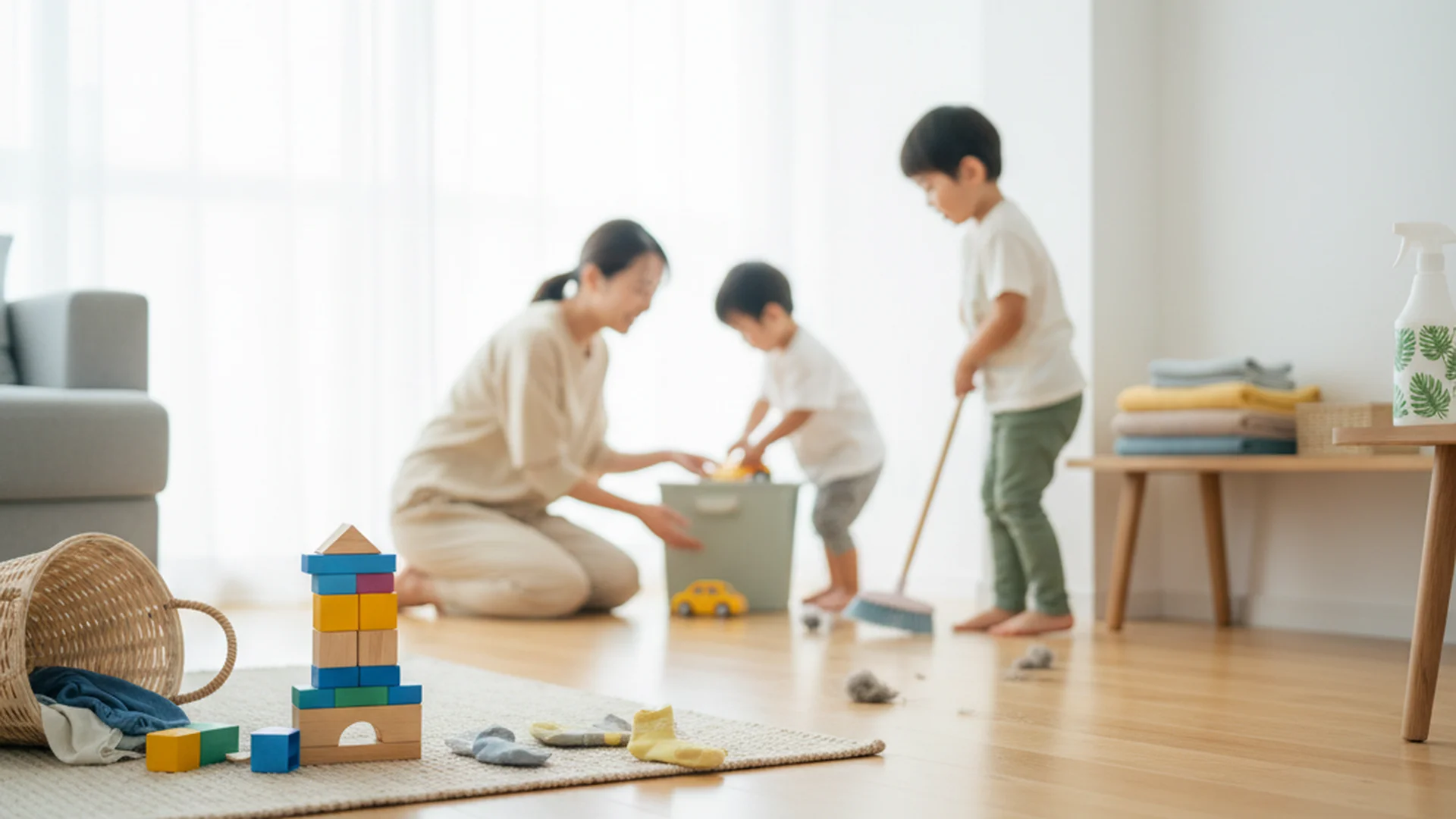
One of the most valuable cleaning routine homeschool tips is to stop viewing chores as a distraction from education and start viewing them as part of the education. Reframing chores as "Home Economics" or "Life Skills" transforms the dynamic from nagging to teaching.
Children who regularly pitch in with chores from an early age tend to build stronger academic habits, better peer relationships, and a greater sense of satisfaction as they grow. In the homeschool world, these are "credit-worthy" moments.
Age-Appropriate Chore Integration
| Age Group | Recommended Tasks | Educational Value |
|---|---|---|
| Preschool (3-5) | Matching socks, putting toys in bins, wiping low baseboards. | Categorization and motor skills. |
| Elementary (6-10) | Emptying the dishwasher, feeding pets, sweeping. | Responsibility and sequence following. |
| Middle/High (11+) | Doing their own laundry, deep-cleaning the kitchen, meal prep. | Time management and independence. |
Note: Teaching a 12-year-old to properly handle non-toxic cleaning agents and follow a multi-step sanitation process is a vital life skill that serves them far beyond graduation.
The "Kitchen Sink Factor" and Science Messes
Homeschooling families eat nearly every meal at home, which means a far higher volume of dishes than households where the children eat lunch at school. If you don't stay on top of the dishes, the kitchen becomes a source of extreme stress.
The "One-In, One-Out" Rule With the constant influx of new books, kits, and supplies, homeschool homes can quickly turn into warehouses. For every new curriculum set or art kit brought into the home, one old item must be donated, sold, or recycled. This prevents "curriculum creep" from taking over your living space.
Managing the Multi-Day Mess What do you do when a biology experiment needs to sit on the counter for 72 hours? Designate a "Project Zone." Using a mobile cart or a specific corner of the room for ongoing projects prevents them from bleeding into the "living" areas of the home.
Warning: Never try to multi-task by cleaning during active instruction time. Trying to fold laundry while teaching phonics usually results in neither task being performed well, leading to frustration for both you and your child.
2026 Trends: Tech, AI, and Micro-Cleaning
As we move into 2026, the best cleaning routine homeschool strategies are embracing technology and modern psychology.
AI-Generated Schedules
Many families are now using AI tools like ChatGPT or specialized apps like Sweepy to sync their cleaning schedules with their curriculum. If you have a heavy testing week, the AI can automatically scale back your "Zone Cleaning" to "Maintenance Only" mode.
The "Lofi" Cleaning Hour
Influenced by social media, many homeschoolers are adopting the "Silent Cleaning Hour." The family puts on a "Lofi Beats" playlist or an educational audiobook. For 60 minutes, everyone cleans their assigned zones in tandem. This reduces the "nagging factor" because the parent is working alongside the children, and the music sets a rhythmic, focused pace.
Modular Learning Spaces
A major trend in 2025-2026 is the use of modular, fold-away furniture. By using "fold-away" desks and mobile learning carts, the "school" can be tucked into a closet or corner in under five minutes, allowing the home to return to a "living space" for the evening.
Tip: Invest in a few heavy-duty rolling carts. Each child can have their own "desk-in-a-cart" that rolls into a pantry or closet when the school day ends.
Common Mistakes to Avoid
Even the most well-intentioned cleaning routine homeschool plan can fail if you fall into these common traps:
1. The Perfectionist Trap
A homeschool house will never look like a Pinterest board, and that is okay. The goal is "functional," not "spotless." If you spend all your energy chasing every dust bunny, you will have no energy left for teaching. Accept the "lived-in" look as a sign of a rich, active education.
2. The "Sole Provider" Mistake
In many households, the parent who teaches also feels they must be the one who cleans. This is the leading cause of "Homeschool Burnout." The burden of a 24/7 house must be shared by everyone who lives in it. If the children are old enough to learn algebra, they are old enough to clean a toilet.
3. Neglecting "The Launchpad"
The entryway or mudroom is the "psychological gate" of your home. If it is cluttered with shoes, old mail, and half-finished projects, it creates a mental barrier to starting the school day with a clear mind. Clear the "launchpad" every single night.
4. Saving Everything for Saturday
If you save all the cleaning for the weekend, you lose your ability to rest. Successful homeschool families distribute tasks throughout the school week (Monday-Friday) so that Saturday and Sunday can be dedicated to family adventures and rest.
Frequently Asked Questions
How do I balance teaching and cleaning without burning out?
What are age-appropriate chores for a 5-year-old vs. a 12-year-old?
Should we clean before we start school, during breaks, or after the day is done?
Is it okay to skip cleaning on heavy lesson days?
How do I get my kids to actually help instead of making more mess?
Conclusion
A successful cleaning routine homeschool families can thrive with isn't about achieving perfection—it's about creating a sustainable rhythm that supports your educational goals. By implementing the "Zone and Reset" strategy, leveraging 2026 tech trends, and involving your children in the process as a form of life-skills education, you can reclaim your home from the chaos. Remember, your home is a place of growth and learning; a little bit of "lived-in" mess is just a sign that big things are happening within those walls.
Success: By distributing the workload and utilizing micro-cleaning, you can protect your weekends for rest and family time.
Cleaning that keeps score
Every task earns points, every streak multiplies them, and Premium adds a household leaderboard plus a monthly Dustagorgon to beat.
- Free forever
- 30 badges to earn
- Up to 6 in a household
No card needed. Set up your rooms in a couple of minutes.