In this article
What you’ll learn
- Implement a 15-minute family reset to prevent daily clutter creep.
- Use toy rotation and "underconsumption core" to reduce the total volume of items.
- Transition to probiotic and eco-friendly cleaners to protect children's health.
Maintaining a pristine home while raising a large family is a feat often compared to "brushing your teeth while eating Oreos." It feels like a perpetual cycle of one step forward and three sticky footprints back. However, as we navigate 2025, the philosophy of household management is shifting. Cleaning with multiple children no longer has to be a solo marathon of exhaustion; instead, it is becoming a streamlined, eco-conscious, and team-based operation. By focusing on efficiency and involving the whole family, you can move away from the "martyrdom trap" and toward a home that feels like a sanctuary rather than a source of stress.
The High Cost of Clutter: Why Management Matters
When we talk about the best cleaning multiple children strategies, we aren't just talking about aesthetics. There is a deep psychological and physiological impact associated with the state of our living spaces. Parents who describe their homes as "cluttered" or filled with "unfinished projects" tend to live in a permanently keyed-up state, with stress hormones running high. In a household with multiple children, where noise levels are already high, physical clutter acts as additional "visual noise," leading to burnout and anxiety.
The time commitment is equally staggering. In a multi-child household, cleaning easily eats several hours out of every week. This doesn't include the "invisible load" of planning meals, managing schedules, or organizing the household.
Note: In most dual-income households, the housework still lands unevenly on one partner. Balancing this load is essential for long-term family harmony.
Strategic Strategies for Cleaning with Multiple Children
To effectively manage a large household, you must move away from "panic cleaning" and toward a system of "functional tidiness." Here are the core strategies that work best for busy families today.
The 15-Minute Family Reset
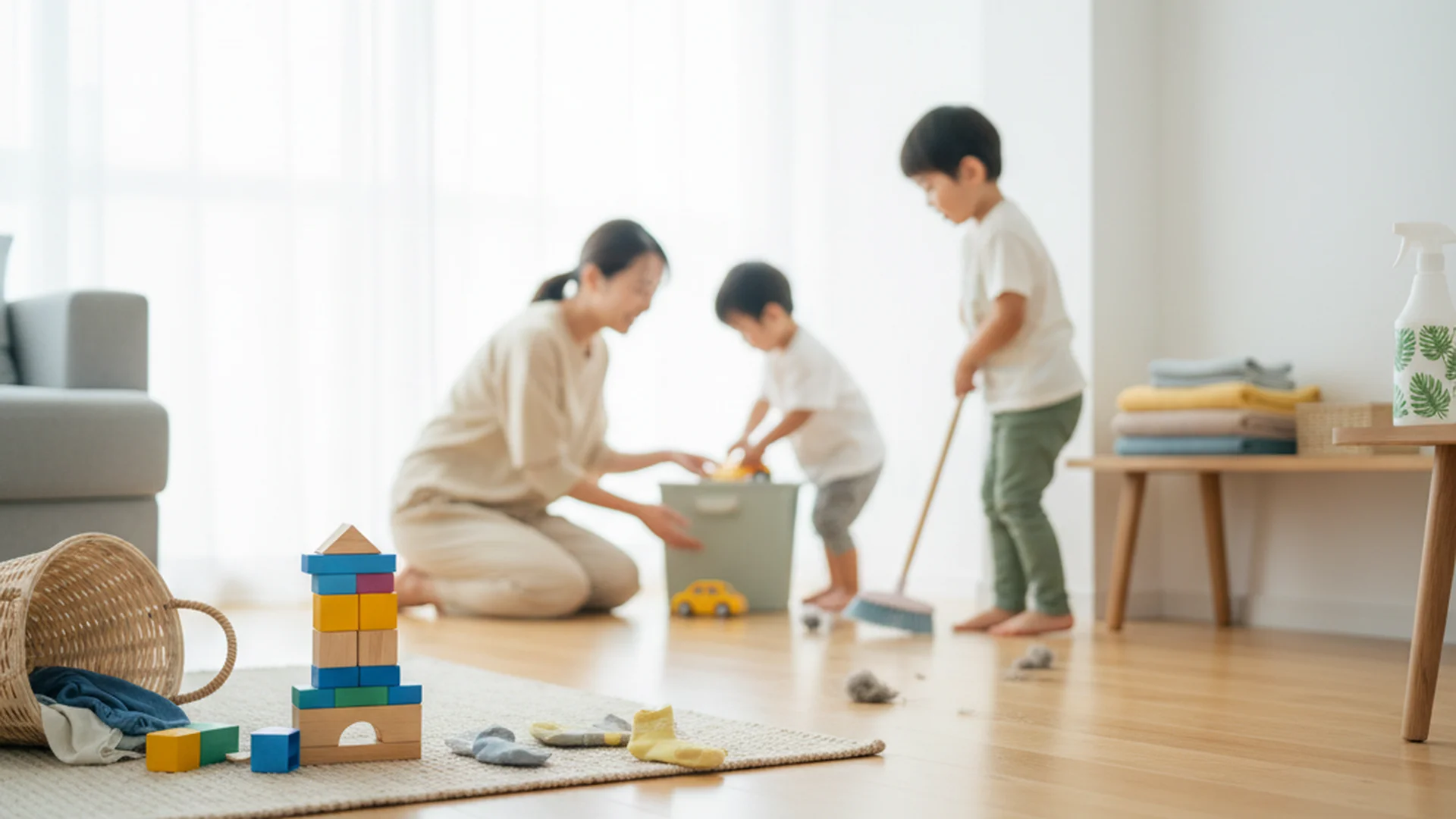
One of the most effective cleaning multiple children tips is the 15-Minute Reset. Instead of spending your entire evening cleaning, set a loud, fun timer before the bedtime routine begins. Every family member, from the toddler to the teenager, is assigned a specific "home" for items.
- Real-World Example: In the Miller household (four children under age 10), the 15-minute reset is treated like a game. The 3-year-old is responsible for "rescuing" stuffed animals and putting them in their bin, while the 9-year-old clears the dining table. By gamifying the process, the kids view it as a transition to rest rather than a chore.
Tip: Use a high-energy playlist during the reset. When the music stops, the work stops. This prevents the "cleaning fatigue" that sets in when chores feel never-ending.
Strategic Storage and Visual Labels
In a house with multiple kids, "out of sight" often means "lost forever" or "dumped on the floor." To combat this, move toward clear, labeled bins. For younger children who cannot yet read, use visual labels—actual photos of the items that belong in the bin (e.g., a picture of LEGOs on the LEGO bin).
The "One-In, One-Out" Rule
To manage the constant influx of new belongings, implement a strict "One-In, One-Out" policy. For every new birthday gift, pair of shoes, or school gadget that enters the home, one existing item must be donated, recycled, or sold. This keeps the total volume of "stuff" manageable.
| Item Category | Rotation Frequency | Management Strategy |
|---|---|---|
| Toys | Monthly | 70% in storage, 30% out |
| Clothing | Seasonal | Max 10 outfits per child |
| School Papers | Weekly | Digitized or Recycled |
| Bedding | Bi-Weekly | Color-coded by child |
Eco-Conscious Cleaning in 2025-2026
A major shift in the 2025 cleaning market is the focus on the domestic microbiome. Children take on more chemical exposure from traditional household cleaners than adults do, largely because they spend more time on the floor and frequently put their hands in their mouths.
Probiotic Cleaners
Instead of "killing 99.9% of germs," modern families are turning to probiotic cleaners. These products leave behind "good" bacteria that continue to clean surfaces and consume organic waste (like skin cells and food particles) long after you’ve finished wiping. This is particularly beneficial for developing immune systems.
Refillable & Plastic-Free Solutions
The 2026 market has seen a 30% increase in concentrated cleaning tablets. By using refillable glass bottles and just adding water, families can reduce their plastic footprint while saving significant cabinet space—a premium in multi-child homes.
Warning: Even "natural" cleaners can be hazardous if ingested. Always store cleaning concentrates in high, locked cabinets, regardless of how "eco-friendly" the packaging appears.
Managing the Laundry Mountain
For many families, laundry is the final boss of housework. To prevent the "laundry mountain" from taking over your living room, consider standardizing the wardrobe.
- Capsule Wardrobes: Limit each child to 8–10 high-quality outfits per season. Fewer clothes mean fewer items to wash, dry, and fold.
- The "No-Sort" System: Give each child their own laundry basket. Wash each child’s clothes separately so you never have to spend time sorting socks between three different siblings.
- Real-World Example: The Garcia family uses a "Wash-Dry-Fold-Same-Day" rule for one person per day. Monday is for Child A, Tuesday for Child B. This ensures the dryer is never full of cold, wrinkled clothes.
Success: Families who adopt a "one child, one load" system cut out sock-matching and sibling sorting almost entirely.
Embracing Modern Trends: AI and Underconsumption
The landscape of cleaning multiple children is being reshaped by two major trends: AI-driven scheduling and the "Underconsumption Core" movement.
AI Home Managers
Families are increasingly utilizing AI home managers to delegate the mental load. Specialized apps can now look at your family's digital calendar and auto-generate chore rotations. If Tuesday is a heavy soccer practice night, the AI will move the "Bathroom Deep Clean" to Wednesday, ensuring the schedule remains realistic.
Underconsumption Core
A viral social media trend in 2025, "Underconsumption Core" encourages families to own fewer, higher-quality items. By rejecting the "more is better" retail culture, families find that they have significantly less to clean. When you only own four bath towels instead of fourteen, they never have the chance to pile up in the corner of the bathroom.
Common Mistakes to Avoid
Even the most well-intentioned parents fall into these common traps:
- Cleaning While Kids Are Awake: Many parents try to clean around their children, only to have a new mess created in the wake of their vacuum. Instead, aim for "cleaning with them" (teaching) or "cleaning after them" (efficiency).
- Using Chores as Punishment: Using cleaning as a consequence for bad behavior makes children loathe tidying. Frame it as "caring for our shared home" to build a positive association.
- The Perfectionism Trap: In a house with multiple kids, a sterile environment is a sign of a house not lived in. Aim for "functional tidiness"—clear counters and safe walkways—rather than a showroom finish.
- The Martyrdom Trap: One parent doing 90% of the work leads to resentment. Every person who lives in the home should contribute to its maintenance according to their ability.
Note: Children as young as 2 years old can begin helping with "micro-chores," which is how the habit gets laid down early.
Frequently Asked Questions
How do I clean when the kids are always underfoot?
At what age can kids actually start helping?
How do I manage the endless toy clutter?
How often should I deep clean with a large family?
Conclusion
Cleaning with multiple children is not about achieving a perfect home; it’s about creating a manageable environment where your family can thrive. By shifting toward a team-based approach, utilizing modern eco-friendly tools, and letting go of the need for perfection, you can reclaim your time and reduce your stress. Remember, the goal is "functional tidiness"—a home that is clean enough to be healthy, but messy enough to be happy.
Success: By implementing a 15-minute family reset today, you can save up to 5 hours of solo cleaning time per week!
Cleaning that keeps score
Every task earns points, every streak multiplies them, and Premium adds a household leaderboard plus a monthly Dustagorgon to beat.
- Free forever
- 30 badges to earn
- Up to 6 in a household
No card needed. Set up your rooms in a couple of minutes.