In this article
What you’ll learn
- Adopt the '3 P’s' of energy conservation: Pacing, Planning, and Posture.
- Utilize AI-driven scheduling and ergonomic tools to reduce physical strain.
- Pivot from aesthetic perfection to 'functional cleaning' to protect your mental health.
For a great many people, the simple act of vacuuming a rug or loading the dishwasher isn't just a household chore—it is a high-stakes exercise in energy management. If you are navigating the daily challenges of cleaning chronic pain, you understand that every movement comes with a "price tag" measured in physical discomfort and fatigue. You aren't alone in this struggle. A large share of adults live with chronic pain, and for many, maintaining a home is one of the most significant hurdles to quality of life.
The goal of this guide is to move beyond the "just push through it" mentality. As a domestic efficiency specialist, I advocate for a "work smarter, not harder" approach that prioritizes your biological budget over a spotless floor. By leveraging 2025 technology and occupational therapy techniques, you can maintain a home that serves you, rather than a home that exhausts you.
The Reality of Household Maintenance with Pain
Cleaning is a physically demanding activity that involves repetitive motions, heavy lifting, and prolonged standing. For those living with "high-impact" chronic pain, these movements can trigger a flare-up that lasts for days, and household chores are one of the most commonly reported struggles.
Furthermore, the risk of injury is real. Intensive cleaning periods, such as "spring cleaning," send plenty of people to the doctor every year. For those with pre-existing musculoskeletal conditions, this risk is significantly higher. This is why we must shift our perspective from "cleaning until the job is done" to "cleaning until our body needs to stop."
The "3 P’s" of Energy Conservation
Occupational therapists often teach the "3 P's" to help patients manage limited energy. When applied to household maintenance, these principles become the ultimate cleaning chronic pain tips.
1. Pacing: The 20/10 Rule
One of the most dangerous habits for those with chronic pain is the "Boom and Bust" cycle. This happens when you feel good on a Tuesday and decide to clean the entire kitchen, only to be bedridden on Wednesday and Thursday.
To avoid this, use the 20/10 Rule:
- Set a timer for 20 minutes of light activity.
- When the timer goes off, you must take a 10-minute rest, even if you feel like you could keep going.
- If 20 minutes is too long, adjust it to a 5/15 ratio (5 minutes of work, 15 minutes of rest).
Tip: Use a visual timer or a smart speaker to track your intervals. This removes the mental load of watching the clock.
2. Planning & Prioritizing
Planning involves looking at your home as a series of zones and your energy as a limited currency (often called "Spoons").
- The Spoon Method: If you wake up with 10 "spoons" of energy, and a shower takes 3, you only have 7 left for the day. Prioritize high-touch areas like kitchen counters or the toilet, and let the baseboards wait for a high-energy day.
- Station Setup: Eliminate the need to carry heavy supplies. Create mini-cleaning kits for every room or floor. A small caddy in the bathroom and another under the kitchen sink prevents unnecessary trips up and down stairs.
3. Posture: Ergonomic Movements
How you move matters just as much as how much you move. Small adjustments in your posture can significantly reduce the torque on your spine and joints.
- The Fencing Position: When vacuuming or mopping, do not bend at the waist. Instead, place one foot in front of the other (like a fencer) and shift your weight back and forth between your legs.
- The Golfer’s Reach: To pick up a stray sock or a piece of trash without bending your spine, hold onto a stable surface with one hand and extend one leg behind you for balance as you lean forward. This keeps your back straight and uses your hip as a hinge.
Warning: Never "push through" sharp or radiating pain. This is your body’s alarm system, and ignoring it can lead to long-term inflammatory responses.
Best Tools for Cleaning with Chronic Pain
Technology has advanced significantly in 2025, providing many options for the best cleaning chronic pain solutions. The key is to find tools that extend your reach and do the mechanical scrubbing for you.
| Tool Category | Recommended Feature | Why it Helps |
|---|---|---|
| Vacuums | Robot Vacuums (AI-mapped) | Removes the need for pushing, pulling, and bending. |
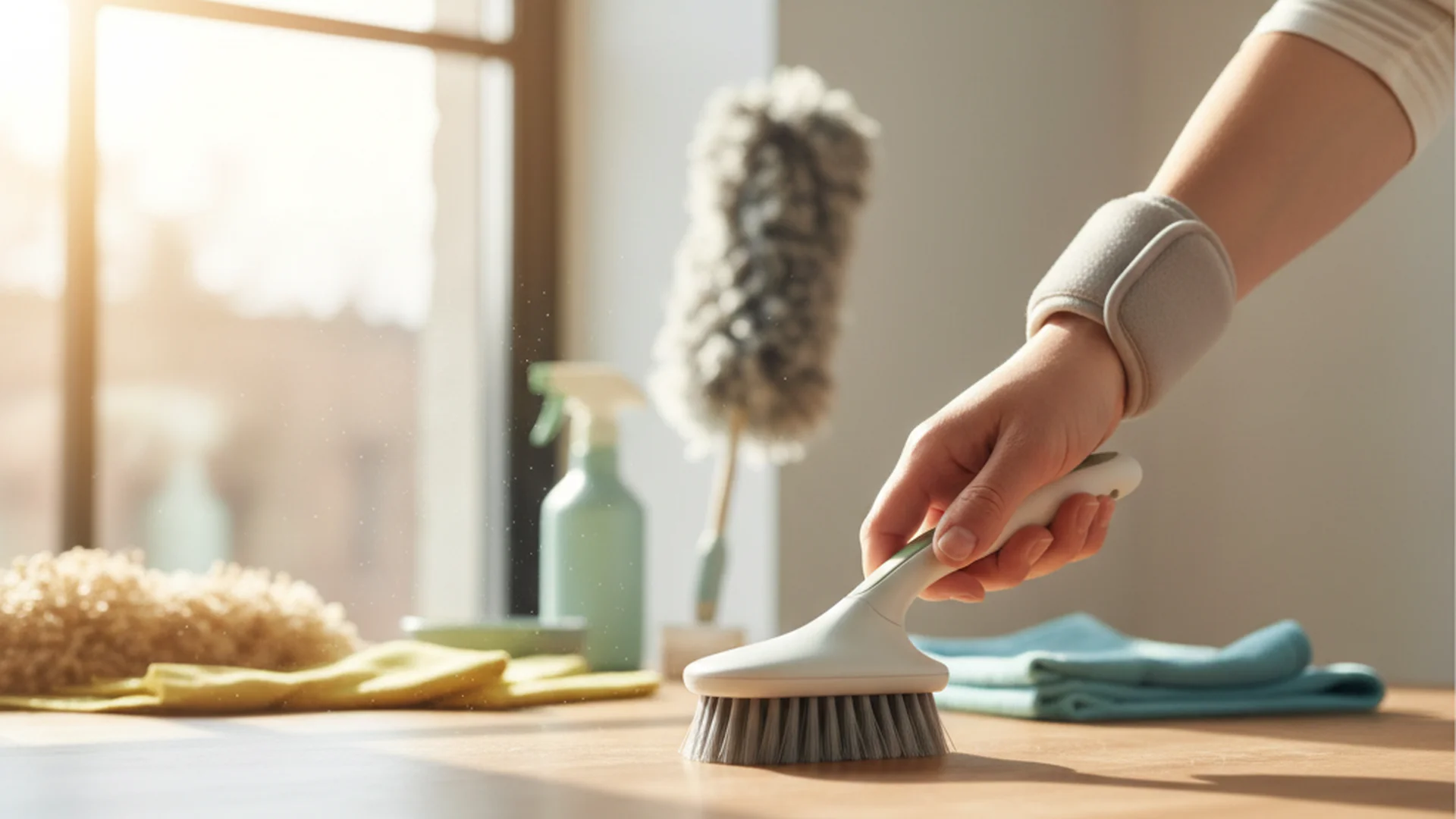
| Scrubbers | Electric Spin Scrubbers | Powerful rotation handles the "elbow grease" in tubs and tiles. |
| Mops | Spray Mops with Offset Handles | Reduces wrist strain and eliminates heavy buckets. |
| Reach | Telescopic Dusters | Allows you to clean high fans and low baseboards without reaching. |
Success: One of my clients with severe rheumatoid arthritis switched to an electric spin scrubber and found her post-cleaning wrist inflammation dropped dramatically.
2025–2026 Trends: The Future of Accessible Cleaning
The cleaning industry is finally embracing "accessibility-first" design. Here are the latest trends helping people with chronic conditions:
AI-Driven Energy-Aware Scheduling
New apps like Sweepy or AI-integrated HealthTap are now able to sync with your wearable fitness trackers. If your Oura ring or Apple Watch detects poor sleep or a high heart-rate variability (indicating a potential flare-up), these apps will automatically adjust your cleaning list to "low-energy only" tasks.
Somatic Cleaning
A rising trend for 2026 is Somatic Cleaning. This involves using nervous-system-calming techniques while tidying. By practicing rhythmic breathing or humming while folding laundry, you can lower your cortisol levels. This is crucial because stress is a known amplifier of pain.
Window Cleaning Robots
Previously expensive and clunky, the 2025 generation of window-cleaning robots (like the Winbot series) has become affordable and lightweight. These devices suction to the glass and clean both sides, removing one of the most dangerous and straining tasks—reaching and stretching to clean windows.
Real-World Examples: Applying the Strategies
Example 1: The "Sitting" Dishwasher
Sarah, who has Fibromyalgia, found that standing at the sink for 15 minutes caused her legs to go numb. She invested in a "perch stool"—a high, angled seat that allows her to sit while her feet remain grounded. By bringing the work to her and sitting down, she can finish the dishes without triggering a flare.
Example 2: The Laundry Lift
Instead of bending deep into a top-loading washing machine, Mark moved his laundry basket to a table at waist height. He uses a "reacher-grabber" tool to move wet clothes from the washer to the dryer, ensuring he never has to bend his lower back.
Example 3: The Bathroom Spray-and-Walk
Instead of scrubbing the shower on her hands and knees, Elena uses a daily "no-wipe" shower spray. Once a week, she uses an electric spin scrubber with a 50-inch extension pole. She cleans the entire shower while standing outside of it, never once having to crouch.
Note: "Functional cleaning" means your home is safe and sanitary. It does not mean it has to look like a magazine cover.
Common Mistakes to Avoid
Even with the best intentions, it is easy to fall into old habits that aggravate pain.
- Over-reliance on Harsh Chemicals: Many people with chronic pain (particularly those with Fibromyalgia or MCAS) have chemical sensitivities. Fumes from bleach or ammonia can trigger headaches or respiratory distress. Correction: Switch to steam mops or vinegar-based cleaners to reduce the toxic load on your body.
- Cleaning at the Wrong Height: Most people clean "where the dirt is," which often requires crouching or reaching. Correction: Bring the work to your "work zone" (between your hips and chest). Put the laundry basket on the counter; sit on a rolling stool to clean the lower fridge shelves.
- Ignoring the "Work-Rest" Ratio: Don't wait until you are tired to rest. Resting is a proactive strategy, not a recovery tactic. Correction: Mandatory breaks are part of the cleaning process, not a sign of failure.
Frequently Asked Questions
How can I clean if I can’t stand for more than 10 minutes?
What are the best tools for cleaning with back pain?
How do I deal with the guilt of a messy house?
Is it better to clean a little every day or do it all at once?
Conclusion
Cleaning with chronic pain requires a radical shift in perspective. It is no longer about the grit and determination to finish a task; it is about the wisdom to preserve your energy for the things that truly matter. By utilizing the 3 P’s—Pacing, Planning, and Posture—and embracing the ergonomic tools of 2025, you can maintain a home that feels like a sanctuary rather than a source of stress.
Forgive yourself for the dust on the bookshelf. Celebrate the fact that you cleaned the kitchen counter while sitting down. In the world of chronic pain management, every small, pain-free victory is a massive success.
Cleaning that keeps score
Every task earns points, every streak multiplies them, and Premium adds a household leaderboard plus a monthly Dustagorgon to beat.
- Free forever
- 30 badges to earn
- Up to 6 in a household
No card needed. Set up your rooms in a couple of minutes.