In this article
What you’ll learn
- Transition from 'marathon cleaning' to 10-minute 'micro-bursts' to prevent burnout.
- Prioritize 'passive cleaning' by running appliances while you sleep or work.
- Leverage 2026 silent technology and AI scheduling to manage irregular hours.
For many professionals, the "9-to-5" is a relic of the past. Whether you are a nurse finishing a 12-hour rotation, an emergency responder on a 48-hour call, or a factory worker on the graveyard shift, the traditional Saturday morning deep-clean is often an impossible dream. Establishing an effective cleaning routine for shift workers isn't just about aesthetics; it’s about reclaiming your limited rest time and reducing the mental fog that comes with a cluttered environment. When your schedule is unpredictable, your home maintenance must be the opposite: predictable, automated, and low-effort.
The Science of the "Second Shift" Struggle
If you feel like you are constantly behind on housework, you aren’t imagining it. When your hours don’t line up with everyone else’s, household maintenance gets squeezed into whatever gaps are left, and small messes accumulate into what we call "clutter creep."
There is also a mental cost that rarely gets counted. For shift workers, the energy required to plan and initiate cleaning is often more exhausting than the physical labor itself. When your circadian rhythm is disrupted, your brain’s executive function takes a hit, making it harder to decide whether to scrub the tub or fold the laundry.
Note: A cluttered bedroom gives your brain one more thing to process at the exact moment you are trying to switch off. For a shift worker, protecting that wind-down is worth more than a spotless living room.
The Micro-Burst Strategy: Cleaning in the Gaps
The most significant mistake shift workers make is trying to replicate a traditional cleaning schedule. Instead of a dedicated "cleaning day," the best cleaning routine for shift workers utilizes the "Micro-Burst" method. This involves three 10-minute high-intensity bursts throughout your day.
1. The "Waking" Burst (10 Minutes)
Immediately after waking—regardless of the time of day—spend ten minutes resetting the common areas. This usually includes:
- Unloading the dishwasher.
- Making the bed (crucial for psychological closure).
- Clearing the kitchen counters.
2. The "Return Home" Burst (10 Minutes)
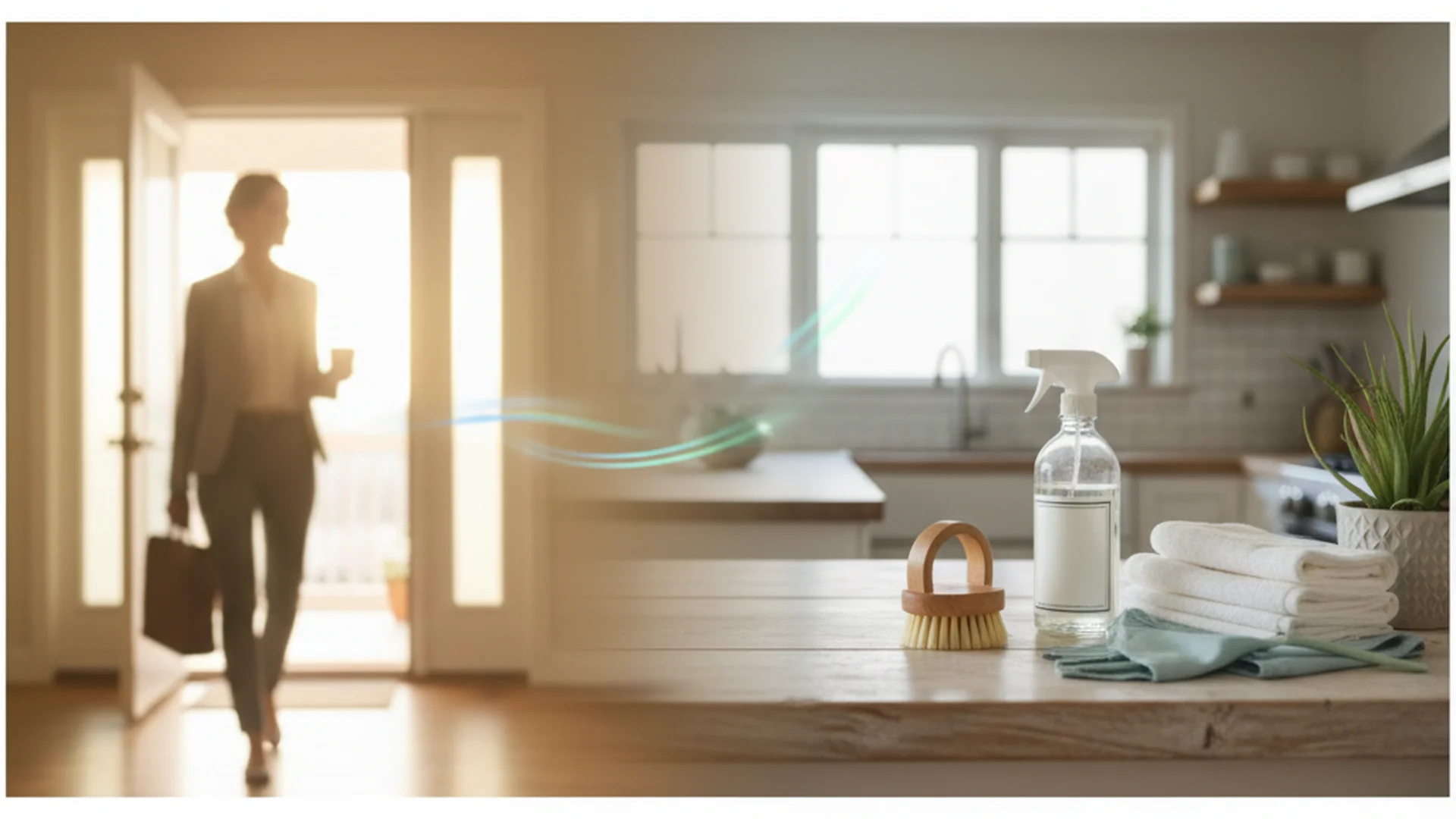
When you walk through the door after a shift, the "Launchpad Strategy" is your best friend. Spend 10 minutes prepping for your next shift.
- Empty your work bag and reset your keys/badge.
- Place dirty uniforms directly into the washing machine.
- Wipe down the high-touch surfaces you just used (entryway table, kitchen tap).
3. The "Pre-Rest" Burst (10 Minutes)
Before you head to sleep (even if it's 8:00 AM), perform a quick sweep of the "Big Three": the kitchen sink, the bathroom counter, and the bedroom floor. If these areas are clear, your brain interprets the entire home as "managed," allowing for deeper, more restorative sleep.
Tip: Use the "One-In, One-Out" rule. Never leave a room empty-handed. If you’re moving from the living room to the kitchen, take that stray coffee mug with you.
Leveraging 2026 Tech and AI for Home Management
We are entering a new era of domestic efficiency where technology does the heavy lifting. Shift workers can now utilize tools that didn't exist a few years ago to bridge the gap between their schedules and their needs.
AI-Driven Chore Scheduling
Apps like Tody and Sweepy have evolved in 2025 to include AI roster integration. You can now input your work schedule, and the AI will automatically distribute chores based on your predicted energy levels.
- Work Days: The AI assigns "low-demand" tasks like dusting a single shelf or starting a load of laundry.
- Off-Days: The AI schedules "high-demand" tasks like vacuuming or meal prepping.
The Rise of Silent Tech
One of the biggest hurdles for night shifters is the fear of waking family members or neighbors. The 2026 trend toward "ultra-low decibel" appliances has solved this. Many modern vacuum mops and dishwashers now run at under 35dB—quieter than a whisper.
| Tech Type | Benefit for Shift Workers | 2026 Standard |
|---|---|---|
| Robot Vacuum | Automated floor care while you sleep | <40dB Noise Level |
| Smart Dishwasher | Delayed start for off-peak energy | App-Controlled |
| AI Chore App | Removes "domestic cognitive load" | Roster Integration |
Success: Investing in a silent robot vacuum allows you to wake up to clean floors every single day without sacrificing a minute of sleep or waking your household.
Room-by-Room Guide for 12-Hour Rotations
When you are working 12-hour shifts, you need a ruthless prioritization of space. Focus on "Priority Zoning."
The Kitchen: The 5-Minute Reset
Don't worry about deep-cleaning the oven or organizing the pantry. Focus on the "Launchpad." Ensure your coffee maker is prepped for the next "morning" and the sink is empty. If the sink is clear, the kitchen feels clean.
The Bathroom: The Wipe-Down Method
Keep a pack of cleaning wipes or a dedicated microfiber cloth under the sink. Every time you brush your teeth, wipe the faucet and the basin. It takes 30 seconds and prevents soap scum buildup that would otherwise require an hour of scrubbing on your day off.
The Bedroom: Sleep Hygiene First
Since sleep is the shift worker’s most valuable resource, the bedroom must be a sanctuary. Keep the floor clear of "the chair"—that dreaded pile of semi-worn clothes. Use a closed hamper to hide visual clutter and maintain a low-stress environment.
Warning: Never sacrifice sleep for deep cleaning. Sleep deprivation leads to slower physical movement and poor decision-making, meaning chores will take twice as long anyway.
Breaking the "Day Off" Burnout Cycle
The most common mistake identified in cleaning routine shift workers tips is the "Day Off Deep Clean Trap." Many workers spend their entire first day off catching up on a week's worth of chores, leaving them exhausted for their actual leisure time.
Active vs. Passive Batching
To avoid the trap, categorize your chores:
- Passive Chores: These can happen while you sleep or work. Starting the laundry, running the dishwasher, or letting a slow cooker prepare a meal.
- Active Chores: These require your physical presence and energy, like scrubbing floors or cleaning windows.
By spreading passive chores throughout your work week, you ensure that your "Active" cleaning list on your day off is manageable.
Real-World Example: Sarah, the ER Nurse
Sarah works three 12-hour night shifts in a row.
- During Shifts: She uses her 10-minute "Return Home" burst to start a laundry load. She sleeps while the machine works. When she wakes up, she moves it to the dryer (another 2 minutes).
- On Her Day Off: She only has one "Active" task—vacuuming. Because she maintained the "Big Three" during her work stretch, she spends only 30 minutes cleaning on her day off instead of four hours.
Common Mistakes to Avoid
- Buying Too Many Specialized Cleaners: Shift workers need speed. Having 20 different bottles slows you down. Stick to one high-quality all-purpose cleaner for 90% of your home.
- Ignoring the "Launchpad": Forgetting to prep your bag or uniform results in "preparation clutter"—a mess of papers, clothes, and containers scattered in a rush.
- The Perfectionism Trap: Your home does not need to look like a showroom at 3:00 AM. If it is functional and hygienic, it is a success.
- Neglecting Body Doubling: Many shift workers find it hard to start cleaning at odd hours. Using "body doubling" apps like Focusmate to connect with someone else cleaning at 2:00 AM can provide the necessary accountability.
Frequently Asked Questions
How do I clean my house when I work 12-hour shifts?
Is it better to clean before or after a night shift?
How do I manage chores with a rotating schedule?
How can I keep the house quiet for my sleeping spouse while I clean at night?
What is the '15-minute' cleaning rule for shift workers?
Conclusion
A successful cleaning routine for shift workers is built on flexibility rather than rigidity. By moving away from the "all-or-nothing" approach of the traditional weekend deep clean and embracing micro-bursts, passive cleaning, and modern silent technology, you can maintain a home that supports your health rather than draining your energy. Remember, the goal isn't a perfect house—it's a functional space that allows you to rest, recover, and head back to your next shift with a clear mind.
Success: By implementing these micro-strategies, you can save up to 5 hours of your precious "day off" time every single week.
Cleaning that keeps score
Every task earns points, every streak multiplies them, and Premium adds a household leaderboard plus a monthly Dustagorgon to beat.
- Free forever
- 30 badges to earn
- Up to 6 in a household
No card needed. Set up your rooms in a couple of minutes.