In this article
What you’ll learn
- Clinical cleaning must follow the 'top-to-bottom' and 'clean-to-dirty' rules.
- Personal decontamination begins the moment you leave the clinical floor.
- Dwell time is the most critical and most ignored factor in effective disinfection.
In the modern medical environment, a professional cleaning routine healthcare workers can rely on is no longer just a matter of hospital policy—it is a critical life-saving intervention. Whether you are a nurse, a physician, or environmental services (EVS) staff, the protocols you follow dictate the safety of your patients and, ultimately, the safety of your own family when you return home. As we navigate the complexities of 2025 healthcare standards, understanding the synergy between clinical disinfection and personal decontamination has never been more vital.
The High Stakes of Healthcare Hygiene
Healthcare-associated infections (HAIs) are a sobering reality of clinical work. A meaningful share of hospital patients and nursing home residents contract at least one infection during a stay that was supposed to make them better.
However, there is a silver lining. Facilities that commit to a rigorous best cleaning routine healthcare protocol see fewer staff sick days from on-site infections, and fewer MRSA cases on the ward. When we get the routine right, we save lives.
Clinical Protocols: Protecting the Patient
A successful clinical cleaning routine is built on logic and microbiology. To prevent cross-contamination, healthcare workers must move through a space with intent.
The "Clean to Dirty" Rule
One of the most fundamental aspects of a cleaning routine healthcare tips guide is the "Clean to Dirty" rule. This means you must always clean the least-soiled areas first before moving toward the most-soiled areas.
For example, when cleaning a patient room, you should start with the bedside table and the call button before moving to the bathroom or the waste receptacles. If you reverse this order, you risk carrying fecal pathogens or bathroom bacteria onto the surfaces where the patient eats and handles their medication.
Top to Bottom Methodology
Gravity affects pathogens just as it affects everything else. When you wipe down a shelf or a light fixture, dust and microorganisms fall. By cleaning from the top (shelves, IV poles, monitors) to the bottom (bed frames, then floors), you ensure that you aren't re-contaminating surfaces you have already addressed.
Warning: Never clean the floor before the surfaces. Doing so allows dust and germs from tables to fall onto the clean floor, rendering your initial work useless.
Identifying High-Touch "Hot Zones"
While every surface matters, high-touch points are the primary vectors for disease transmission. In your daily routine, prioritize the following:
- Bed rails and call buttons
- IV poles and pump touchscreens
- Keyboard and mouse at the workstation
- Elevator buttons and door handles
- Stethoscopes and ID badges
| Surface Type | Pathogen Survival | Recommended Disinfectant |
|---|---|---|
| Bed Rails (Metal) | MRSA: Months | 70% Alcohol or Quats |
| Keyboards (Plastic) | Norovirus: Weeks | Electronic-safe Wipes |
| Linens (Fabric) | Various: Days | High-heat Laundering |
The Science of Dwell Time
Perhaps the most common mistake in healthcare cleaning is ignoring "dwell time" (also known as contact time). This is the specific amount of time a disinfectant must remain visibly wet on a surface to actually kill the pathogens listed on its label.
Note: Most hospital-grade wipes require a dwell time of 1 to 4 minutes. If you wipe a surface and it dries within 30 seconds, or if you immediately wipe it dry with a paper towel, the disinfection process has failed.
Real-World Example: The C. Diff Challenge
Consider a scenario where a room is being turned over after a patient with C. difficile is discharged. C. diff produces spores that are incredibly resistant. In this case, standard 70% alcohol sanitizers will not work. A worker must use a bleach-based solution and ensure the surface remains wet for the full duration specified by the manufacturer (often 4-10 minutes for spores) to ensure the room is safe for the next occupant.
Personal Decontamination: The "Home Transition"
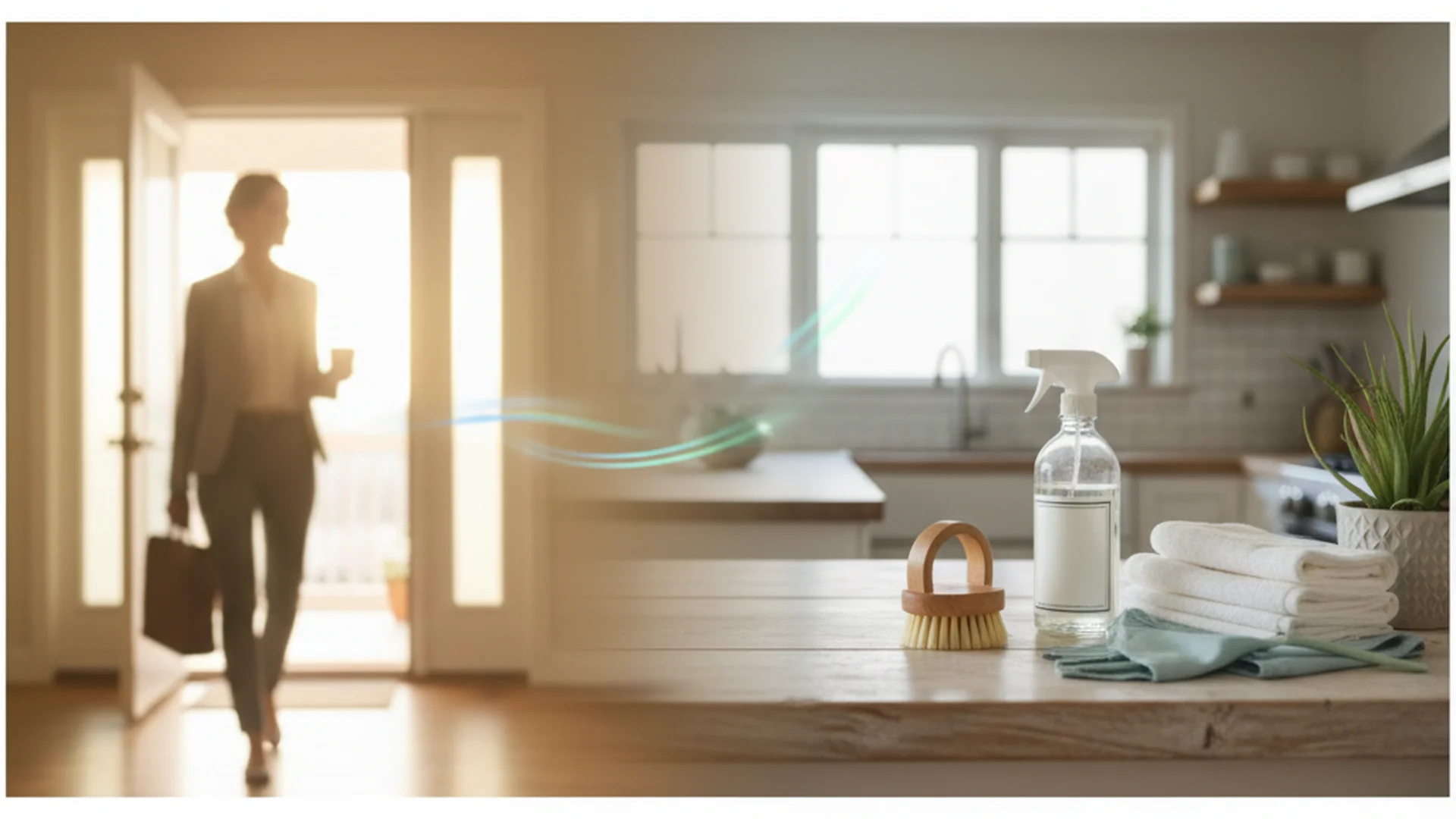
For many healthcare workers, the greatest anxiety isn't getting sick themselves—it's bringing a "superbug" home to their children or elderly parents. To mitigate this, you must treat your workplace as a "Hot Zone" and your home as a "Cold Zone."
The Buffer Zone Strategy
If your facility provides locker rooms, the best practice is to change out of your scrubs and work shoes before leaving the building. Place your used scrubs in a dedicated laundry bag. If you must wear your scrubs home, designate a "transition area" in your garage or entryway.
Footwear Management
Shoes are one of the dirtiest items a healthcare worker owns. They traverse hospital floors that may contain everything from spilled fluids to drug-resistant bacteria.
- Recommendation: Keep "work only" shoes. These should never enter the living areas of your home. Leave them in the garage, a porch, or a dedicated plastic bin by the door.
The Immediate Shower
Before hugging your partner, playing with your kids, or sitting on the sofa, go directly to the shower. This removes any lingering pathogens from your skin and hair that may have been aerosolized during your shift.
Tip: Use 70% isopropyl alcohol wipes on your phone, ID badge, and stethoscope at the end of every shift. Your phone is essentially a portable petri dish that travels between your work hand and your face.
Recent Trends: The Future of Healthcare Cleaning (2025–2026)
As we look toward 2026, the best cleaning routine healthcare workers use is becoming increasingly tech-driven. These advancements are designed to reduce human error and ensure a higher baseline of cleanliness.
- UV-C Disinfection Robots: Many large hospitals now use autonomous robots that emit high-intensity UV-C light to provide terminal cleaning of rooms. These are used after manual cleaning to catch any microscopic pathogens left behind.
- Electrostatic Sprayers: These devices are a game-changer for irregular surfaces. They give disinfectant particles a positive charge, causing them to "wrap around" objects like bed frames and wheelchair wheels for 360-degree coverage.
- IoT Digital Logs: Facilities are moving away from paper checklists. New IoT-enabled systems track in real-time when a room was last cleaned and even monitor hand hygiene compliance via sensors in soap dispensers.
- Enzyme-Based Cleaners: There is a growing shift toward "Green Cleaning" in healthcare. Natural enzymes are being used to break down organic biofilms, which are often resistant to traditional chemicals.
Success: Implementing these automated systems alongside traditional manual cleaning gives you a second line of defence against the pathogens manual cleaning misses.
Common Mistakes to Avoid
Even the most dedicated professionals can fall into bad habits. Here are the most frequent errors seen in healthcare cleaning routines:
- The "Spray and Wipe" Error: Spritzing a surface and immediately wiping it dry. This negates the disinfectant's ability to kill germs.
- Reusing Cloths: Using the same microfiber cloth for multiple rooms is the fastest way to spread MRSA or C. diff across an entire unit.
- Wearing Scrubs in Public: While it may be convenient to grab groceries in your scrubs after a shift, it is heavily discouraged. This practice risks transferring hospital-grade pathogens into the community.
- Misunderstanding "Clean" vs. "Disinfected": Cleaning (removing dirt) is the necessary first step. You cannot disinfect a surface that is covered in visible blood or soil, as the organic matter shields the germs from the chemicals.
Real-World Example: The Cross-Contamination Chain
Picture this: a worker used the same pair of gloves to adjust a patient's IV and then touch the room's keyboard. Even though they "cleaned" the keyboard later with a quick wipe, the lack of dwell time meant the next person to use that keyboard (a doctor) picked up the pathogens on their hands, eventually carrying them to three other patients. This highlights why the routine must be flawless every single time.
Frequently Asked Questions
Should I wash my scrubs at home?
Is hand sanitizer better than soap?
How do I protect my car after a shift?
What is the most forgotten surface in a cleaning routine?
Conclusion
Developing a consistent cleaning routine healthcare workers can follow requires discipline, but the rewards are immeasurable. By adhering to clinical protocols like the "top-to-bottom" rule and the "clean-to-dirty" flow, you create a fortress of safety for your patients. By maintaining a strict personal decontamination routine—the "Hot Zone" strategy—you ensure that your home remains a sanctuary, free from the invisible threats of the hospital.
Stay diligent, respect the dwell time, and remember that every surface you wipe is a potential life saved.
Success: Consistent adherence to these protocols not only protects lives but also builds a culture of safety that defines a world-class healthcare professional.
Cleaning that keeps score
Every task earns points, every streak multiplies them, and Premium adds a household leaderboard plus a monthly Dustagorgon to beat.
- Free forever
- 30 badges to earn
- Up to 6 in a household
No card needed. Set up your rooms in a couple of minutes.