In this article
What you’ll learn
- Understand how executive dysfunction and object permanence cause clutter.
- Use "Body Doubling" and the "Container Concept" to bypass decision fatigue.
- Replace aesthetic goals with functional systems that serve your brain.
If you have ADHD, the traditional advice of "just spend fifteen minutes a day tidying" often feels like being told to "just breathe" during an asthma attack. You want to clear the mess, but the sheer volume of items, the emotional weight of old mail, and the paralysis of not knowing where to start keep you stuck. ADHD decluttering isn't about a lack of discipline; it is a complex navigation of executive dysfunction, sensory overload, and decision fatigue.
The good news is that your home can be functional without looking like a minimalist showroom. By shifting your focus from "perfection" to "function," you can build a living space that supports your brain instead of draining it. This guide will walk you through the science of why your brain struggles and provide actionable, 2025-approved strategies to help you finally clear the "doom piles."
The Science: Why Your Brain Loves (and Hates) Clutter
Before we dive into the "how," we must address the "why." For many with ADHD, clutter is a physical manifestation of internal cognitive processes. Research shows that individuals with ADHD are 77% more likely to struggle with chronic disorganization than neurotypical peers. This isn't because of "laziness"—it’s because of how your brain handles information.
Executive Dysfunction and Task Initiation
Decluttering requires a sequence of high-level cognitive functions: planning, prioritizing, and initiating. For an ADHD brain, the simple task of "cleaning the kitchen" is actually forty smaller tasks hidden under one label. When your brain can't decide which task is the priority, it shuts down. This is known as "ADHD Paralysis."
The Cortisol Loop
A study from UCLA’s Center on Everyday Lives of Families found that high "clutter density" in the home directly correlates to higher levels of cortisol, the stress hormone. For those with ADHD, who are already prone to sensory overload, visual noise (clutter) acts like a constant, loud hum that prevents relaxation. You can't rest because your environment is screaming for your attention.
Object Permanence and "Visual Noise"
Many in the ADHD community joke about "Out of Sight, Out of Mind," but the struggle is real. If you put your stapler in a drawer, your brain might register it as "gone forever." This leads to "cluttering for visibility," where you leave things out on surfaces so you don't forget they exist. Eventually, these items blend into the background, creating "visual noise" that you no longer see but still feel the stress of.
Core Strategies for ADHD Decluttering
If you've spent any time researching adhd decluttering reddit threads, you’ll notice that the community gravitates toward systems that bypass the need for intense focus. Here are the most effective strategies recommended by experts for 2025.
Body Doubling: The Power of Presence
Body doubling is perhaps the #1 most suggested tip on adhd decluttering reddit. It involves having another person in the room (or on a video call) while you work. They don't even have to help; their presence acts as an "anchor," keeping your brain tethered to the task at hand. In 2025, virtual body doubling apps and Discord servers have made this easier than ever to access 24/7.
The Container Concept
Popularized by Dana K. White, the Container Concept is a game-changer for decision fatigue. Traditional decluttering asks, "Does this spark joy?" ADHD decluttering asks, "Does it fit?"
A shelf, a drawer, or a bin is not just a storage space—it is a physical limit. If your "spare cable drawer" is full, you cannot keep another HDMI cable. The container makes the decision for you, removing the emotional burden of choosing what to keep.
Tip: Start with the "No-Brainer Toss." Carry a trash bag and look only for obvious garbage (old receipts, food wrappers, broken items). Don't look at photos or mail yet. Build momentum with easy wins.
Point-of-Performance Storage
We often try to store things where they "should" go according to society. ADHD brains need things stored where they are actually used. If you always take your socks off by the sofa, put a small, attractive basket by the sofa. If your mail always piles up on the kitchen island, put a recycling bin right next to that spot.
| Strategy | Goal | Why it Works for ADHD |
|---|---|---|
| Body Doubling | Task Initiation | Provides external accountability and "dopamine" support. |
| The Container Concept | Limiting Volume | Removes the need for complex decision-making. |
| Micro-bursts (5-min) | Avoiding Burnout | Prevents the "marathon" cleaning sessions that lead to exhaustion. |
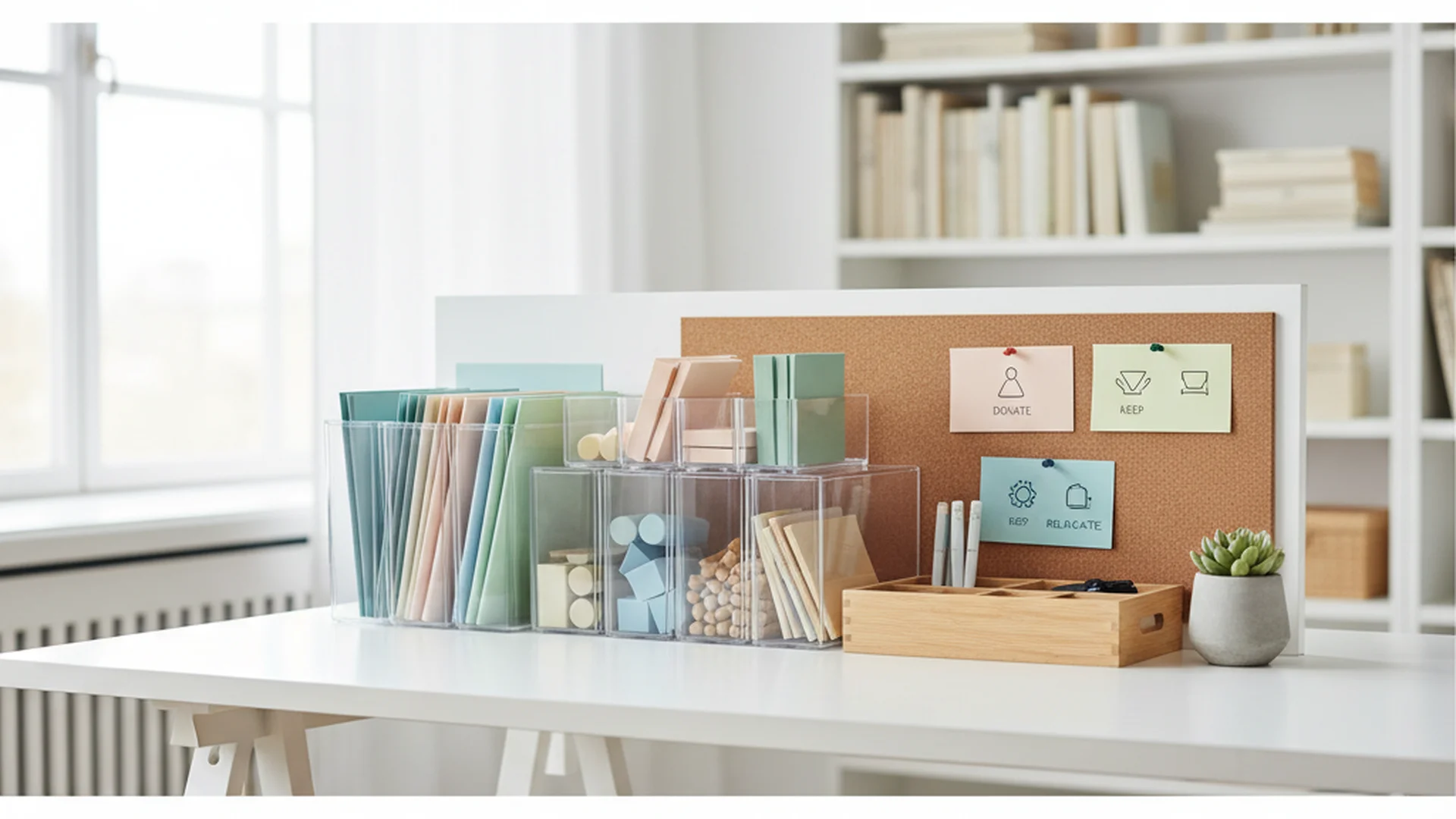
| Clear Bins | Visibility | Solves the "Out of Sight, Out of Mind" issue. |
Handling the Infamous "Doom Boxes"
"DOOM" stands for Don't Organize, Or Money/Move. These are the boxes or piles where you put things when you need the house to look clean quickly, or when you simply don't know where an item belongs.
How to Tackle a Doom Box Without Spiral
- The 10-Item Rule: Don't try to empty the whole box. Just take out 10 items.
- The Sorting Floor: Dump the 10 items on a neutral surface.
- Immediate Rehoming: If an item has a home, take it there now. If it doesn't, it goes into a "Needs a Home" category.
- The Trash Check: Usually, at least 30% of a Doom Box is old mail or packaging that can be tossed immediately.
Warning: Never start a decluttering session by emptying every closet onto the floor. This creates a "mountain of overwhelm" that often ends with you sleeping on a pile of clothes because you ran out of energy halfway through.
Real-World Examples: ADHD Success Stories
To understand how these adhd decluttering tips look in practice, let's look at three common scenarios:
Example 1: The "Laundry Mountain"
- The Problem: Clothes are clean but sit in the dryer or in baskets until they are wrinkled, leading to "re-washing" cycles.
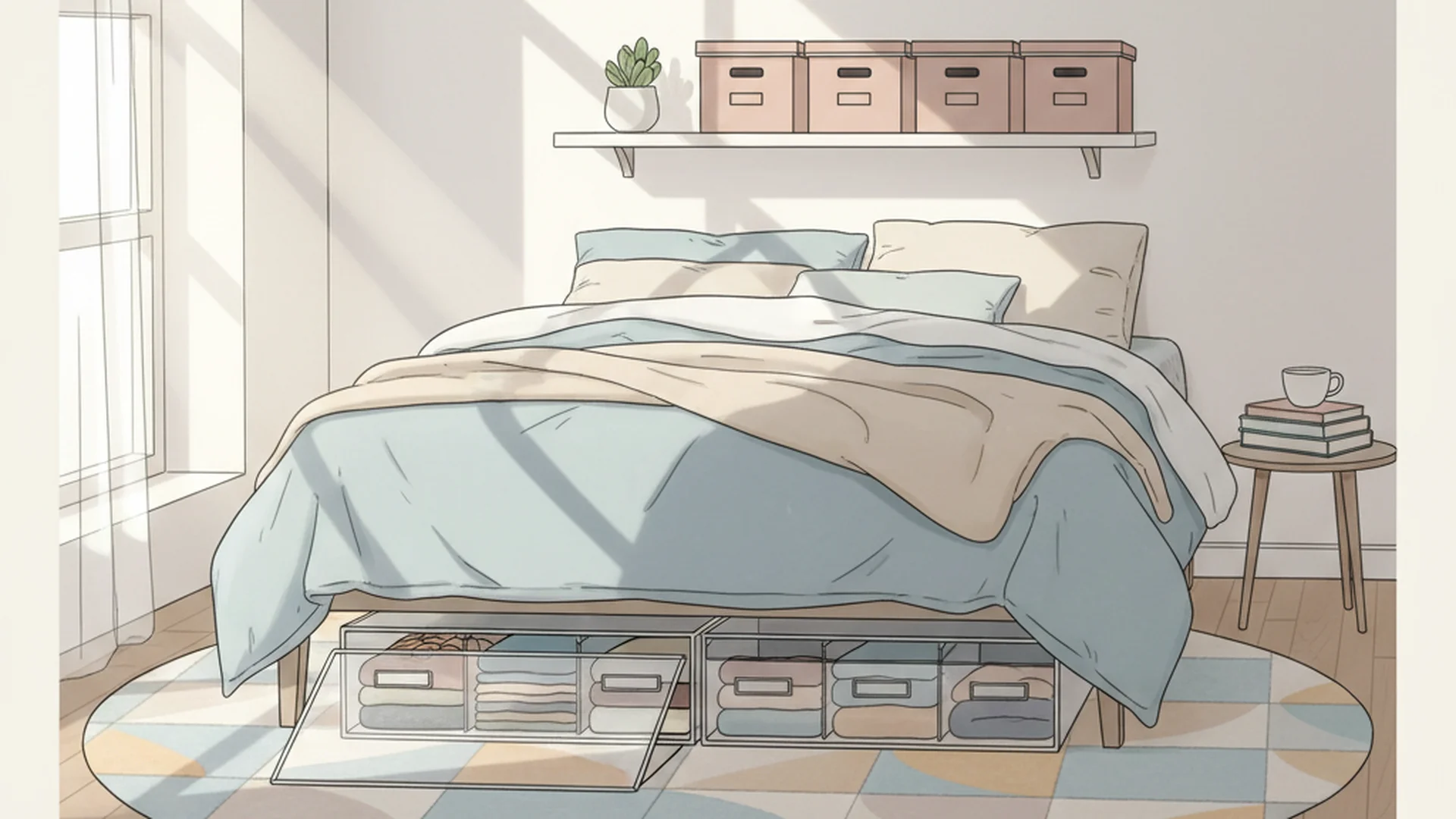
- The ADHD Solution: Sarah stopped folding. She bought clear, open-front bins for her closet. Socks go in one, underwear in another, t-shirts in a third. By removing the "barrier" of folding, she actually put her clothes away for the first time in years.
Example 2: The Paperwork Pileup
- The Problem: Mail sits on the counter for months because the filing cabinet is in another room and feels "too hard" to use.
- The ADHD Solution: James put a shredder and a trash can directly under the spot where he drops his mail. He also switched to 100% digital billing. Now, 90% of the paper never even touches his counter.
Example 3: The "Hobby Graveyard"
- The Problem: ADHD often comes with "hyperfixations." You buy all the supplies for sourdough, then crochet, then woodworking. These supplies now take up the entire guest room.
- The ADHD Solution: Elena designated one "Hobby Wardrobe." When the wardrobe is full, she cannot start a new hobby until she sells or donates the supplies from an old one. The container defines her capacity.
Modern Tech: Using AI to Declutter in 2025
As we move through 2025 and 2026, technology has become a powerful ally for the neuro-divergent brain.
- AI Task Breakdowns: Tools like Goblin.tools use AI to take a prompt like "Clean the living room" and break it down into tiny, manageable steps (e.g., "Pick up 3 cups," "Move the remote to the TV stand"). This bypasses the executive dysfunction of "where do I start?"
- Visual Reminder Apps: Apps that allow you to take a photo of what’s inside a box and tag it with a QR code are becoming mainstream. This helps with object permanence—you can "see" inside the box without opening it.
- Digital Decluttering: Clutter isn't just physical. In 2025, digital noise is at an all-time high. Experts recommend a "Sunday Reset" for your phone: deleting screenshots you don't need, clearing browser tabs, and unsubscribing from junk mail.
Note: Low-sensory zones are the new "minimalism." Instead of trying to make the whole house perfect, focus on creating one "Visual Sanctuary"—a corner or room with zero clutter—where your brain can truly rest.
Common Mistakes to Avoid
Even with the best intentions, ADHD brains often fall into these common traps:
- Buying the Bins First: This is a dopamine-seeking trap. You buy $200 worth of matching containers before you’ve actually reduced the number of items you own. This results in "organized clutter." Declutter first, buy bins last.
- Organizing by Category (KonMari Style): For many with ADHD, gathering every single book in the house into one pile creates a mess so large it triggers a shutdown. Organize by location or small drawer instead.
- The "All or Nothing" Mentality: Thinking you have to finish the whole room today. If you only declutter three pens, you are in a better position than you were yesterday.
- Storing "Just in Case": ADHD brains often fear forgetting a need. Remind yourself: If it costs less than $20 and takes less than 20 minutes to replace, you don't need to store it "just in case."
Frequently Asked Questions
Why can't I just start decluttering?
What is the best way to handle sentimental clutter with ADHD?
How do I maintain a clean house once I’ve decluttered?
Why do I feel physically exhausted after only 15 minutes?
Conclusion
Your home should be a tool that serves you, not a museum you have to maintain. For the ADHD brain, adhd decluttering is not a one-time event but a lifestyle of managing boundaries and lowering the "cost of entry" for daily tasks. By using body doubling, the container concept, and modern AI tools, you can move away from the shame of the "doom pile" and into a space that actually breathes.
Remember: "Good enough" is a perfectly acceptable goal. If your keys are on the wall and you can find your shoes, you're winning.
Success: By implementing "Point-of-Performance" storage and the "No-Brainer Toss," you are significantly reducing the daily cognitive load on your brain.
Cleaning that keeps score
Every task earns points, every streak multiplies them, and Premium adds a household leaderboard plus a monthly Dustagorgon to beat.
- Free forever
- 30 badges to earn
- Up to 6 in a household
No card needed. Set up your rooms in a couple of minutes.