In this article
What you’ll learn
- Vinegar kills ~80% of germs but is not an EPA-registered disinfectant.
- Commercial cleaners are essential for high-risk pathogens like SARS-CoV-2.
- Mixing vinegar with bleach or peroxide creates dangerous toxic gases.
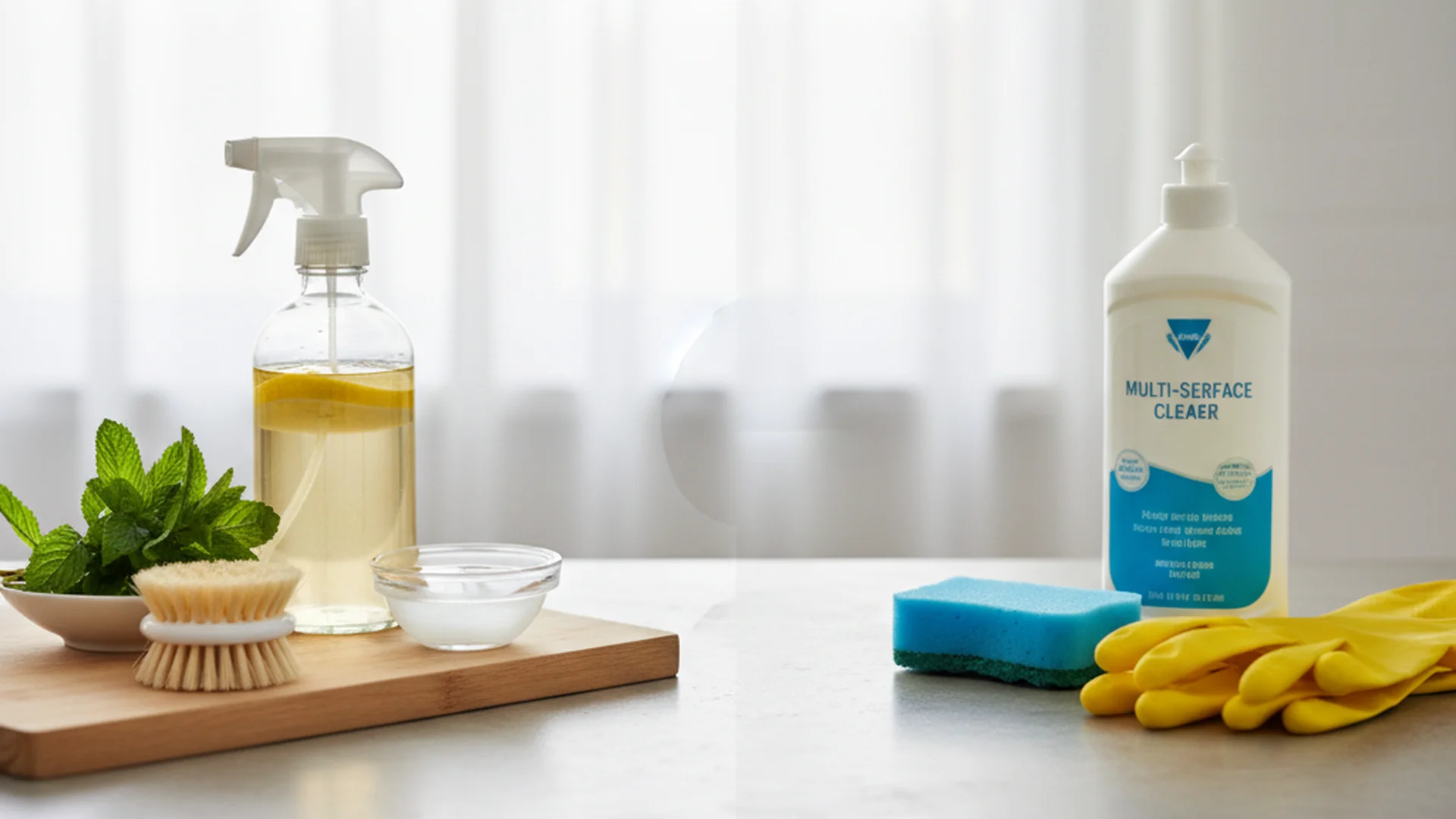
For decades, homeowners have stood at a crossroads in the cleaning aisle: do you reach for the heavy-duty, lab-formulated spray or the humble bottle of distilled white vinegar from the pantry? As we look toward the 2025-2026 cleaning landscape, the choice is no longer just about "natural vs. chemical." It is about understanding the molecular science of efficacy, the safety of our indoor air quality, and the specific needs of modern household surfaces.
Whether you are trying to reduce your environmental footprint or simply wondering which is better vinegar vs commercial cleaners for your kitchen counters, this guide breaks down the trade-offs, the dangers, and the sensible "middle ground" for a healthy home.
The Efficacy Gap: When "Clean" Isn't "Disinfected"
The most significant distinction between vinegar and commercial cleaners lies in their ability to kill pathogens. While many people use these terms interchangeably, "cleaning" (removing dirt) and "disinfecting" (killing germs) are two very different scientific processes.
The 80% Threshold
Standard white vinegar, which typically contains 5% acetic acid, is an effective cleaner for breaking down grease and mineral deposits. However, it only kills roughly 80% of germs. While it can handle common household bacteria like E. coli and Salmonella, it is not an EPA-registered disinfectant.
In contrast, commercial disinfectants are legally required to meet a 99.9% kill rate threshold to earn their labeling. For high-traffic areas or homes dealing with seasonal illnesses, that 19.9% gap is the difference between a healthy family and a spreading virus.
The Contact Time Problem
A common mistake users make when choosing vinegar vs commercial cleaners is ignoring "contact time"—the duration a surface must remain wet to actually kill germs.
- Commercial Cleaners: Most are formulated to work in 30 seconds to 10 minutes.
- Vinegar: To show significant antibacterial properties against tougher strains like M. tuberculosis, vinegar requires a contact time of up to 30 minutes.
Most people spray and wipe immediately, which means if you are using vinegar, you are likely just moving the germs around rather than eliminating them.
Note: Acetic acid is the active component in vinegar. While food-grade vinegar sits at a pH of 2.4, "cleaning vinegar" can have a pH as low as 1.5, making it significantly more powerful—and more corrosive.
Financial and Safety Considerations
When deciding which is better vinegar vs commercial cleaners, the budget is often the deciding factor. However, the "cheaper" option can sometimes carry hidden costs.
The Cost of the Bottle
There is no denying the price advantage of vinegar. A gallon of distilled white vinegar typically costs between $3 and $5. In contrast, specialized commercial cleaners—especially those targeting specific rooms like the bathroom or kitchen—often cost $5 to $15 for a single 32oz bottle. For a household on a budget, vinegar is the clear winner for general maintenance.
The Healthcare Cost of Chemicals
On the flip side, commercial chemicals carry a human cost. Accidental ingestion and respiratory irritation from household chemicals send people to the doctor every year, and the treatment bills are real money. This "safety tax" is a primary reason so many households are moving toward vinegar-based solutions or "Green-Certified" commercial products.
Success: Using vinegar for the bulk of your household cleaning tasks can save your family a meaningful sum each year in cleaning supply costs while reducing chemical exposure.
Surface Safety: Where Vinegar Can Ruin Your Home
One of the most dangerous myths in the cleaning world is that vinegar is "safe for everything" because it is edible. This couldn't be further from the truth. The high acidity of vinegar can cause permanent, irreversible damage to expensive household finishes.
The "Stone Etching" Nightmare
If you have natural stone countertops, vinegar is your greatest enemy. Marble, granite, limestone, and quartz are chemically sensitive to acids. When vinegar touches these surfaces, it causes "etching"—a process where the acid eats away at the stone, leaving dull, white, pitted marks that cannot be wiped away.
Modern Appliance Hazards
Many viral "life hacks" suggest using vinegar as a rinse aid in dishwashers or a cleaner for washing machines. However, modern appliance manufacturers have issued warnings against this. The acetic acid can degrade rubber seals, gaskets, and hoses over time, leading to slow leaks and thousands of dollars in water damage.
| Surface Type | Vinegar Safe? | Recommended Cleaner |
|---|---|---|
| Glass & Mirrors | Yes | Vinegar/Water (1:1) |
| Sealed Granite | No | pH-Neutral Stone Cleaner |
| Hardwood (Poly) | No | Damp microfiber / Wood Soap |
| Ceramic Tile | Yes | Vinegar or All-Purpose |
| Stainless Steel | Yes | Vinegar or specialized polish |
Warning: Never use vinegar on raw egg spills. The acid causes the egg proteins to coagulate, essentially "poaching" the egg onto your floor and making it significantly harder to scrub away.
Common Mistakes to Avoid
The debate of vinegar vs commercial cleaners often leads to dangerous DIY experiments. Understanding chemical reactions is vital for home safety.
1. The "Bleach Bomb"
This is the most critical safety rule in the home: NEVER mix vinegar with bleach. Vinegar is an acid, and bleach is a base. When combined, they release toxic chlorine gas. Inhaling this gas, even in small amounts in a poorly ventilated bathroom, can cause severe respiratory distress, coughing, and even permanent lung damage.
2. The Peracetic Acid Trap
Some DIY enthusiasts mix vinegar and hydrogen peroxide in the same bottle, thinking it creates a "super cleaner." While this does create peracetic acid—a strong disinfectant—it is also highly corrosive and can irritate the skin, eyes, and lungs. It is much safer to use these products sequentially (and rinse in between) rather than mixing them in a spray bottle.
3. Dull Hardwood Floors
Using vinegar on wood floors is a common mistake that takes years to notice. The acid slowly breaks down the polyurethane finish that protects the wood. Eventually, the floor will look "cloudy" or "milky," and the wood underneath becomes vulnerable to water damage and rot.
2025-2026 Trends: The Hybrid Revolution
As we move further into the decade, the binary choice of vinegar vs commercial cleaners is disappearing. New technologies are bridging the gap between "natural" and "powerful."
Probiotic Cleaning
A major 2025 trend involves cleaners that use live probiotics (such as Unilever’s Cif Probiotic line). Unlike vinegar, which stops working the moment it dries, these microscopic "good bacteria" continue to eat away at grime, odors, and hidden pathogens for up to 72 hours after application.
Electrolyzed Water (HOCl)
If you want the safety of vinegar with the power of a hospital-grade disinfectant, look toward Hypochlorous Acid (HOCl). Created using salt, water, and electricity, HOCl is an EPA-registered disinfectant that is non-toxic to humans. Many families are now purchasing small countertop "electrolyzer" units to make this "super-water" at home.
Waterless Concentrates
To compete with the low-waste profile of vinegar, commercial brands are pivoting toward the "Circular Economy." Instead of buying a new plastic bottle of diluted cleaner, you buy a small glass pod of concentrate and mix it with your own tap water. This offers the efficacy of a lab-tested formula without the environmental guilt.
Tip: If you prefer the smell of commercial cleaners but the safety of vinegar, infuse your vinegar with citrus peels or rosemary for two weeks before using it. It masks the pungent scent without adding synthetic fragrances.
Frequently Asked Questions
Does vinegar kill COVID-19?
Is "Cleaning Vinegar" the same as "White Vinegar"?
Which is better vinegar vs commercial cleaners for mold?
Can I use vinegar in my steam mop?
Why is the "Two-Step" Rule worth adopting?
Conclusion: Finding Your Cleaning Balance
The winner of the vinegar vs commercial cleaners battle depends entirely on the task at hand. Vinegar is an unbeatable, eco-friendly powerhouse for glass, mirrors, chrome fixtures, and descaling your coffee maker. It is the cost-effective choice for a daily "refresh" of your living space.
However, when the stakes are high—such as during flu season, after prepping raw chicken on a counter, or when cleaning up after a sick pet—commercial cleaners remain the gold standard. The 99.9% efficacy and rapid contact times of modern disinfectants provide a level of bio-safety that acetic acid simply cannot match.
By adopting the "Two-Step" rule and staying informed about 2025 trends like HOCl and probiotics, you can maintain a sparkling, hygienic home that is safe for both your family and the planet.
Success: By choosing the right tool for the right job, you extend the life of your home’s surfaces and ensure the highest level of health for your household.
Cleaning that keeps score
Every task earns points, every streak multiplies them, and Premium adds a household leaderboard plus a monthly Dustagorgon to beat.
- Free forever
- 30 badges to earn
- Up to 6 in a household
No card needed. Set up your rooms in a couple of minutes.