In this article
What you’ll learn
- Use the "Match or Trash" method to eliminate lid clutter.
- Standardize your collection to one or two brands for interchangeability.
- Store lids vertically using dividers or tension rods to save space.
We have all been there: you open a kitchen cabinet, and a plastic lid—or worse, a whole stack of containers—comes tumbling out in a clattering "Tupperware avalanche." It is one of the most universal frustrations in home maintenance. Most of us lose a surprising amount of time every single day looking for items we own but cannot find, and in the kitchen, the primary culprit is the dreaded mismatched food storage bin. Learning how to organize tupperware isn't just about aesthetics; it is about reclaiming your time, reducing food waste, and bringing a sense of calm to your daily meal prep routine.
The Great Purge: The "Match or Trash" Method
Before you can implement the best way to organize tupperware, you must confront the clutter. Most households suffer from the "Lid Paradox," a phenomenon where we somehow end up with far more lids than containers. We keep them "just in case" the base magically reappears, but in reality, that base is usually long gone or melted in the dishwasher.
Step 1: The Total Empty
Clear off your kitchen island or dining table and empty every single food storage container from your cabinets and drawers. Every. Single. One. This allows you to see the true scale of your collection.
Step 2: The Pairing Phase
Begin matching every lid to its corresponding base. If a lid doesn't have a partner, set it aside. If a container is missing a lid, set it aside.
Step 3: The Quality Check
Inspect the survivors. As we move into 2026, there is an increased focus on health and sustainability. Discard any plastic containers that are:
- Stained or cloudy: This often indicates plastic degradation.
- Warped: If the lid doesn't create a perfect seal, it won't keep food fresh.
- Scratched: Deep scratches can harbor bacteria and microplastics.
Warning: Older plastic containers (pre-2010) may contain BPA. If you are unsure of the age or material, it is safer to recycle them and transition to glass or BPA-free Tritan plastic.
Strategies for a Streamlined System
Once you have narrowed down your collection to the essentials, you need a strategy. The biggest mistake homeowners make is owning too many different brands.
Standardize Your Brand
If you have three different brands of rectangular containers, you have three different lid sizes that are almost the same but not quite interchangeable. To achieve the most efficient organize tupperware ideas, pick one or two systems and stick to them.
For example, the Rubbermaid Brilliance line or Pyrex Glass sets are popular because their lids often fit multiple sizes of bases. When lids are interchangeable, the stress of matching disappears instantly.
Zone by Frequency
Not all Tupperware is created equal. Your "Prime Real Estate"—the areas between your waist and shoulders or top-level drawers—should be reserved for daily-use items like lunch boxes and leftover containers.
- Tier 1 (Daily): Standard leftovers, meal prep containers.
- Tier 2 (Weekly): Large mixing bowls with lids, specialty salad shakers.
- Tier 3 (Occasional): Extra-large holiday platters or bulk storage used once a month.
Tip: Store your Tier 3 items on the highest shelves or in the back of the cabinet to keep your daily workflow unobstructed.
The Best Way to Organize Tupperware Lids
The "how" of lid storage is where most people struggle. If you store containers with lids on, you take up massive amounts of volume. If you store them off, the lids become a jumbled mess.
The Vertical Rule
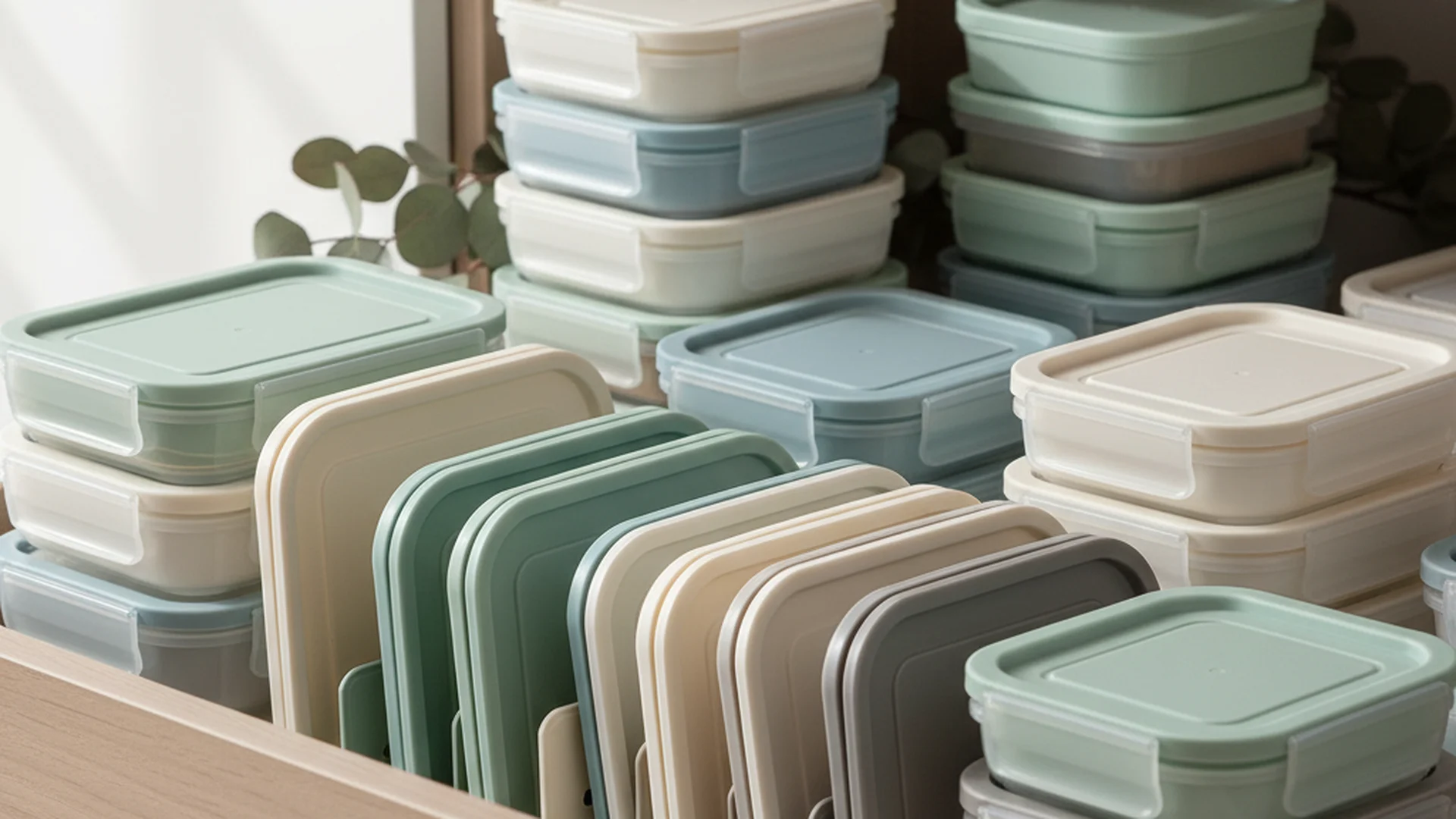
The golden rule of organization is: Never stack lids horizontally. When lids are stacked on top of each other, you have to dig through the pile to find the one at the bottom. Instead, store them vertically like files in a folder.
You can achieve this by using:
- Specialized Lid Organizers: These are adjustable racks designed to hold lids upright.
- Tension Rods: Place two small tension rods across a drawer to create a "lane" specifically for lids.
- Baskets or Bins: Use a narrow plastic bin to keep lids standing up within a larger drawer.
| Method | Best For | Space Efficiency |
|---|---|---|
| Lid Rack | Large Cabinets | High |
| Tension Rods | Deep Drawers | Very High |
| Nesting | Small Collections | Medium |
| Lids-On Storage | Large Walk-in Pantries | Low |
Nesting vs. Group Stacking
While nesting (putting smaller containers inside larger ones) saves space, it can become a hassle if you have to unstack six items to get to the one you need. A better approach is "Group Stacking." Stack 3-4 containers of the exact same size together. This ensures that every item in the stack is exactly what you need.
Note: If you are using glass containers, place a piece of felt or a paper towel between them when nesting to prevent chipping or "locking" together.
Real-World Examples of Organized Success
Example 1: The Busy Parent (The Standardization Pro)
Emily, a mother of three, struggled with morning lunch-packing chaos. She replaced her mismatched collection with 24 identical BPA-free plastic containers. Because every lid fit every container, she could grab any base and any lid blindly. By standardizing, she cut her packing time by 10 minutes every morning.
Example 2: The Apartment Dweller (The Vertical Master)
Living in a studio with only three kitchen cabinets, Mark used the "Tension Rod" hack. He dedicated one-third of his bottom drawer to a "lid lane" using two rods. This allowed him to nest his containers in the remaining two-thirds of the drawer, effectively doubling his usable storage space.
Example 3: The Sustainable Meal Prepper (The Glass Shift)
In line with 2025-2026 trends, Sarah transitioned entirely to glass. She used "Smart Lids" with QR codes. When she prepped her Sunday meals, she scanned the lid to log the contents and expiration date. Her phone notified her on Thursday when her leftovers were about to spoil, noticeably reducing her household food waste.
2026 Trends: The Future of Food Storage
The world of kitchen organization is evolving. If you are looking for modern organize tupperware ideas, consider these upcoming trends:
- Invisible Organization: New kitchen designs are featuring "clutter stations"—hidden pull-out drawers that look like part of the cabinetry but reveal tiered storage for containers when opened.
- Silicone "Forever" Bags: Brands like Stasher are replacing bulky plastic bins. These silicone bags are dishwasher safe and can be stored flat or hanging, taking up 80% less space than traditional Tupperware.
- Aesthetic Uniformity: The "Clean Girl" aesthetic has moved into the kitchen. Many are ditching multi-colored lids for uniform shades of sage, charcoal, or clear glass to reduce "visual noise" inside the cabinets.
Success: Transitioning to uniform glass containers not only looks better but also prevents the absorption of odors and stains, making your organization system last longer.
Common Mistakes to Avoid
- Buying Organizers First: Never buy a lid rack or a carousel before you have purged your collection. You will likely end up with an organizer that doesn't fit your specific containers. Measure first, buy last.
- Mixing Shapes: Round containers are classic, but they create "dead zones" in the corners of your cabinets. Rectangular and square containers are much more space-efficient.
- The "Just in Case" Trap: Keeping a lid for a container you think might be in the dishwasher is how clutter starts. If the base isn't found within one week, recycle the lid.
- Stacking Too High: Any stack taller than five containers is a safety hazard. If you have to stack that high, you either have too much Tupperware or you need more shelving.
Frequently Asked Questions
Should I store containers with the lids on or off?
How do I stop my Tupperware from smelling like old food?
How many containers do I actually need?
Is glass better than plastic for organization?
Conclusion
Organizing your food storage doesn't have to be a daunting task. By applying the "Match or Trash" method, standardizing your brands, and utilizing vertical storage for lids, you can transform a chaotic cabinet into a functional workspace. Not only will this save you time and money by reducing food waste, but it will also eliminate the daily stress of the "Tupperware avalanche."
Spend 15 minutes today auditing your current collection. You might find that the best way to organize tupperware in your home is simply to own less of it, but of a higher, more uniform quality.
Cleaning that keeps score
Every task earns points, every streak multiplies them, and Premium adds a household leaderboard plus a monthly Dustagorgon to beat.
- Free forever
- 30 badges to earn
- Up to 6 in a household
No card needed. Set up your rooms in a couple of minutes.