In this article
What you’ll learn
- Implement a dedicated drying zone to prevent odor and gear degradation.
- Utilize vertical space and clear bins to reduce "clutter cost" and search time.
- Conduct end-of-season audits to remove outgrown items and maintain efficiency.
For many families, the garage or mudroom often looks more like a chaotic locker room after a championship loss than a functional part of the home. Between soccer cleats, hockey pads, and a literal mountain of basketballs, learning how to organize sports equipment has become a survival skill for the modern parent. With the average U.S. family now spending over $1,000 per child annually on sports, your gear isn't just "stuff"—it is a significant financial investment that deserves a proper management system.
Why Organization is a Financial Priority
In my years as a professional cleaning consultant, I’ve seen how "clutter creep" can quietly drain a family’s bank account. When you can’t find a shin guard ten minutes before practice, you end up buying a duplicate. When a $200 helmet is left at the bottom of a heavy pile, its structural integrity is compromised.
The stakes are higher than just aesthetics. Research shows that high-quality gear like pads and helmets can lose up to 20% of their effectiveness in a single off-season if stored in humid, non-climate-controlled environments. Proper storage isn't just about neatness; it's about safety and performance. Furthermore, professional organizers estimate that the "clutter cost"—the time spent hunting for misplaced items—totals nearly 15 hours a year for the average active family.
The Foundation: The "Drying Zone" Strategy
The biggest enemy of sports equipment isn't a lack of space; it’s moisture. Bacteria trapped in sweat and dampness cause the infamous "sports smell" and lead to the premature breakdown of fabrics.
Creating Your Staging Area
Before any piece of gear goes into a permanent bin or onto a shelf, it must pass through a drying zone. This should be a well-ventilated area, preferably near the entry point of your home.
- Mesh Shelving: Use wire or plastic mesh racks that allow air to circulate around the entire object.
- Dedicated Fans: A small, high-velocity floor fan can dry a set of hockey pads or football cleats in a fraction of the time.
- The Golden Rule: Never store gear wet. This prevents "hockey rot" and keeps your storage area smelling fresh.
Warning: Storing damp gear in airtight plastic containers is a recipe for mold and permanent fabric damage. Always ensure items are bone-dry before long-term storage.
Maximizing Your Space with Smart Layouts
The best way organize sports equipment is to stop thinking horizontally and start thinking vertically. Floor space is precious, and piles are the enemy of visibility.
Vertical Slatwalls and Pegboards
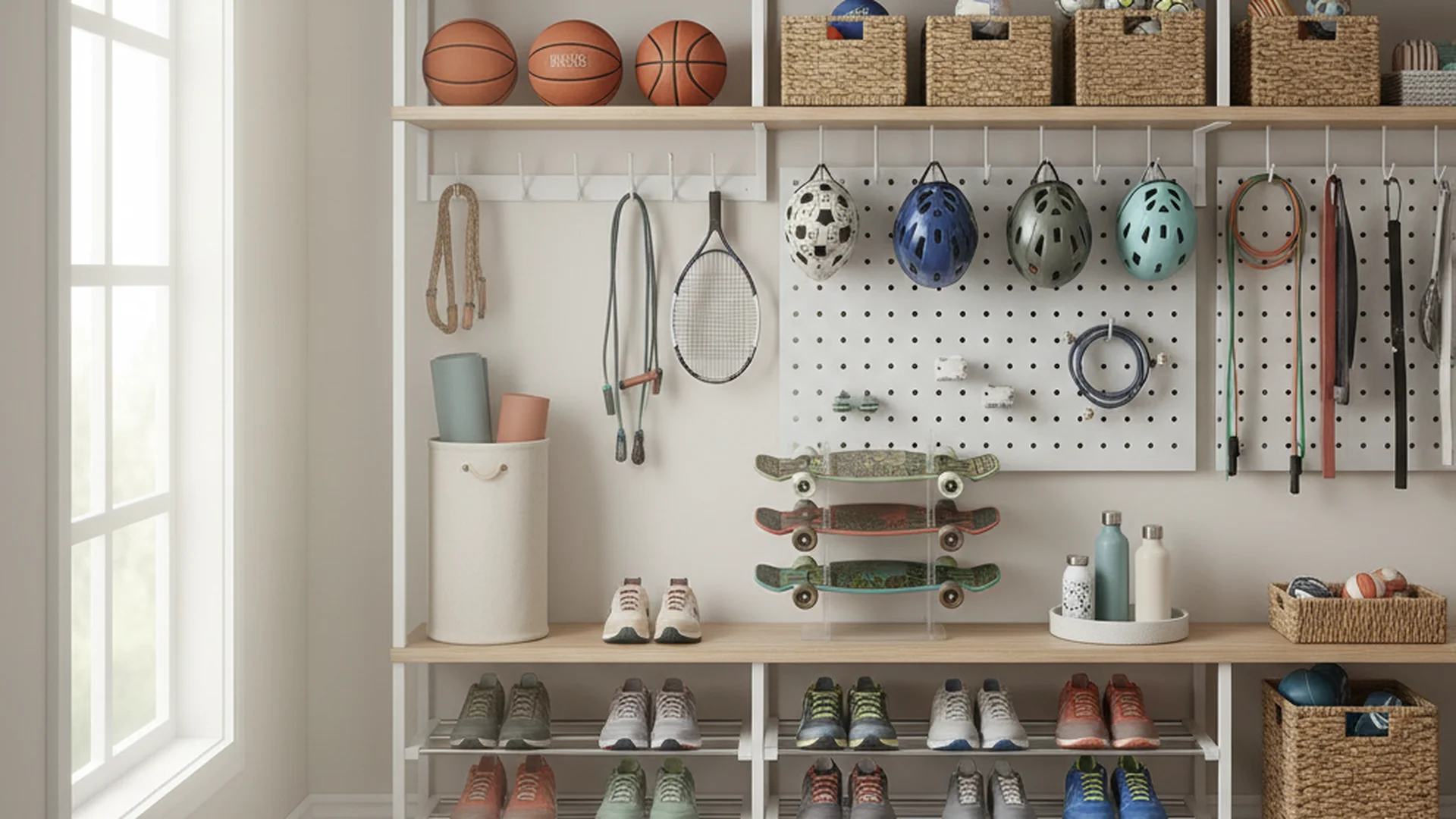
Slatwalls are the gold standard for 2025–2026 home organization. They allow you to swap out hooks, baskets, and racks as your children’s interests change. You can hang a baseball bat rack today and replace it with a ski holder next winter without drilling new holes.
The "Zoning" Strategy for Multiple Kids
If you have multiple children in different sports, "Zoning" is your best friend. Assign each child a specific color-coded area or locker.
- Child A (Soccer/Dance): Green bins and hooks.
- Child B (Baseball/Football): Blue bins and hooks.
- General Gear (Balls/Pumps): Neutral gray or clear bins.
Tip: Use clear bins instead of opaque ones. Being able to see that the "blue bin" contains soccer socks rather than baseball pants saves minutes of frustration during the morning rush.
Top Organize Sports Equipment Ideas for 2025
As we move into 2026, storage technology is evolving. We are seeing a shift toward smarter, more sustainable, and more specialized solutions.
Smart Lockers and UV-C Sanitization
One of the most exciting trends is the rise of residential "Smart Lockers." These units aren't just for storage; they feature built-in UV-C lights that kill 99% of bacteria and moisture sensors that alert your smartphone if your gear hasn't reached the optimal dryness level.
Magnetic Storage Solutions
For those with limited wall space, heavy-duty magnetic caddies are a game-changer. These can be attached to the side of a metal garage door, a spare refrigerator, or metal shelving units. They are perfect for small, easily lost items like whistles, stopwatches, wristbands, and air pump needles.
Eco-Conscious Materials
Homeowners are moving away from cheap, brittle plastics. Sustainable bamboo shelving and bins made from recycled ocean plastics are becoming the preferred choice for modern, eco-conscious mudrooms. These materials are often more durable and handle the weight of heavy gear better than traditional plastic.
| Storage Method | Best For | Pros | Cons |
|---|---|---|---|
| Slatwalls | Bats, Rackets, Sticks | Highly customizable | Requires professional-style install |
| Bungee Racks | Basketballs, Soccers balls | High visibility; easy access | Only works for spherical items |
| Clear Bins | Uniforms, Socks, Pads | Protects from dust; visible | Needs shelving to prevent stacking |
| Smart Lockers | High-end pads, Helmets | Sanitizes and dries | High initial investment |
Maintenance: The "One-Size-Up" Rule
Organization is not a one-time event; it is a process. To prevent "clutter creep," you must perform regular inventory audits.
The End-of-Season Purge
At the conclusion of every sports season, sit down with your child and go through every piece of gear. If it’s worn out, toss it. If it’s outgrown, use the "One-Size-Up" rule: unless you have a younger child who will definitely use it within 12 months, donate it or sell it immediately.
Success: Regular purging can reclaim up to 30% of your storage space, which is typically occupied by "just-in-case" gear that is never actually used.
Common Mistakes to Avoid
Even with the best intentions, many homeowners fall into traps that make their organization systems fail within weeks.
- Ignoring Temperature Fluctuations: Storing high-performance items like carbon-fiber tennis rackets or expensive leather baseball gloves in a non-insulated garage can lead to warping and cracking. High-value items should stay in a climate-controlled area.
- Storing Helmets on the Floor: Helmets are designed to withstand specific types of impact. When left on the floor, they are prone to being kicked, stepped on, or dropped, which can cause micro-fractures in the protective foam.
- The "Bucket" Fail: Deep, dark buckets are where sports gear goes to die. If an item is at the bottom of a 3-foot-deep bucket, your child will likely dump the entire bucket on the floor to find it, undoing all your hard work. Use shallow, tiered baskets instead.
Note: AI-assisted organization apps (like ChatGPT-Vision) can now help you map out your garage. Simply take a photo of your empty space and your pile of gear, and these tools can suggest the most efficient layout based on your specific dimensions.
Frequently Asked Questions
How do I stop my gear from smelling?
What is the best way to store sports balls?
Should I use clear or opaque bins?
How do I manage gear for multiple kids in a small space?
Conclusion
Mastering how to organize sports equipment is about more than just a tidy garage; it’s about reclaiming your time and protecting your financial investment. By implementing a drying zone, utilizing vertical slatwalls, and embracing new technologies like smart lockers or AI-assisted layouts, you can turn a chaotic equipment pile into a streamlined system that supports your family's active lifestyle.
Remember, the best system is the one your kids can actually use. Keep the most-used items at eye level, use clear containers for visibility, and never underestimate the power of a good end-of-season purge.
Success: A well-organized sports station can save your family up to 15 hours a year—time much better spent on the field than in the garage.
Cleaning that keeps score
Every task earns points, every streak multiplies them, and Premium adds a household leaderboard plus a monthly Dustagorgon to beat.
- Free forever
- 30 badges to earn
- Up to 6 in a household
No card needed. Set up your rooms in a couple of minutes.