In this article
What you’ll learn
- Organize by functional 'work zones' rather than item type.
- Declutter before buying any storage containers to avoid 'contained clutter.'
- Focus on vertical storage and high-frequency items at eye level.
For many of us, the kitchen is the undisputed heart of the home, but it is also a frequent source of hidden stress. If you find yourself hunting for a matching lid or digging through a "junk drawer" just to find a whisk, you aren't alone. Implementing the right kitchen organization ideas is more than just an aesthetic choice; it is a fundamental shift in how you experience your daily life. A disorganized kitchen can quietly affect your wellbeing too, keeping your stress levels raised and nudging you toward quicker, less considered food choices.
The Psychology of the Organized Kitchen
Before we dive into the "how-to," it is essential to understand the "why." A home holding far more objects than it has room for tends to feel tense rather than restful, and the kitchen is usually where that pressure shows up first. For a lot of people, a cluttered kitchen isn't just an eyesore—it’s a genuine physical stressor.
Plenty of homeowners point to kitchen clutter as their single biggest source of daily stress. A chaotic kitchen can also nudge you toward the easiest possible food, simply because the snack cupboard is the path of least resistance when every counter is covered. By streamlining your storage, you are quite literally creating a healthier environment for your body and mind.
Step 1: The Kitchen Census (The Purge)
The most common mistake homeowners make is buying beautiful bins and baskets before they have actually addressed the volume of their belongings. As a domestic efficiency specialist, I always tell my clients: "Organizing clutter is still clutter."
How to Conduct a Kitchen Audit
- Empty Every Cabinet: You cannot see the potential of a space while it is full of half-used spice jars and mismatched Tupperware.
- The 12-Month Rule: If you haven't used a specific gadget (looking at you, avocado slicer) in the last year, it is time to donate or sell it.
- Check Expiration Dates: You would be surprised how many "pantry staples" expired three years ago.
- Group Like with Like: Place all baking supplies together, all pastas together, and all cleaning supplies together on your floor or table to see the total volume.
Warning: Never buy organizational products before measuring your cabinet depth and shelf height. There is nothing more frustrating than an "aesthetic" bin that prevents a cabinet door from closing.
Step 2: Implementing Work Zones (The Golden Triangle 2.0)
For decades, designers focused on the "Golden Triangle"—the path between the sink, fridge, and stove. While still relevant, 2025 trends have shifted toward "Work Stations." This allows multiple people to work in the kitchen without crossing paths.
The Prep Zone
This should be located near your primary counter space. It should house:
- Knives and cutting boards.
- Mixing bowls.
- Measuring cups and spoons.
- Peelers and graters.
The Cooking Zone
Located directly around the stove and oven, this zone needs:
- Pots and pans.
- Stirring spoons and spatulas.
- Essential oils and frequently used spices.
- Pot holders and trivets.
The Cleaning Zone
Centered around the sink and dishwasher, this area should contain:
- Dish soap and sponges.
- Trash and recycling bins.
- Dish towels.
The Storage & Coffee Zone
This is where your fridge and pantry live. Many homeowners are now adding a dedicated "Coffee Station" or "Appliance Garage" to keep the main countertops clear.
Tip: Store daily items like coffee mugs and everyday plates between hip and eye level. Move seasonal items, like turkey roasters or holiday platters, to the highest, hardest-to-reach shelves.
Step 3: DIY Kitchen Organization Ideas for Small Budgets
You don't need a $60,000 renovation to achieve a professional look. If you are looking for budget kitchen organization ideas, creativity is your best tool.
The Power of the Pegboard
Inspired by the legendary Julia Child, a wall-mounted pegboard is one of the most effective diy kitchen organization ideas. It moves bulky pots and pans out of cramped cabinets and onto the wall, turning your cookware into a functional art piece.
Repurposing Household Items
- Magazine Files: Use these to store rolls of aluminum foil, plastic wrap, and parchment paper inside a cabinet door.
- Tension Rods: Place a tension rod under your sink to hang spray bottles, or use them vertically in a cabinet to create "slots" for baking sheets and cutting boards.
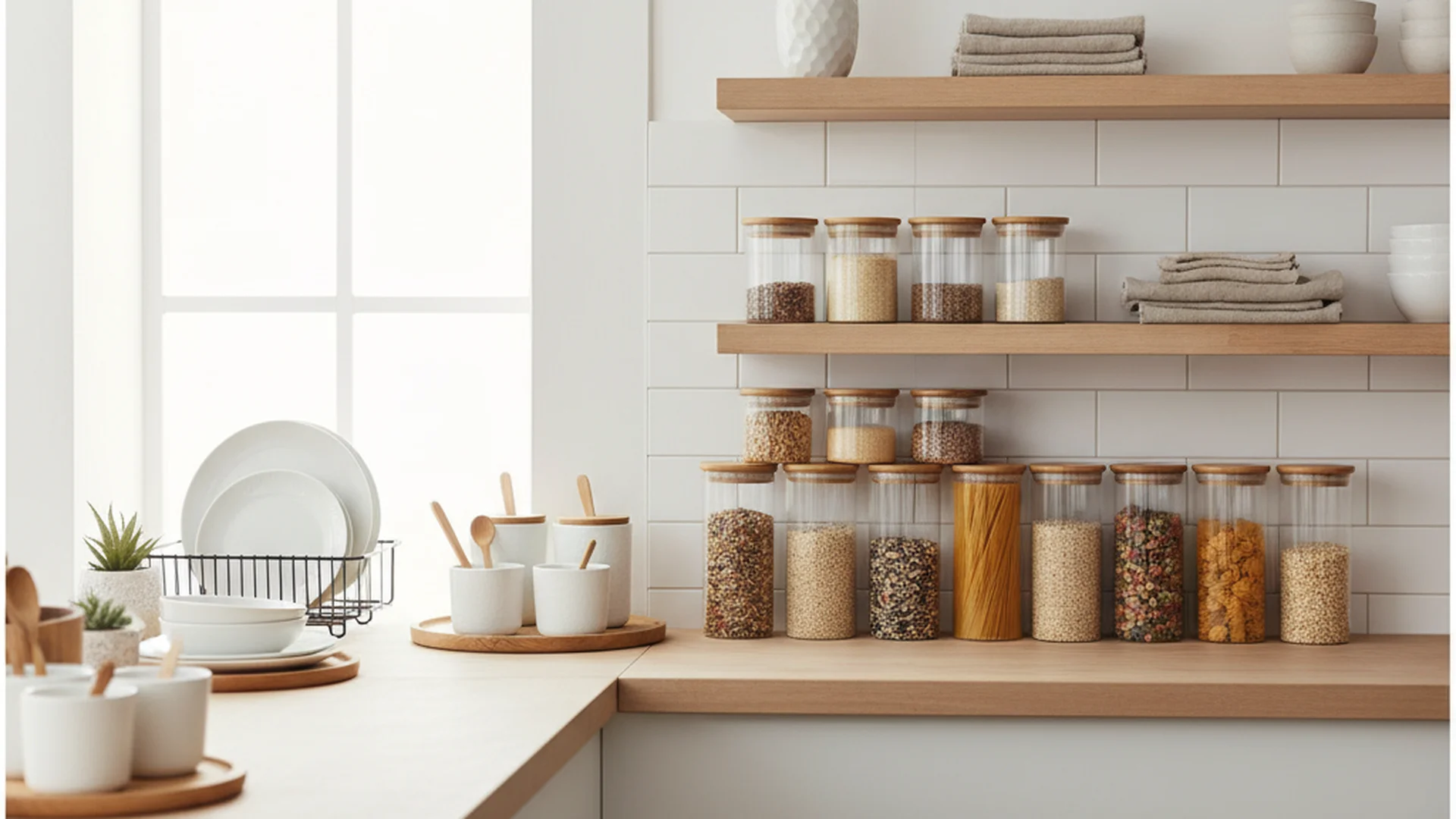
- Mason Jars: Use old jars for dried beans, rice, or even to hold small snacks.
Note: Sustainable materials like bamboo and glass are the fastest-growing segment in kitchen storage for 2025. They are more durable than plastic and offer a timeless, high-end look on a budget.
| Material | Durability | Eco-Friendliness | Best For |
|---|---|---|---|
| Plastic | Medium | Low | Fridge/Freezer |
| Bamboo | High | High | Drawer Dividers |
| Glass | High | High | Dry Goods/Pantry |
| Wire | High | Medium | Fruit/Root Veggies |
Step 4: Verticality and Hidden Storage
If you have a small kitchen, you must stop thinking about floor space and start thinking about wall space. "Verticality is King" in 2026 kitchen design.
Deep Drawer Organizers
Deep drawers are replacing traditional lower cabinets because they allow you to see everything from above without kneeling. Use adjustable dividers to keep stacks of plates or heavy pots from sliding around.
Over-the-Door Racks
The back of your pantry door is prime real estate. An over-the-door rack can hold an entire spice collection or serve as a "grab-and-go" snack station for kids.
The Corner Cabinet Solution
Corner cabinets are notorious "black holes." To fix this, consider a "Lazy Susan" for smaller items or a "blind corner" pull-out rack for heavy mixers or Dutch ovens.
Success: Utilizing vertical space can increase your storage capacity by up to 30% without adding a single square foot to your kitchen's footprint.
Future-Proofing: Trends for 2025 & 2026
The next two years see a departure from the "all-white minimalism" of the past decade. Instead, we are seeing a move toward "Warm Functionality."
Sculleries and Back Kitchens
A major trend for 2026 is the "Back Kitchen." This is a smaller, walk-in prep pantry where the messy work (chopping, blending, dishwasher loading) happens. This allows the main kitchen to remain a clean "experience zone" for entertaining.
Smart Inventory Systems
AI-enabled pantries are now a reality. Smart sensors can track your staples and notify your phone when you are low on flour or when the milk is nearing its expiration date. While a higher investment, these systems significantly reduce food waste.
Appliance Garages
To meet the goal of clear countertops—a priority for most homeowners—appliance garages are a must-have. These are counter-level cabinets with sliding or "garage-style" doors that hide your toaster, air fryer, and coffee maker when not in use.
Common Mistakes to Avoid
Even with the best intentions, it's easy to fall into organizational traps. Here are the most common pitfalls:
- Over-Decanting: While matching glass jars look stunning on Instagram, decanting everything (like specialized pastas or rare flours) is a maintenance nightmare. Stick to high-volume staples like flour, sugar, cereal, and coffee.
- Forgetting the "Trash Path": Many people place their trash can in a spot that blocks the flow of the Cooking Zone. Ensure your trash is easily accessible from both the Prep and Cleaning zones.
- The "Open Shelf" Trap: Designers now warn that many homeowners find open shelving impractical due to dust and the constant need for "perfect" arrangement. If you choose open shelves, use them for items you use daily to prevent dust buildup.
- Ignoring the "Golden Rule" of Containers: Always choose square or rectangular containers over round ones. Round containers leave "dead space" in the corners of your cabinets, wasting up to 25% of your storage area.
Frequently Asked Questions
How do I organize a small kitchen on a budget?
Where do I start when my kitchen is overwhelming?
How do I organize deep corner cabinets?
Should I decant all my dry goods into jars?
How do I keep my countertops clear?
Conclusion
Transforming your kitchen through smart kitchen organization ideas is an investment in your mental well-being and your home's value. By moving away from "contained clutter" and toward a system based on functional work zones and sustainable materials, you create a space that works for you, rather than against you. Remember, the goal isn't a "perfect" kitchen—it's a kitchen that allows you to cook, eat, and live with ease.
Success: Following the "Work Zone" and "Frequency of Use" rules will significantly reduce the time you spend searching for items, making meal prep faster and more enjoyable.
Cleaning that keeps score
Every task earns points, every streak multiplies them, and Premium adds a household leaderboard plus a monthly Dustagorgon to beat.
- Free forever
- 30 badges to earn
- Up to 6 in a household
No card needed. Set up your rooms in a couple of minutes.