In this article
What you’ll learn
- Clean high-traffic handles daily and interior handles weekly.
- Use material-specific methods for brass, steel, and chrome to avoid damage.
- Never spray cleaners directly into the handle mechanism.
Every time you move through your home or office, you are engaging with one of the most significant "high-touch fomites" in existence: the door handle. While we often focus on scrubbing floors or wiping down countertops, learning how to clean door handles is actually one of the most impactful things you can do for your environment's hygiene. Recent 2025 data indicates that the average person touches their face nearly 16 times per hour after touching common surfaces, making these metal fixtures a primary bridge for pathogens.
Whether you are looking for the best way how to clean door handles to protect your family's health or you simply want to restore the luster to a tarnished brass fixture, this guide provides a comprehensive, professional-grade framework. From the antimicrobial properties of copper to the latest in UV-C sterilization technology, we will cover everything you need to know to keep your hardware pristine and germ-free.
The Science of Door Handle Hygiene
Before we dive into the "how-to," it is crucial to understand the "why." Door handles are not just pieces of hardware; they are biological hubs. A 2025 global systematic review revealed that the pooled prevalence of microbial contamination on door handles sits at approximately 9.66%. However, this number jumps significantly in high-risk zones. For instance, bathroom and toilet handles have a contamination rate of 23.04%.
Interestingly, viruses are more common on these surfaces than bacteria, appearing on 17.73% of handles compared to 6.20% for bacteria. Rotavirus and Norovirus are the most frequent culprits. This makes a regular cleaning schedule not just an aesthetic choice, but a health necessity.
Note: If you have solid brass or copper handles, you have a natural advantage. These materials exhibit the "oligodynamic effect," meaning they can self-disinfect and kill most bacteria within 8 hours.
How to Clean Door Handles Quickly: The 30-Second Wipe
If you are short on time and need to know how to clean door handles quickly, follow this professional "Quick Clean" workflow. This method is safe for almost all materials and is ideal for daily maintenance.
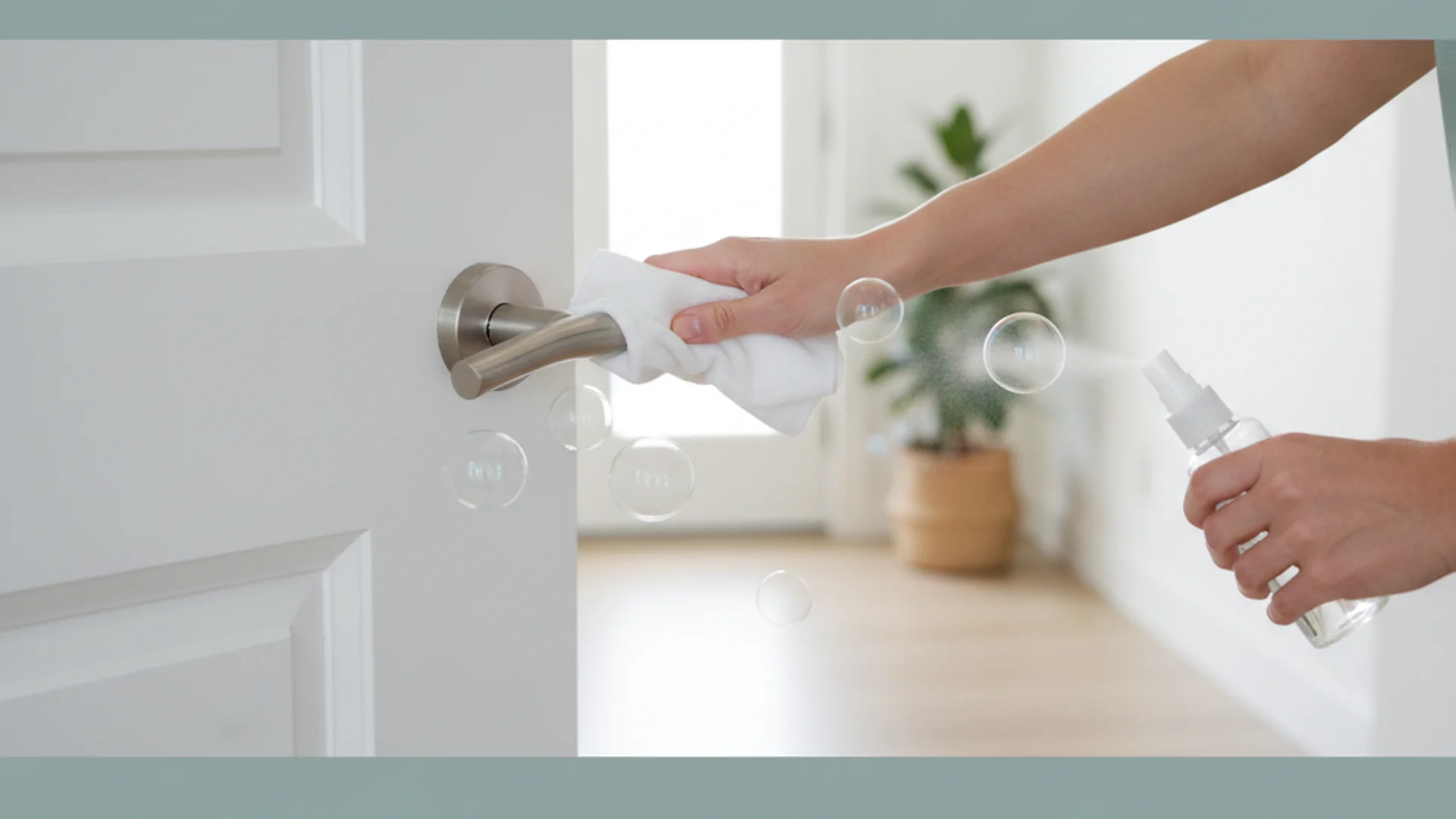
- Dampen, Don’t Soak: Take a high-quality microfiber cloth and dampen it with warm, soapy water.
- The Full Wrap: Wrap the cloth around the handle and rotate it firmly.
- The Rose and Latch: Don't forget to wipe the "rose" (the backplate attached to the door) and the edge of the door where the latch sits.
- Dry Immediately: Use a secondary, dry microfiber cloth to buff the handle. This prevents water spots and streaks, especially on polished finishes.
Tip: Keep a dedicated microfiber cloth near high-traffic areas like the kitchen or entryway for a 10-second "swipe-and-go" clean every evening.
Material-Specific Deep Cleaning Methods
To achieve the best way how to clean door handles, you must tailor your approach to the material. Using the wrong chemical on a premium finish can lead to permanent pitting or stripping.
Brass, Bronze, and Copper
These materials are often "living finishes," meaning they change over time.
- The Method: Create a paste using lemon juice and baking soda (or vinegar, salt, and flour).
- The Process: Apply the paste to the handle, let it sit for 2–3 minutes, and then buff it off with a soft cloth.
- Example 1: A homeowner in a historic 1920s Victorian home noticed their unlacquered brass handles had turned almost black. By using a lemon-baking soda paste, they restored the original golden glow without using harsh industrial strippers.
Stainless Steel
Stainless steel is durable but shows fingerprints easily.
- The Method: Mild dish soap for cleaning, followed by a 50/50 mix of white vinegar and olive oil for polishing.
- The Process: The vinegar acts as a degreaser to remove skin oils, while the olive oil provides a protective, smudge-resistant shine.
Chrome and Nickel
These are prone to water spots and can lose their mirror-like finish if cleaned with abrasives.
- The Method: A simple vinegar-water solution.
- The Process: After cleaning, apply a single drop of baby oil to a cloth and buff the handle. This creates a microscopic barrier that repels water and fingerprints.
| Material | Best Cleaning Agent | Polish Tip |
|---|---|---|
| Brass | Lemon & Baking Soda | Microfiber Buff |
| Steel | Vinegar & Water | Olive Oil |
| Chrome | Diluted Vinegar | Baby Oil |
| Wood | pH-Neutral Soap | Wax-based Polish |
Warning: Never use bleach on stainless steel or brass. It can cause permanent "pitting" (small holes) in steel and will strip the protective lacquer off brass.
Common Mistakes to Avoid
Even professional cleaners sometimes make mistakes that can shorten the lifespan of door hardware.
- Spraying Directly on the Handle: This is the most common error. Liquid can seep into the internal lock cylinder or the spring mechanism, leading to rust, "crunchy" movement, or total mechanical failure. Always spray your cloth first.
- Using Abrasive Pads: The "green side" of a kitchen sponge or steel wool will create micro-scratches. These scratches don't just look bad; they act as tiny canyons where bacteria can hide from future cleanings.
- Cleaning in Direct Sunlight: If you are cleaning exterior handles on a hot summer day, the cleaning solution can "burn" into the metal, leaving permanent chemical streaks.
- Example 2: A local boutique hotel once used abrasive scouring pads on their matte black handles. Within a week, the finish began to flake off, requiring a total replacement of hardware across 40 rooms.
Success: By spraying the cloth rather than the handle, you protect the internal mechanics and ensure your door locks work smoothly for decades.
Advanced Maintenance: The Latch and the Mechanism
Cleaning isn't just about the surface. To truly maintain your door hardware, you must look at the moving parts. The "latch bolt"—the part that retracts when you turn the handle—often accumulates a "black gunk" which is a mix of metal dust and old grease.
- The Pro Tip: Once a year, wipe the latch bolt clean and apply a tiny amount of lithium grease or graphite lubricant. This ensures a smooth, quiet operation.
- Example 3: In a high-traffic medical office, handles were sticking and squeaking, causing disruption. After a deep clean of the exterior and a quick application of dry graphite lubricant to the internal latch, the handles functioned like new, saving the office thousands in replacement costs.
2025-2026 Trends in Door Hygiene
The industry has moved toward "set it and forget it" hygiene. If you are replacing hardware, consider these modern updates:
- Antimicrobial Nano-Coatings: Many 2025 models now come with silver-ion coatings that naturally destroy 99.9% of microbes on contact.
- Probiotic Cleaners: These are the latest trend in sustainable cleaning. These solutions contain "good" bacteria that stay on the handle after you wipe, continuing to consume organic grime for days.
- UV-C Integration: In luxury settings, handles now feature integrated UV-C LED rings that activate for 10 seconds after each use to sterilize the surface automatically.
Frequently Asked Questions
How often should I clean my door handles?
Can I use rubbing alcohol to disinfect handles?
How do I tell if my handle is real brass or just plated?
Why do my matte black handles look cloudy?
Conclusion
Mastering how to clean door handles is a small task that yields significant rewards in both home aesthetics and family health. By identifying your material—whether it's the self-disinfecting power of brass or the sleek durability of stainless steel—and using the correct pH-balanced approach, you can preserve your hardware's finish for a lifetime. Remember, the best way how to clean door handles involves a balance of regular disinfection and gentle mechanical care.
Success: Regular maintenance not only keeps your home germ-free but also prevents the costly replacement of tarnished or corroded hardware.
Cleaning that keeps score
Every task earns points, every streak multiplies them, and Premium adds a household leaderboard plus a monthly Dustagorgon to beat.
- Free forever
- 30 badges to earn
- Up to 6 in a household
No card needed. Set up your rooms in a couple of minutes.