In this article
What you’ll learn
- Clean your juicer immediately to prevent pulp from becoming "organic cement."
- White vinegar kills 98.6% of household microbes and descales mesh screens.
- 2025 trends like ultrasonic cleaning are revolutionizing juicer maintenance.
For many health enthusiasts, the vibrant glow of a fresh green juice is often dimmed by the looming shadow of the kitchen sink. We have all been there: you finish your nutrient-dense drink, only to look at the countertop and see a machine caked in fibrous debris. Learning how to clean juicer pulp efficiently is the difference between a daily habit that sticks and a $400 appliance gathering dust in the pantry. As a professional cleaning consultant, I have seen how quickly "organic cement" can ruin a machine, but with the right non-toxic techniques, you can master the cleanup in under a minute.
The Invisible Threat: Why "Rinsing" Isn't Enough
While the visible fibers are annoying, the real reason you need to know how to clean juicer pulp properly is microscopic. Juicers are a prime environment for bacterial growth. Because they process raw produce that grows in soil, they can harbor pathogens like Listeria and Salmonella.
Research from the University of Valencia found that between 14% and 23% of juicers in professional settings were contaminated due to insufficient cleaning. Furthermore, if pulp is left to dry, it creates a "biofilm." This is a colony of microorganisms that sticks to the mesh screen and becomes 100 to 1,000 times more resistant to cleaning agents than free-floating bacteria.
Warning: Never let your juicer parts soak overnight in plain water. This creates a stagnant environment that actually encourages bacterial blooming rather than preventing it.
The "60-Second Rule" and Daily Maintenance
The secret to an easy cleanup is the "60-Second Rule." You must clean your juicer immediately after the last drop of juice hits your glass. When the pulp is wet, it lacks structural integrity and can be rinsed away with high-pressure tap water. Once it dries, the natural sugars and pectins act as a glue.
Step-by-Step Rapid Clean
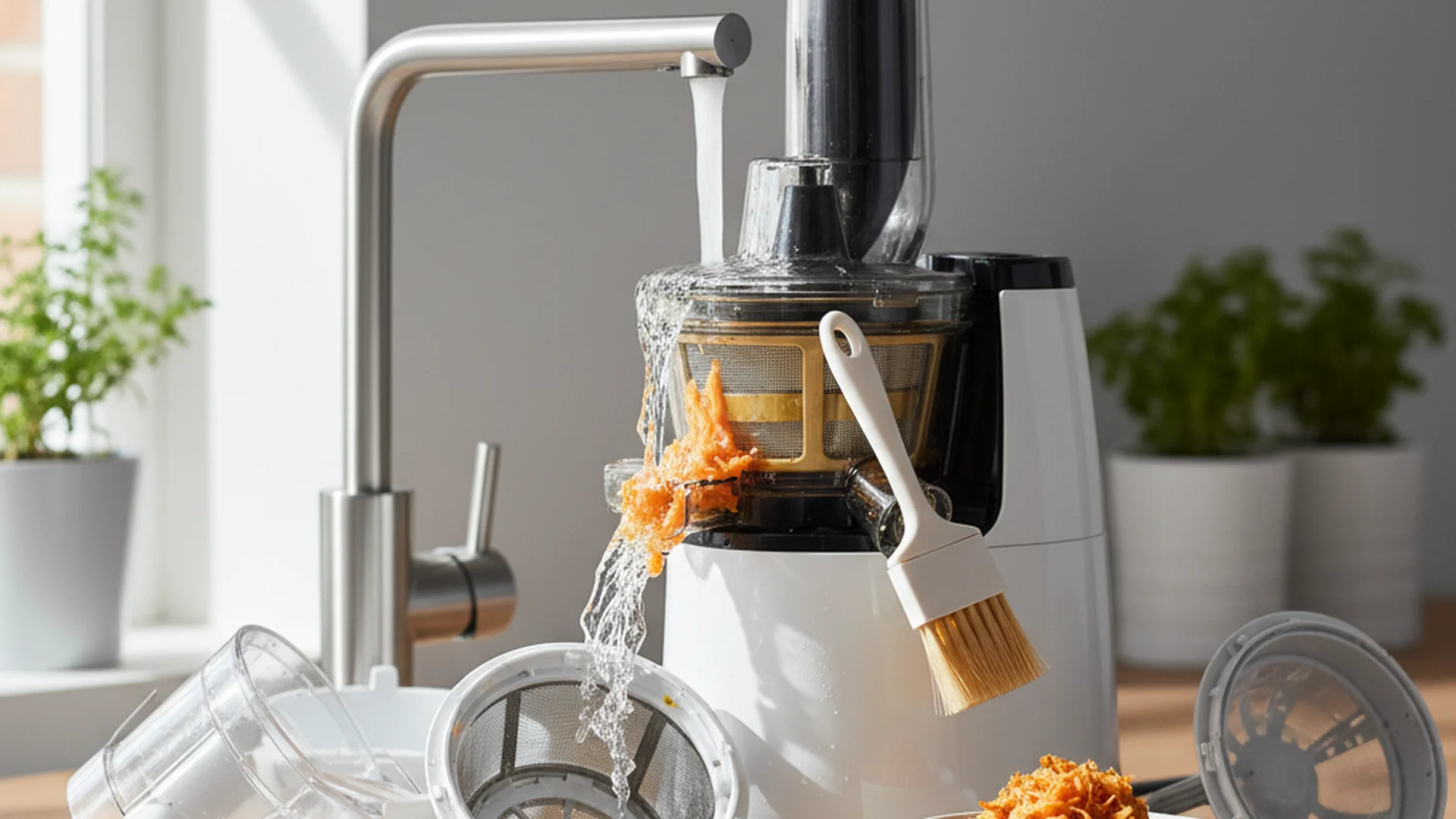
- The Auto-Clean Hack: If you have a vertical juicer with a juice cap, close it once you are done. Pour 16oz of warm water into the hopper while the motor is running. Let it "juice" the water for 30 seconds. This flushes out the majority of the pulp before you even disassemble it.
- Disassemble: Take the machine apart immediately.
- The Power Rinse: Use a high-pressure faucet setting to blast the pulp out of the mesh filter and the pulp chute.
- Soft Brush Scrub: Use a dedicated nylon brush to quickly swipe the mesh screen.
Tip: Keep a dedicated dish brush or an old toothbrush specifically for your juicer. Standard sponges often get torn apart by the sharp edges of the juicer blades.
How to Clean Juicer Pulp Without Chemicals
Many people are hesitant to use harsh detergents on a machine that processes raw food. Fortunately, you can effectively clean juicer pulp without chemicals by using household staples like white vinegar and baking soda.
The Power of Vinegar
If you are wondering how to clean juicer pulp vinegar style, the science is on your side. White vinegar is an acetic acid that kills approximately 98.6% of common household microbes, including E. coli. It is also a natural descaler, which is essential if you have hard water that leaves mineral deposits on your filter.
The Baking Soda Solution
Baking soda is a mild abrasive and a powerful deodorizer. Research indicates that a baking soda solution can kill 99.99% of certain viruses and bacteria within just one minute of contact.
| Cleaning Agent | Primary Benefit | Best Used For |
|---|---|---|
| White Vinegar | Disinfection & Descaling | Clogged mesh screens and mineral buildup |
| Baking Soda | Deodorizing & Gentle Abrasion | Removing odors and scrubbing stains |
| Vegetable Oil | Pigment Lifting | Removing orange stains from carrots and beets |
| Lemon Juice | Natural Bleaching | Brightening stained plastic components |
Real-World Examples of Pulp Problems
Example 1: The "Morning Commuter" Scenario
Sarah juices every morning before work. She used to leave her juicer in the sink to "soak" until she got home at 5 PM. By then, the pulp had turned into a hard crust. By switching to the "Auto-Clean Hack" (running water through the machine before leaving), she reduced her evening scrubbing time from 15 minutes to 30 seconds.
Example 2: The Beet Stain Crisis
Mark noticed his clear plastic juicer housing was turning a permanent shade of pink from beet juice. Instead of using bleach, he applied a small amount of vegetable oil to a paper towel and wiped the plastic. The oil lifted the fat-soluble pigments, and a quick rinse with warm soapy water left the machine looking brand new.
Example 3: The Clogged Screen Mystery
A client complained that their juicer's yield had dropped by 30%. Upon inspection, the mesh screen looked clean but felt "waxy." This was a buildup of fruit pectins and hard water minerals. A 30-minute soak in a 1:1 water-to-vinegar solution dissolved the invisible film, restoring the machine's efficiency immediately.
Success: Regularly using vinegar not only cleans but also extends the life of your motor by reducing the strain caused by clogged filters.
2025 Trends in Juicer Cleaning
As we move into 2025 and 2026, technology is finally catching up to the "pulp problem." If you are in the market for a new machine or want to upgrade your cleaning kit, look for these trends:
- Ultrasonic Cleaning: High-frequency sound waves are the latest trend for cleaning mesh screens. Small home ultrasonic baths can vibrate every microscopic particle of pulp out of the filter holes without any manual scrubbing.
- Screenless Technology: Brands like Hurom have pioneered "Easy-Clean" strainers. These replace the traditional mesh (with thousands of holes) with two interlocking grooved pieces that simply rinse clean under the tap.
- UV-C Sanitization: New kitchen drying racks now include UV-C lights. This ensures that after you wash your juicer, any remaining microbes are neutralized during the drying process, preventing the formation of biofilms.
Common Mistakes to Avoid
- Using Abrasive Pads: Never use green "Scotch-Brite" style pads. They create microscopic scratches in the plastic which then harbor bacteria and make the machine harder to clean over time.
- Ignoring the Motor Base: Juice often drips into the gear area. Wipe this down daily with a vinegar-dampened microfiber cloth to prevent the motor from seizing.
- The Dishwasher Trap: While many parts are "top-rack safe," the high heat of modern dishwashers can warp plastic and dull the stainless steel blades over time. Hand-washing is always the better choice for longevity.
Note: If you use your juicer for heavy greens like kale or spinach, the "stringy" fibers can wrap around the augur. Always use a brush to clear these out, as they can cause the machine to overheat.
Frequently Asked Questions
Can I put my juicer parts in the dishwasher?
How do I get rid of orange carrot or beet stains?
Why is my juicer screen still clogged after scrubbing?
Is juicer pulp "clean" enough to eat or reuse?
Conclusion
Cleaning your juicer doesn't have to be a deterrent to your health goals. By implementing the 60-second rule and utilizing natural solutions like vinegar and baking soda, you can keep your machine hygienic and high-performing. Remember, the key is to act while the pulp is wet and to perform a deep vinegar soak once a week to prevent mineral buildup.
Success: A clean juicer produces better-tasting juice and lasts twice as long as a neglected one.
Cleaning that keeps score
Every task earns points, every streak multiplies them, and Premium adds a household leaderboard plus a monthly Dustagorgon to beat.
- Free forever
- 30 badges to earn
- Up to 6 in a household
No card needed. Set up your rooms in a couple of minutes.