In this article
What you’ll learn
- Clean within 90 seconds of use to prevent oil polymerization.
- Citric acid and baking soda are more effective than vinegar for removing coffee residue.
- Never use metal spoons or abrasive pads on borosilicate glass.
There is nothing quite like the rich, full-bodied flavor of a French press coffee. However, that richness comes from a high concentration of natural oils—the very same oils that can turn your morning ritual into a bitter experience if you don’t know how to clean french press equipment properly. Many coffee lovers assume a quick rinse is enough, but invisible residues are quietly sabotaging your brew.
Maintaining a French press isn't just about aesthetics; it’s about chemistry and hygiene. The window for effective cleaning is much smaller than most people realize. In this guide, we will break down the science of coffee residue and provide a step-by-step masterclass on keeping your brewer in "factory-silver" condition.
The Science of the "Dirty" Press
To understand why a deep clean is necessary, we have to look at the biology of the coffee bean. Coffee beans are composed of 10% to 17% lipids (oils) by dry weight. Unlike paper filters used in pour-over methods, which trap nearly 99% of these oils, a French press allows them to pass directly into your cup and onto the surfaces of your carafe.
The 90-Second Critical Window
The easiest window for cleaning is narrow—call it the "90-Second Critical Window." Once your coffee temperature drops below 70°C (158°F), the oils begin a process called polymerization. This is where the oils harden into a stubborn, varnish-like film. If you leave your French press sitting on the counter for an hour after breakfast, you aren't just dealing with wet grounds; you are dealing with a chemical bond that is significantly harder to break.
Bacterial Biofilms and Health
It’s not just about flavor. The complex multi-part mesh of the plunger is an ideal breeding ground for microbial deposits. If not sanitized daily, bacterial biofilms can form within the weave of the stainless steel. Furthermore, while French press coffee contains higher concentrations of cafestol (a compound that can raise cholesterol), a dirty press allows these compounds to accumulate and oxidize, creating a rancid environment for your next brew.
The Daily "45-Second" Defense
You don't need a full chemistry set every morning. To prevent oil polymerization, follow this "45-Second Defense" immediately after you pour your last cup.
- Dump the Grounds: Use a wooden or plastic spatula to scoop the grounds into your compost or trash.
- The Quick Agitation: Fill the carafe one-third of the way with hot water. Insert the plunger and move it up and down rapidly 3–5 times. This physical agitation breaks the surface tension of the oils before they can bond to the glass.
- The Microfiber Wipe: After rinsing, use a dry microfiber cloth to wipe the interior. This removes the "hydrophobic film" that water alone cannot touch.
Warning: Never use a metal spoon to scrape out grounds. Borosilicate glass is heat-resistant but vulnerable to impact. Small scratches from metal utensils can lead to the carafe shattering unexpectedly during a high-heat brew.
How to Clean French Press Without Chemicals
Many users want to clean french press without chemicals to ensure no soapy aftertaste lingers in their coffee. While dish soap is a fine degreaser, it often fails to penetrate the mesh screen.
The Baking Soda Method
A baking soda soak is incredibly effective. By mixing 2 tablespoons of baking soda with 500ml of hot water, you can lift the great majority of oxidized oils.
- Step 1: Add baking soda to the carafe.
- Step 2: Fill with hot water and insert the plunger.
- Step 3: Let it sit for 10 minutes, then plunge and rinse.
The Citric Acid Shift (The 2025 Trend)
In the past, the go-to advice was to clean french press vinegar solutions. however, 2025 trends show a massive shift toward citric acid. Why? Vinegar leaves a persistent, pungent aroma (often described as "feet-like") that can absorb into the silicone seals of your press. Citric acid is odorless, tasteless, and significantly more effective at breaking down mineral scale and protein deposits.
| Cleaning Agent | Oil Removal Efficacy | Odor Residue |
|---|---|---|
| Vinegar | 68% | High |
| Baking Soda | 92% | None |
| Citric Acid | 95% | None |
| Dish Soap | 75% | Moderate |
Step-by-Step: The Weekly Deep Clean
Every 5–7 uses, you must perform a full disassembly. This is the only way to reach the "fines" (micro-grounds) trapped between the mesh layers.
1. Complete Disassembly
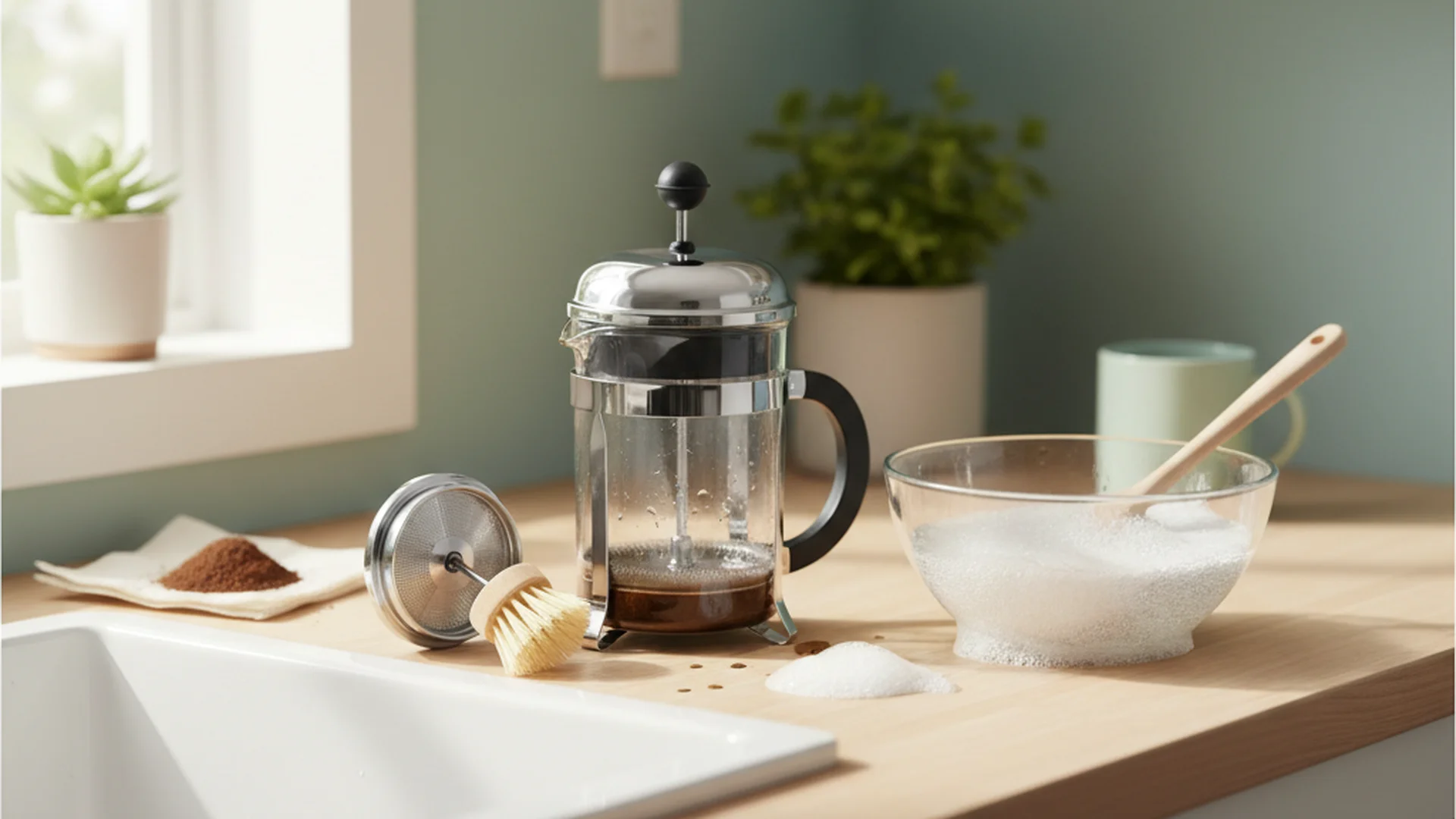
Unscrew the plunger rod from the base. You should have four separate pieces: the spiral plate, the mesh screen, the cross plate, and the rod itself.
2. The Deep Soak
Submerge all metal parts in a solution of citric acid or a specialized enzymatic cleaner (like Cafiza). Let them soak for 20 minutes. This breaks down the "varnish" that standard washing misses.
3. The Scrub
Using a soft-bristled nylon brush, scrub the mesh screen. You will likely see small brown particles falling out—these are the "hidden" grounds that cause your coffee to taste metallic or "cardboard-like."
4. Rinse and Reassemble
Rinse with water hotter than 70°C to ensure all cleaning agents are flushed away. Reassemble the plates in the correct order: Cross plate (bottom), Mesh screen (middle), and Spiral plate (top).
Tip: If your mesh screen is frayed or has visible holes, replace it. A damaged screen allows sediment through and can scratch the interior of your carafe.
Common Mistakes to Avoid
Even seasoned baristas make mistakes when it comes to maintenance. Here are the most common errors to avoid:
- The "Soap-Only" Method: Standard dish soap is great for plates, but it cannot dissolve polymerized coffee varnish. You need an alkaline soak (baking soda) or an acid soak (citric acid) to get the metal back to its original shine.
- The "Seasoned" Myth: Unlike a cast-iron skillet, a French press does not get better with age if it isn't cleaned. "Seasoning" in a coffee press is actually just rancid oil.
- Abrasive Sponges: Using steel wool or the green side of a heavy-duty sponge creates "micro-pockets" in the glass and steel. These pockets are perfect hiding spots for bacteria and oils.
- The Sink Disposal: Never pour coffee grounds down the sink. They are heavy and non-soluble, acting like "grease magnets" that lead to major plumbing clogs.
Real-World Examples
Example 1: The "Mysterious Bitter" Batch
A client recently complained that their high-end Ethiopian beans tasted like "burnt rubber." Upon inspection, the French press looked clean to the naked eye. However, once we disassembled the plunger, we found a thick layer of black sludge between the mesh and the cross plate. A 20-minute citric acid soak restored the floral notes of the coffee immediately.
Example 2: The Shattered Carafe
A domestic enthusiast used a metal tablespoon to scrape grounds out every morning. Over six months, the spoon created microscopic "tic-marks" on the glass. One morning, when pouring 95°C water into the press, the thermal shock hit a structural weakness caused by those scratches, and the carafe cracked in half.
Example 3: The "Vinegar Aroma" Ruin
A user tried to clean french press vinegar style to be eco-friendly. They used a 50/50 water-to-vinegar ratio but didn't rinse the silicone gasket thoroughly. For the next week, every cup of coffee had a subtle acidic tang that masked the natural sweetness of the roast.
Success: Switching to citric acid or baking soda ensures a 90%+ clean rate without any lingering odors or flavors.
Frequently Asked Questions
Can I put my French press in the dishwasher?
Why does my coffee taste metallic even with fresh beans?
How do I dispose of grounds without a compost bin?
How often should I replace the mesh screen?
Conclusion
Mastering how to clean french press brewers is the "secret ingredient" to professional-grade coffee at home. By understanding the 90-second polymerization window and moving away from smelly vinegar in favor of citric acid or baking soda, you ensure that every cup is as fresh as the beans you bought. Remember: a clean press isn't just a chore; it’s a commitment to the flavor and quality of your daily ritual.
Success: Following this guide will not only extend the life of your equipment but will significantly improve the clarity and aroma of your coffee.
Cleaning that keeps score
Every task earns points, every streak multiplies them, and Premium adds a household leaderboard plus a monthly Dustagorgon to beat.
- Free forever
- 30 badges to earn
- Up to 6 in a household
No card needed. Set up your rooms in a couple of minutes.