In this article
What you’ll learn
- Focus on functional 'anchors' rather than a rigid 20-step schedule.
- Use AI and micro-step planning to overcome task paralysis.
- Prioritize 'frictionless cleaning' by keeping supplies at the point of use.
For many adults with neurodivergence, the concept of a "miracle morning" feels less like a self-improvement goal and more like a cruel joke. When your brain is wired differently, a traditional adhd morning routine home isn’t just about waking up early; it’s about navigating a neurological minefield of executive dysfunction, task paralysis, and sensory overwhelm.
If you have ever found yourself standing in the middle of a messy kitchen, unable to decide whether to start the dishwasher or take out the trash—only to end up researching how to grow sourdough starter for three hours—you aren't lazy. You are experiencing the "Dopamine Gap." In 2025, we are finally moving away from "pull yourself up by your bootstraps" advice and toward functional, neuro-inclusive systems that make maintaining a home possible.
The Science of Why Cleaning is Harder for ADHD Brains
Before we dive into the "how-to," it is vital to understand the "why." As of 2025, over 16 million adults in the US alone live with ADHD. Research from PAR Inc. indicates that adults with ADHD typically score 10–15 points lower on measures of executive function than their neurotypical peers.
This directly impacts your ability to manage a household, which requires roughly 20–25 hours of labor per week. For someone with ADHD, this "labor" is doubled because every single out-of-place item requires a mini-decision: Should I keep this? Where does it go? Is it worth the walk to the other room? This leads to profound decision fatigue and a 58% higher risk of burnout compared to neurotypical individuals.
Note: Motivation in the ADHD brain is neurochemical. It is not a lack of willpower; it is a lack of consistent dopamine signaling to initiate tasks that don't offer an immediate reward.
Moving from Routines to "Rhythms"
The biggest mistake most people make when seeking adhd morning routine home help is trying to adopt a rigid, time-blocked schedule. ADHD brains often rebel against the feeling of being "trapped" by a clock. Instead, experts like KC Davis suggest moving toward "rhythms"—a sequence of events that happen in order, regardless of what time the clock says.
The "Non-Negotiable Trio" Anchor
Instead of a 20-step checklist, focus on three functional anchors. If these are the only things you do, your home remains sanitary and functional.
- The Dishes: Clear the sink so you can prepare the next meal.
- The Trash: Remove the physical manifestations of yesterday’s chaos.
- The Surface Wipe: Clear one "hot spot" (like the kitchen island) to give your eyes a visual rest.
Tip: If the "Trio" feels too big, use the "Rule of One." Do one dish, take out one bag, or wipe one square foot. Often, the momentum of the first tiny step breaks the task paralysis.
2025-2026 Trends: Leveraging AI and Tech
We are in a new era of home management. In 2025, the most successful adhd morning routine home tips involve using technology to bridge the executive function gap.
AI-Generated Dynamic Schedules
Tools like Saner.AI or even ChatGPT have become game-changers. Instead of a static list, you can tell an AI: "I have 10 minutes, I’m feeling low energy, and my kitchen is a disaster. What should I do?"
The AI can then generate a "Low-Dopamine Cleaning List" that prioritizes high-impact, low-effort tasks. This removes the "decision" part of cleaning, which is often the hardest part for an ADHD brain.
Micro-Step Planning
2026 trends are leaning heavily into apps like Fhynix, which offer micro-step breakdowns. Instead of the overwhelming prompt "Clean the Kitchen," these apps break it down into:
- Pick up 5 items of trash.
- Put 3 mugs in the dishwasher.
- Wipe the handle of the fridge.
| Task Level | Traditional Instruction | ADHD Micro-Step Breakdown |
|---|---|---|
| Level 1 | "Clean the Bathroom" | "Spray the mirror. Wipe the mirror." |
| Level 2 | "Do the Laundry" | "Move clothes to dryer. Set a 30-min timer." |
| Level 3 | "Clear the Table" | "Stack the plates. Bring plates to sink." |
Creating a Frictionless Environment
The "Out of Sight, Out of Mind" (Object Permanence) struggle is real. If you put your cleaning supplies in a dark cabinet under the sink, you will likely forget they exist—or the "friction" of having to bend down and dig them out will stop you from cleaning a spill.
Dopamine-Forward Organizing
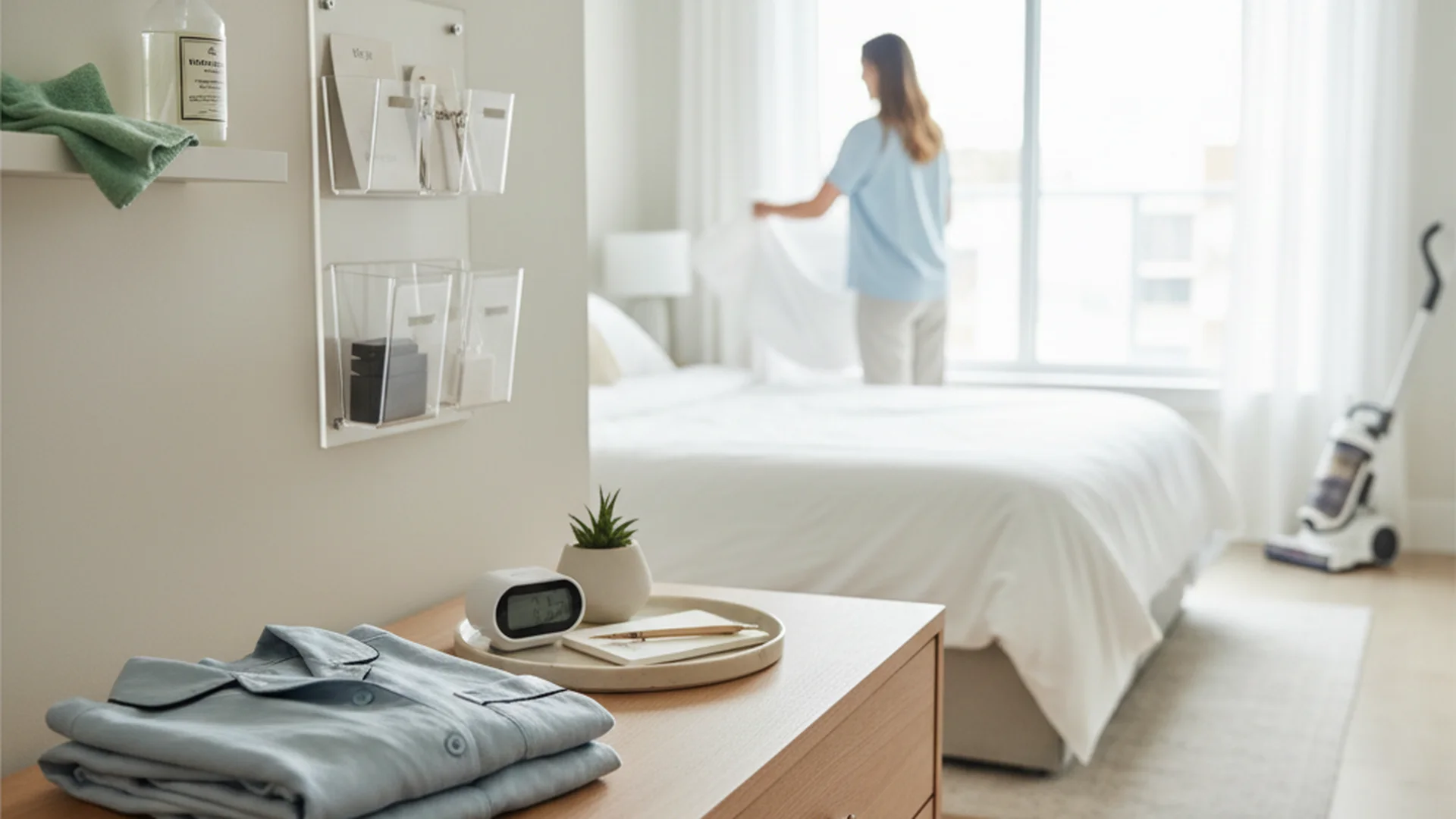
Replace "Minimalism" with "Dopamine Decor." Use colorful, clear bins and open shelving. If you can see your tools, you are more likely to use them.
Magnetic and Vertical Caddies
A major 2026 trend is the "Point of Performance" setup. Attach magnetic cleaning kits directly to the side of your fridge or washing machine. Keep a spray bottle and a microfiber cloth in every room where a mess happens. If you see a smudge on the mirror and the glass cleaner is right there, you are 90% more likely to wipe it immediately.
Warning: Avoid "organizational shopping." Buying 20 new clear bins feels like a productive task, but it is often a form of "procrasti-cleaning." Use what you have first.
Real-World Examples: ADHD Success Stories
Example 1: The "Wall of Awful" Breakout
Alex struggled with a mountain of laundry for three weeks. Every time he looked at it, he felt shame (the "Wall of Awful"). To break through, he used body doubling. He started a "Clean With Me" video on TikTok. Seeing someone else fold clothes in real-time provided the social mirroring his brain needed to start. He didn't finish the whole pile, but he got his work shirts done, which was a "Success."
Example 2: The Rabbit Hole Reversal
Maya went into the kitchen to make coffee but noticed the junk drawer was messy. Usually, she would spend two hours organizing paperclips and forget her coffee. Now, she uses a "Park It" notepad. When she sees the messy drawer, she writes "Fix junk drawer" on the pad and returns to her coffee. She saves the "deep dives" for her scheduled weekend focus block.
Example 3: The Sensory Hack
Jordan hated the "wet" feeling of cleaning and the smell of bleach, which caused sensory avoidance. By switching to high-quality reusable silicone gloves and scent-free, plant-based cleaners, the "gross factor" was removed. Jordan now cleans the shower while they are actually in the shower, using a dish wand filled with soap.
Common Mistakes to Avoid
- Decluttering While Cleaning: This is the #1 trap. If you start cleaning a counter and end up trying to decide if you should donate a 10-year-old cookbook, stop. Cleaning is removing dirt; decluttering is deciding on the fate of an object. Keep these sessions separate.
- The "Discipline" Trap: Stop telling yourself you "just need more discipline." ADHD is a neurochemical deficiency. Use systems, timers, and external rewards (dopamine) instead of internal shame.
- The Miracle Morning Trap: Don't try to start a 5:00 AM routine that includes meditation, journaling, and a deep-cleaned house. Start where you are. If you wake up at 8:30 AM, your "morning" starts then.
- Ignoring Sensory Needs: If the vacuum is too loud, wear noise-canceling headphones. If the floor feels sticky, wear socks. Don't force yourself to "tough out" sensory discomfort.
Success: A functional home is not a "staged" home. A home that works for you is one where you can find your keys, have a clean plate for dinner, and feel safe to rest.
Frequently Asked Questions
How do I start when everything feels like a priority?
Why do I end up cleaning the bathroom when I meant to just get a snack?
Can I have a clean home without a rigid schedule?
Is a 'clean enough' house a moral failure?
Conclusion
Building an adhd morning routine home isn’t about achieving perfection; it’s about reducing the friction between you and your environment. By embracing 2026 tools like AI-driven micro-steps and sensory-friendly cleaning kits, you can move away from the cycle of "shame and scrub" and toward a sustainable rhythm. Remember, your home exists to serve you—you do not exist to serve your home.
Cleaning that keeps score
Every task earns points, every streak multiplies them, and Premium adds a household leaderboard plus a monthly Dustagorgon to beat.
- Free forever
- 30 badges to earn
- Up to 6 in a household
No card needed. Set up your rooms in a couple of minutes.