In this article
What you’ll learn
- ADHD cleaning requires breaking tasks into micro-steps to bypass executive dysfunction.
- Visual aids and "low-energy" alternatives are essential for long-term consistency.
- Gamification and "dopamine menus" make repetitive chores more stimulating for the ADHD brain.
If you have ever stared at a messy kitchen and felt physically unable to move, you aren't lazy—you are likely experiencing executive dysfunction. For those with ADHD, "cleaning the house" isn't just a chore; it is a complex series of decisions that can lead to immediate brain fog and task paralysis. This is where a specialized adhd cleaning checklist template becomes a life-changing tool. Unlike standard checklists, an ADHD-friendly version accounts for the way your brain processes information, prioritizes stimulation, and manages limited energy reserves.
By using a free adhd cleaning checklist template, you can stop wasting mental energy on "deciding what to do" and start moving. In this guide, we will explore why the ADHD brain struggles with domestic maintenance and provide a printable-ready structure that actually works.
Why the ADHD Brain Struggles with Cleaning
Understanding the "why" behind the struggle is the first step in removing the shame often associated with a messy home. ADHD is fundamentally a system failure of the brain's "command centers."
The Science of Executive Dysfunction
In people with ADHD, several of the brain's key command centers—including the Basal Ganglia (responsible for habit formation) and the Pre-frontal Cortex (responsible for executive function)—simply work differently. This means that a vague task like "clean the living room" is perceived as one giant, impossible block of static.
Furthermore, the ADHD brain suffers from a chronic dopamine deficiency. Because cleaning is repetitive and lacks immediate rewards, the brain often "goes on strike." When you use an adhd cleaning checklist template printable, you are essentially providing an external prosthetic for your brain’s executive function, helping it navigate through the dopamine-dry desert of housework.
Note: Many children diagnosed with ADHD still meet the full criteria as adults, and that is when managing a household becomes a primary source of chronic stress.
Strategies for an ADHD-Friendly Checklist
A standard list of chores often leads to "visual overload." To make a template work, it must incorporate specific ADHD-friendly methodologies.
The "Five Things" Method
Popularized by KC Davis, this method reduces any room into just five categories. When you feel overwhelmed, your checklist should only ask you to look for:
- Trash
- Dishes
- Laundry
- Things that have a place
- Things that don’t have a place
By focusing on these five categories, you eliminate the "decision fatigue" of what to pick up next.
The "One Room, One Change" Rule
Instead of aiming for a "deep clean," which can trigger perfectionism and subsequent burnout, aim for one noticeable change. This could be as simple as clearing the coffee table. This "quick win" triggers a small dopamine release, which can sometimes provide the momentum needed to complete another small task.
Tip: Use "Point of Performance" placement. Tape your bathroom-specific checklist inside the bathroom cabinet or directly onto the mirror so you see it exactly where the work needs to happen.
Trending Cleaning Concepts for 2025–2026
The world of ADHD organization is evolving, moving away from "shame-based" cleaning toward gamification and low-demand routines.
The "Closing Shift"
Borrowing from the hospitality industry, the "Closing Shift" trend focuses on a 10-minute nightly reset. Instead of a deep clean, you are simply "setting up your future self for success." Your free adhd cleaning checklist template should include a "Closing Shift" section that focuses on three things: clearing the sink, wiping one counter, and setting the coffee maker.
Gamification and AI Integration
New trends for 2025 involve turning chores into "quests." Many adults are now using AI tools to break down vague tasks.
Example 1: The AI Breakdown If you tell an AI, "I need to clean my garage but I'm overwhelmed," it can generate a step-by-step list like: "Find 5 pieces of cardboard," "Pick up all power tools," and "Sweep a 3x3 square." This removes the cognitive load of planning.
Dopamine Menus (Dopamenus)
A "Dopamine Menu" pairs a boring task with a "side dish" of stimulation. Your checklist might include a column for your "stimulation pairing." For example, you only listen to your favorite true-crime podcast while folding laundry.
Success: Pairing high-stimulation inputs (like a specific "cleaning-only" playlist) with low-stimulation tasks (like dusting) is one of the most effective ways to maintain focus.
Building Your ADHD Cleaning Checklist Template
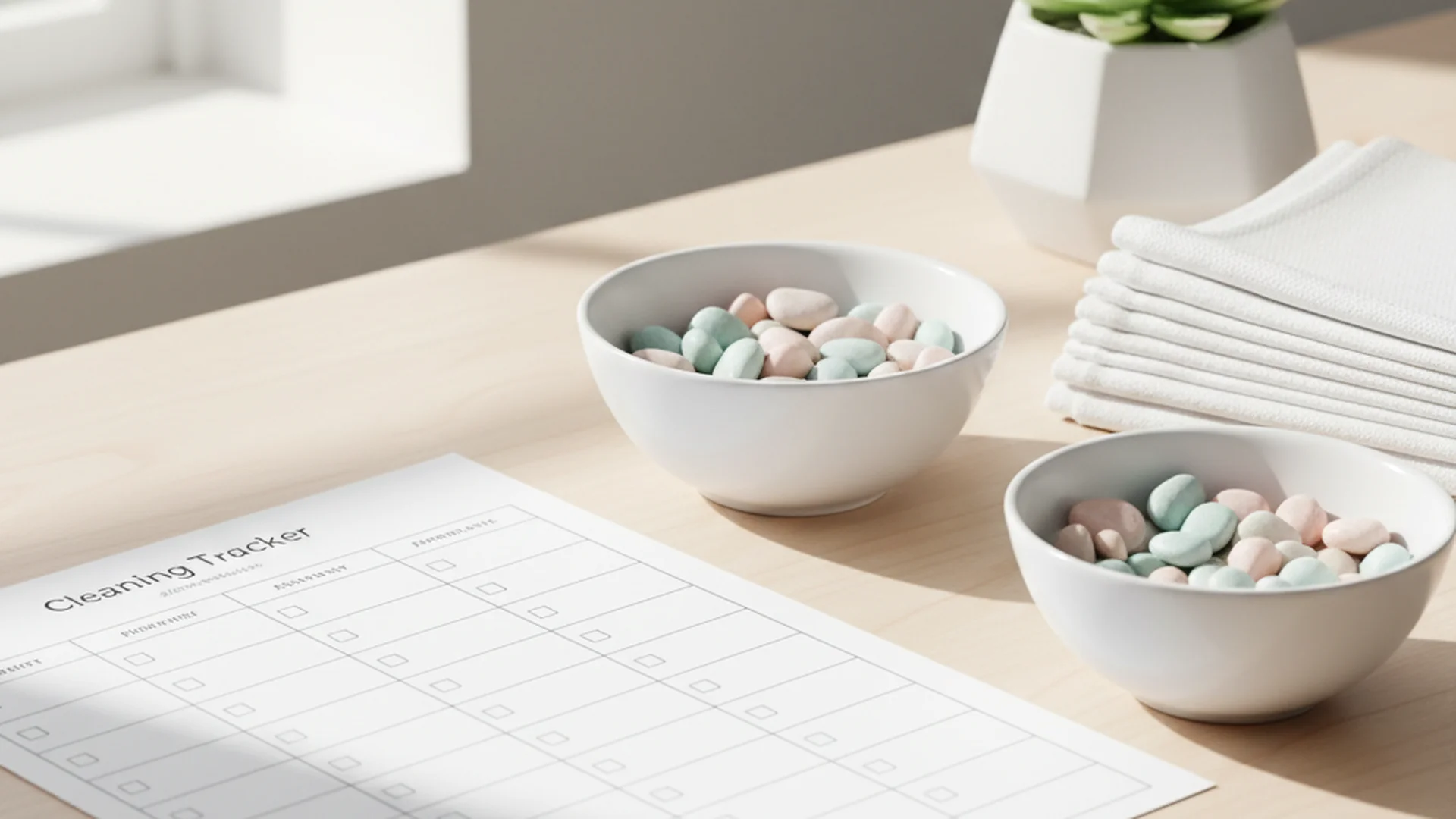
When choosing or creating your adhd cleaning checklist template printable, ensure it includes these four vital columns:
| The Micro-Task | Estimated Time | The Reward (Dopamine) | Low-Energy Alternative |
|---|---|---|---|
| Load Dishwasher | 5 Mins | 1 Level of a game | Just soak the pans |
| Clear Floor | 10 Mins | Listen to 2 songs | Move piles to a basket |
| Wipe Counter | 2 Mins | A piece of chocolate | Use a disinfecting wipe |
| Take out Trash | 3 Mins | Text a friend | Just tie the bag |
Warning: Avoid checklists with small fonts or cluttered layouts. Visual overload can cause your brain to shut down before you even pick up a sponge.
Common Mistakes to Avoid
Even with the best template, certain pitfalls can derail your progress.
- The Perfectionism Trap: Many ADHDers believe that if they can't do the job "right" (e.g., scrubbing baseboards with a toothbrush), they shouldn't do it at all. A good checklist prioritizes "functional" over "perfect."
- Mistaking Convenience for Logic: Don't try to store things where they should go; store them where you naturally drop them. If you always drop mail on the dining table, put a mail organizer on the dining table.
- The All-or-Nothing Fallacy: If you miss a day, don't abandon the list. ADHD brains thrive on novelty, so it's normal to fall off the wagon. Just start again with a "Low Energy" day.
- Ignoring Sensory Needs: If the smell of bleach or the feeling of wet hands bothers you, you won't clean. Include "Wear gloves" or "Open windows" as part of your checklist.
Frequently Asked Questions
Why can’t I just start cleaning?
Should I use a digital or paper checklist?
How long should an ADHD cleaning session be?
What is a "Body Double"?
Conclusion
Managing a home with ADHD is not about trying harder; it’s about trying differently. By using an adhd cleaning checklist template, you remove the heavy lifting of decision-making and allow your brain to focus on the action. Remember to keep your tasks micro-sized, embrace "good enough," and always pair your chores with a hit of dopamine.
Success: Small, consistent wins are better than occasional, exhaustive deep cleans. Start with just one task today.
Cleaning that keeps score
Every task earns points, every streak multiplies them, and Premium adds a household leaderboard plus a monthly Dustagorgon to beat.
- Free forever
- 30 badges to earn
- Up to 6 in a household
No card needed. Set up your rooms in a couple of minutes.