In this article
What you’ll learn
- A structured cleaning schedule cuts down the total time you spend on housework.
- Use the "Top-Down" method to prevent re-cleaning surfaces.
- Integrate habit stacking and dwell time for professional-grade results.
Maintaining a home can often feel like a full-time job on top of your actual career. The secret to a peaceful, tidy home isn't working harder; it’s working smarter with a consistent cleaning schedule. Whether you are a busy professional, a parent managing a chaotic household, or someone looking to optimize their environment for better mental health, a well-structured routine is the foundation of a functional home.
In this guide, we will explore the science of domestic maintenance, the latest trends for 2025 and 2026, and a step-by-step framework to build a routine that actually sticks. By the end of this article, you will have the tools to transform your living space from a source of stress into a sanctuary of productivity.
The Science of a Clean Home: Why Scheduling Matters
Creating a cleaning schedule is about more than just aesthetics. Our physical environment has a direct impact on our cognitive load and emotional well-being. Plenty of people report feeling noticeably less stressed once the cleaning is done, and many find they concentrate better in a tidy space.
Furthermore, efficiency is the primary driver for a scheduled approach. A planned cleaning routine takes far less total time than cleaning reactively. This is because consistent maintenance prevents the accumulation of "stubborn grime"—the kind of deep-set dirt that requires aggressive scrubbing and specialized chemicals to remove.
This growth is fueled by dual-income households who realize that their time is their most valuable asset. Whether you DIY your cleaning or hire help, a schedule ensures that no corner of your home is neglected.
Choosing Your Methodology: Room-by-Room vs. Task-by-Task
Before you write down a single task, you need to decide which organizational philosophy fits your brain. There are two primary schools of thought when it comes to a house cleaning schedule:
The Room-by-Room Method
This is the most popular approach, and the one most people default to. In this model, you assign specific days of the week to specific rooms. For example:
- Monday: Bathrooms
- Tuesday: Kitchen
- Wednesday: Living Areas
- Thursday: Bedrooms
This method provides a sense of "completion" each day. When the bathroom is done, you are finished for the day.
The Task-by-Task Method
Also known as "horizontal cleaning," this method involves doing one type of chore throughout the entire house.
- Monday: Dusting all surfaces
- Tuesday: Vacuuming and mopping all floors
- Wednesday: Wiping down all glass and mirrors
This is often more efficient because you only have to get your tools out once. You aren't switching between a vacuum, a mop, and a glass cleaner constantly.
Tip: If you are a beginner, start with the "Zone Method." Focus on just 15–20 minutes of daily "waistline-down" cleaning (counters and floors) before you attempt to tackle deep-cleaning tasks.
The Professional Secret: The "Top-Down" Method
If there is one rule that professional cleaners live by, it is the Top-Down Method. This practice dictates that you always begin cleaning at the highest point in a room and work your way to the floor.
Why? Gravity. When you dust a ceiling fan or the top of a bookshelf, particles inevitably fall onto the surfaces below. If you have already cleaned your coffee table and vacuumed your rug, you will have to do it all over again.
How to Execute Top-Down Cleaning:
- Ceilings and Corners: Use a long-handled duster for cobwebs.
- High Fixtures: Ceiling fans, recessed lighting, and top shelves.
- Mid-Level: Windows, mirrors, and wall decor.
- Furniture: Tables, chairs, and countertops.
- Baseboards: Often forgotten, these collect the dust that falls from above.
- Floors: Vacuuming and mopping should always be the final step.
Note: Following this sequence ensures you never "double clean," which is a primary cause of cleaning fatigue and time waste.
Designing Your Segmented Cleaning Schedule
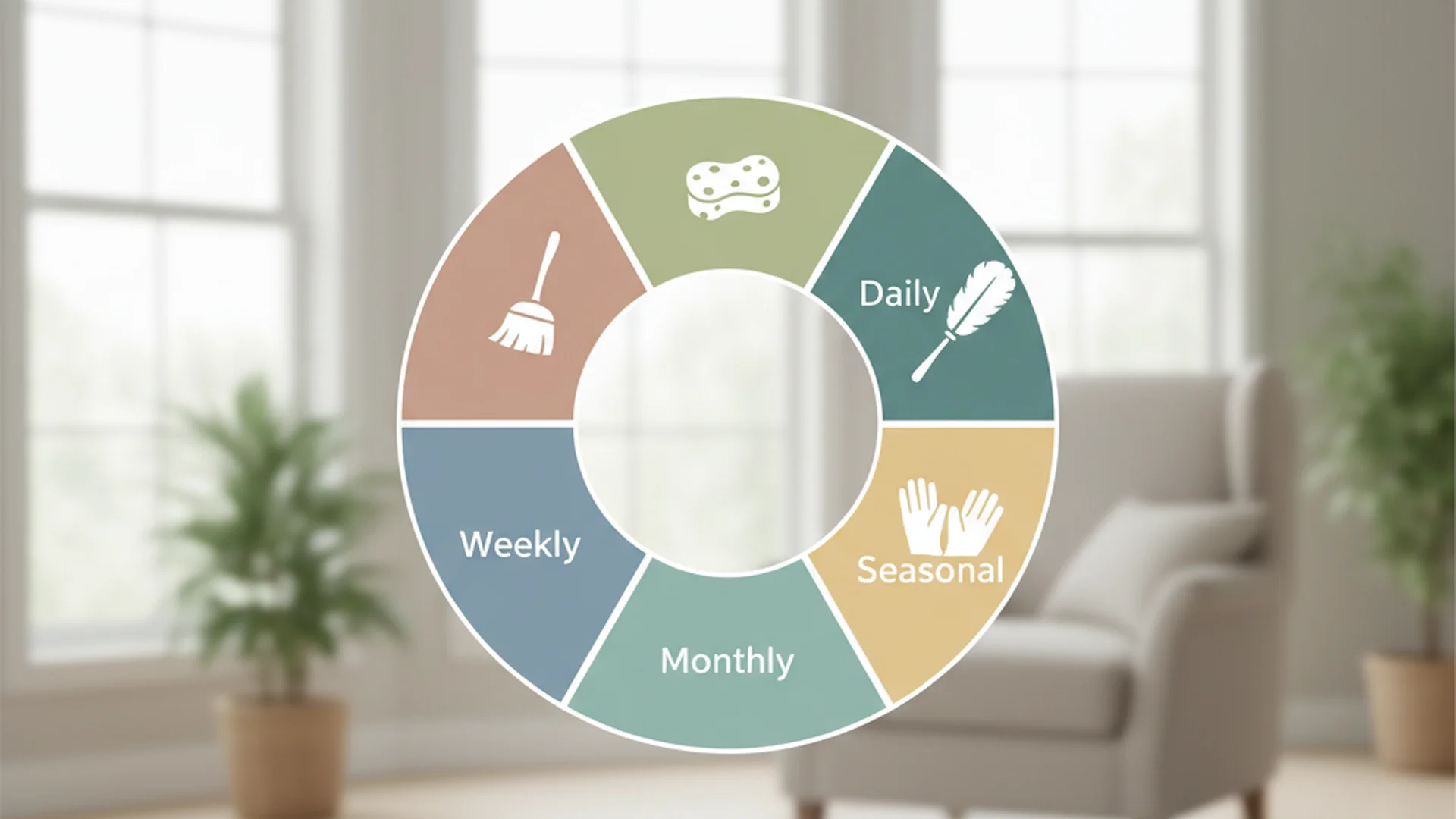
To make a weekly cleaning schedule sustainable, you must break it down into manageable segments. A "marathon cleaning session" on Saturday morning is the fastest way to burn out. Instead, use this segmented framework.
Daily Maintenance (The 20-Minute Tidy)
These tasks are designed to keep the "house-load" from becoming overwhelming.
- Make the bed: Sets the tone for the day.
- Load/Unload the dishwasher: Keeps the kitchen functional.
- Wipe kitchen counters: The kitchen is the most frequently cleaned area in most homes.
- 10-minute "reset": Walk through the house and return items to their designated homes.
The Weekly Routine
This is where the bulk of the "real" cleaning happens.
- Laundry: Wash, dry, and put away linens and clothes.
- Vacuuming/Mopping: High-traffic entryways and kitchens need this at least once a week.
- Sanitizing Bathrooms: Toilets, sinks, and showers.
- Dusting: Focus on visible surfaces and electronics.
Monthly Deep Cleaning
These are the tasks that prevent long-term damage to your home.
- Appliance Maintenance: Clean the dishwasher filter and run a cleaning cycle on the washing machine.
- Baseboards and Doors: Wipe away scuffs and dust.
- Vents and Filters: Change HVAC filters to maintain air quality.
- Deep Clean the Oven/Fridge: Remove expired items and burnt-on food.
| Frequency | Task | Est. Time |
|---|---|---|
| Daily | Dishes & Counters | 15 min |
| Weekly | Vacuum & Mop | 45 min |
| Monthly | Windows & Baseboards | 90 min |
| Quarterly | Curtains & Carpets | 3 hours |
Advanced Techniques for 2025
As we move into 2026, cleaning has evolved from a chore into a system of "home wellness." Incorporate these expert strategies to elevate your routine.
Habit Stacking
Popularized by productivity experts, habit stacking involves attaching a new cleaning task to an existing habit.
- Example: "After I finish my morning coffee (existing habit), I will wipe down the kitchen sink (new task)."
- Example: "While I brush my teeth (existing habit), I will use my free hand to wipe the bathroom counter (new task)."
The "Three-Box Method" for Decluttering
You cannot clean clutter; you can only move it around. Before a deep clean, use three boxes: Keep, Donate, and Trash. Quick decision-making prevents you from getting bogged down in the sentimental value of an old magazine when you should be scrubbing the baseboards.
Mastering Dwell Time
Most people spray a surface and immediately wipe it off. This is a mistake. Dwell time is the amount of time a disinfectant must remain wet on a surface to actually kill bacteria and viruses. Most products require 2 to 10 minutes to work effectively.
Success: Spraying your bathroom surfaces and letting them "dwell" for 5 minutes while you tidy the bedroom allows the chemicals to do the hard work for you, meaning less scrubbing is required.
2025–2026 Trends: The Future of Cleaning
The way we clean is changing. Modern schedules now incorporate technology and new biological science.
1. Smart Home Integration
AI-powered robotic vacuums and mops are no longer a luxury; they have become a staple in plenty of modern households. Integrating these into your digital cleaning calendar (like Google Calendar or Notion) allows you to automate the "floor day" entirely.
2. Probiotic and Bio-Based Cleaners
The trend for 2026 is "microbiome-friendly" cleaning. Instead of harsh bleach that kills 99.9% of all bacteria (including the good ones), homeowners are switching to probiotic cleaners. These use beneficial bacteria to consume organic waste (dirt and oils) long after you’ve finished wiping.
3. Cleaning as Self-Care
"Mindful cleaning" is a rising movement where the act of tidying is used as a mental reset. This includes using aromatherapy-based cleaners (eucalyptus, lavender) and "body doubling"—cleaning while on a video call with a friend or watching "Clean With Me" videos on social media to stay motivated.
4. UV-C Sanitization
With the rise of high-touch electronics, portable UV-C light devices are being integrated into weekly routines to sanitize smartphones, remote controls, and keyboards without using liquids that could damage the hardware.
Common Mistakes to Avoid
Even the most dedicated cleaners can fall into traps that make their cleaning routine less effective or even damaging.
Neglecting Cleaning Tools
Using a dirty sponge or a vacuum with a full filter is simply spreading bacteria and dust around your home.
- The Fix: Wash microfiber cloths after every use, replace sponges weekly, and empty vacuum canisters when they are 75% full.
The "Wait Until It’s Dirty" Fallacy
If you can see the dirt, it’s already been there too long. A cleaning schedule is designed to remove "invisible" layers of skin cells, oils, and microscopic dust before they bond to surfaces and become difficult to remove.
Using Vinegar on Everything
Vinegar is a wonderful natural cleaner, but it is highly acidic.
Warning: Never use vinegar on natural stone like marble or granite, or on unsealed grout. It can cause permanent "etching" or dissolve the protective sealants.
Spraying Directly on Surfaces
Spraying a cleaner directly onto a wood table or an electronic screen can cause staining, streaking, or internal damage.
- The Fix: Always spray your microfiber cloth first, then apply the cloth to the surface.
Frequently Asked Questions
How do I start a cleaning schedule without getting overwhelmed?
Can you over-clean a house?
How often should I mop high-traffic floors?
Should I clean room-by-room or task-by-task?
What is a "Cleaning Caddy" and do I need one?
Conclusion: Making It Stick
A cleaning schedule is not a rigid set of rules; it is a living document that should adapt to your life. Some weeks, you will hit every goal. Other weeks, life happens, and you might only manage the daily dishes. The goal is consistency, not perfection.
By utilizing the "Top-Down" method, respecting dwell times, and staying ahead of the "invisible dirt," you can maintain a home that supports your health and happiness rather than draining your energy. Start small, use the right tools, and remember that a tidy home is a powerful foundation for a tidy mind.
Success: Implementing just three of the strategies in this guide can save you hours of housework every single week.
Cleaning that keeps score
Every task earns points, every streak multiplies them, and Premium adds a household leaderboard plus a monthly Dustagorgon to beat.
- Free forever
- 30 badges to earn
- Up to 6 in a household
No card needed. Set up your rooms in a couple of minutes.