In this article
What you’ll learn
- Synchronize chores with noise-level windows to respect neighbors and family.
- Implement the "Anchor Day" method to avoid burning out on your days off.
- Use "Quiet-Tech" and AI-driven apps to automate low-energy maintenance.
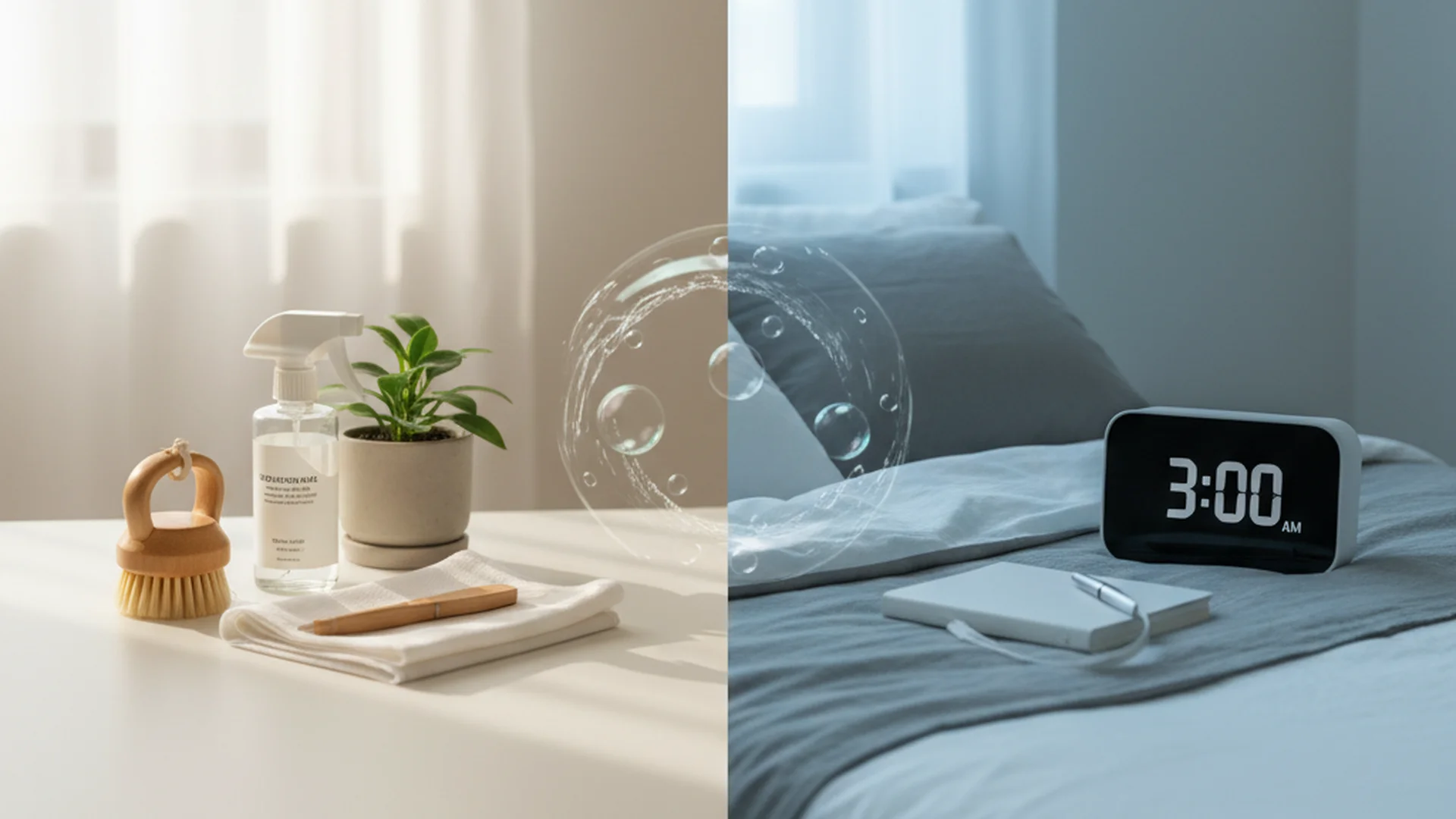
Living life "upside down" presents a unique set of challenges that 9-to-5 workers rarely understand. When your "morning" starts at 4:00 PM and your "dinner" happens at 3:00 AM, a traditional home maintenance routine isn't just difficult—it is practically impossible. Establishing a cleaning schedule night shift workers can actually stick to requires moving away from conventional wisdom and embracing a strategy built around your circadian rhythm and energy windows.
For the sizeable slice of the workforce navigating the night shift, the home environment is more than just a living space; it is a recovery zone. A cluttered bedroom or a sink full of dishes doesn't just look messy—it actively interferes with your ability to get the high-quality restorative sleep necessary for your health.
The Psychology of the "Clean-Sleep" Connection
The physical state of your home directly impacts your mental state, but for night shift workers, this link is even more pronounced. A "visually loud" environment—one filled with clutter and unfinished chores—increases cognitive load. For someone already battling Shift Work Disorder (SWD), this extra stress can be the difference between five hours of restless nap-time and eight hours of deep recovery.
Shift workers who keep a tidy sleeping and living environment tend to sleep noticeably better for it. When you walk through your front door at 7:00 AM, your brain is already fighting the sunrise to produce melatonin. Seeing a clean kitchen and an organized living room signals to your brain that the "work" phase is over, allowing you to transition into sleep mode much faster.
Success: A clean environment acts as a psychological "off-switch," helping you bypass the anxiety that often keeps shift workers awake during daylight hours.
Categorizing Chores: Noisy vs. Silent Windows
The biggest logistical hurdle for any cleaning routine shift is the noise factor. You cannot run a vacuum at 3:00 AM without waking your family or neighbors, and you shouldn't be scrubbing floors at 4:00 PM when you've just woken up and your energy is at its lowest.
To build a sustainable schedule, you must categorize every chore by its "noise footprint."
The Silent Window (2:00 AM – 6:00 AM or Mid-Sleep)
This is the time for low-impact activities that won't disturb the household.
- Folding laundry: A perfect "mindless" task while catching up on a show.
- Wiping counters: Using a microfiber cloth and a quiet spray bottle.
- Organizing cabinets: Sorting the pantry or cleaning out the fridge.
- Dusting: High-reach dusting or furniture polishing.
The Noisy Window (The "Transition" Hours)
These are the hours immediately after you wake up (late afternoon) or shortly before you leave for work, when the rest of the world is active.
- Vacuuming and Mopping: Save the heavy machinery for when the sun is up.
- Running the Dishwasher: Even "quiet" models can have loud drain cycles.
- Laundry Machines: The spin cycle is the enemy of a sleeping family.
Tip: If you live in an apartment, check your lease for "quiet hours." Usually, 8:00 AM to 8:00 PM is your safe zone for noisy appliances, even if that’s your "nighttime."
The "Anchor Day" Method
One of the most common mistakes night shift workers make is the "Day Off Trap"—saving every single chore for their first day off. This leads to a phenomenon known as "Revenge Bedtime Procrastination," where you spend your entire recovery period working, eventually feeling like you never had a weekend at all.
Instead, implement the Anchor Day.
Your Anchor Day is your first full day off. On this day, you do a "Home Reset." This isn't a 6-hour deep clean; it’s a 90-minute concentrated effort to get the house back to a baseline.
Example: The Nurse’s Anchor Day Maya, an ER nurse working three 12-hour shifts, uses her Tuesday (her first day off) as her Anchor Day. She spends 20 minutes on laundry, 30 minutes on a "floor sweep" (vacuuming/mopping), and 40 minutes on meal prepping for her next block of shifts. The rest of her week is dedicated to 15-minute maintenance bursts.
Note: Your "Saturday" is whenever your work week ends. If that's a Wednesday, treat it with the same respect you would a traditional weekend.
The 15-Minute Pre-Sleep Reset
Before you close those blackout curtains and put on your sleep mask, you must perform a "Pre-Sleep Reset." This is a non-negotiable 15-minute sweep of your high-traffic areas.
- The Kitchen Surface Clear: Clear the "3 AM dinner" dishes. Waking up to dried pasta sauce at 4:00 PM is a major psychological mood killer.
- The Living Room Fluff: Straighten the pillows and fold the throw blankets.
- The Bedroom De-Clutter: Ensure no clothes are on the floor. Your bedroom should be a sanctuary, not a storage unit.
Warning: Ignoring the 15-minute reset leads to "clutter creep." Over a three-day shift rotation, small messes snowball into an overwhelming disaster that ruins your first day off.
Tech to the Rescue: 2025 Cleaning Trends
The landscape of home maintenance has shifted toward automation, which is a godsend for the exhausted shift worker. In 2025, we are seeing a surge in "Quiet-Tech" specifically designed for non-traditional schedules.
AI-Integrated Scheduling
Apps like Sweepy or Tody now feature "Shift Work" toggles. Instead of reminding you to clean the bathroom every Saturday morning, these apps allow you to input your work rotation. They adjust reminders based on your sleep cycles, ensuring you aren't pinged to scrub the tub when you’re in the middle of your REM cycle.
The Rise of Quiet-Tech
Modern appliances are finally prioritizing decibel levels. Handheld "silent" vacuums (operating under 60dB) allow you to spot-clean a rug at 2:00 AM without waking a sleeping toddler in the next room. Similarly, ultra-quiet dishwashers (38-40dB) are now standard for apartment dwellers working nights.
Body Doubling for the Night Owl
"Body Doubling" is the practice of working alongside someone else to stay focused. For night shift workers, this used to be impossible. However, in 2025, TikTok Live "Clean With Me" streams and platforms like Focusmate have created a 24/7 community. You can find someone in a different time zone to "work with" at 4:00 AM, providing the accountability needed to finish the laundry when you’re running on fumes.
| Technology | Benefit for Shift Workers | Recommended Usage |
|---|---|---|
| Robot Vacuum | Automated floor care | Schedule while you are at work |
| Air Purifier | Passive dust reduction | Run 24/7 to improve sleep air quality |
| Smart Plugs | Automated lighting | Dim lights at "3 AM dinner" to help sleep |
| Silent Vacuums | Quiet spot cleaning | Use during "Silent Windows" |
The "Junebugging" Technique: Low-Energy Cleaning
When you are coming off a 60-hour week, your energy is a finite resource. This is where "Junebugging" comes in. Named after the way a June bug sticks to one spot, this technique involves picking one "anchor point"—like the kitchen sink—and cleaning around it.
If you get distracted and wander to the living room, you immediately return to your anchor point. This prevents the "exhausted wandering" where you start five tasks and finish none.
Tip: Use Junebugging on your "low-energy" days. Even if you only clean the area within three feet of your kitchen sink, that is a victory.
Common Mistakes to Avoid
- The "Standard Saturday" Mindset: Do not feel pressured to clean when the rest of the world is cleaning. If the neighbors are all out mowing their lawns on Saturday morning and you need to sleep, let the house stay messy until your scheduled window.
- Treating 3 AM Meals as Snacks: Because you’re eating in the middle of the night, it’s easy to leave the bowl in the sink "for the morning." But in your world, "morning" is when you should be sleeping. Treat every meal with a full cleanup routine.
- Neglecting Air Quality: Shift workers often keep windows and curtains closed 24/7 to maintain darkness. This leads to stagnant air and rapid dust buildup.
- Saving Deep Cleans for Vacations: Don't spend your hard-earned time off doing things like cleaning baseboards. Hire a professional or use the "one deep task per Anchor Day" rule.
Warning: Never mix bleach with ammonia-based cleaners, especially when you are tired. Fatigue leads to lapses in safety judgment—always ensure proper ventilation even if it means cracking a window in the middle of the night.
Frequently Asked Questions
When is the best time to vacuum without waking my family or neighbors?
How do I maintain a routine when my shift rotates every two weeks?
Should I clean before I go to work or after I wake up?
Is it better to do one big cleaning day or "micro-cleaning"?
How can I keep the kitchen clean when I'm eating 'dinner' at 3 AM?
Conclusion: Prioritizing Rest Over Perfection
A cleaning schedule night shift workers can stick to isn't about having a magazine-ready home; it's about creating a space that supports your unconventional lifestyle. By categorizing your chores into noisy and silent windows, utilizing the Anchor Day method, and embracing modern "Quiet-Tech," you can maintain a sense of order without sacrificing your precious sleep.
Remember, your home serves you—not the other way around. If you have to choose between scrubbing the bathtub and getting an extra hour of sleep before a long shift, choose the sleep. Use the 15-minute reset to keep the chaos at bay, and save the deep cleaning for when you truly have the energy.
Success: Transitioning to a shift-friendly cleaning routine takes a real weight off at home, giving you back your days off for actual relaxation.
Cleaning that keeps score
Every task earns points, every streak multiplies them, and Premium adds a household leaderboard plus a monthly Dustagorgon to beat.
- Free forever
- 30 badges to earn
- Up to 6 in a household
No card needed. Set up your rooms in a couple of minutes.