In this article
What you’ll learn
- Always clean from the highest point down to prevent re-soiling surfaces.
- Implement the 'Dry to Wet' rule to avoid creating mud and streaks.
- Modern deep cleaning in 2025 focuses on Indoor Air Quality (IAQ) and sustainability.
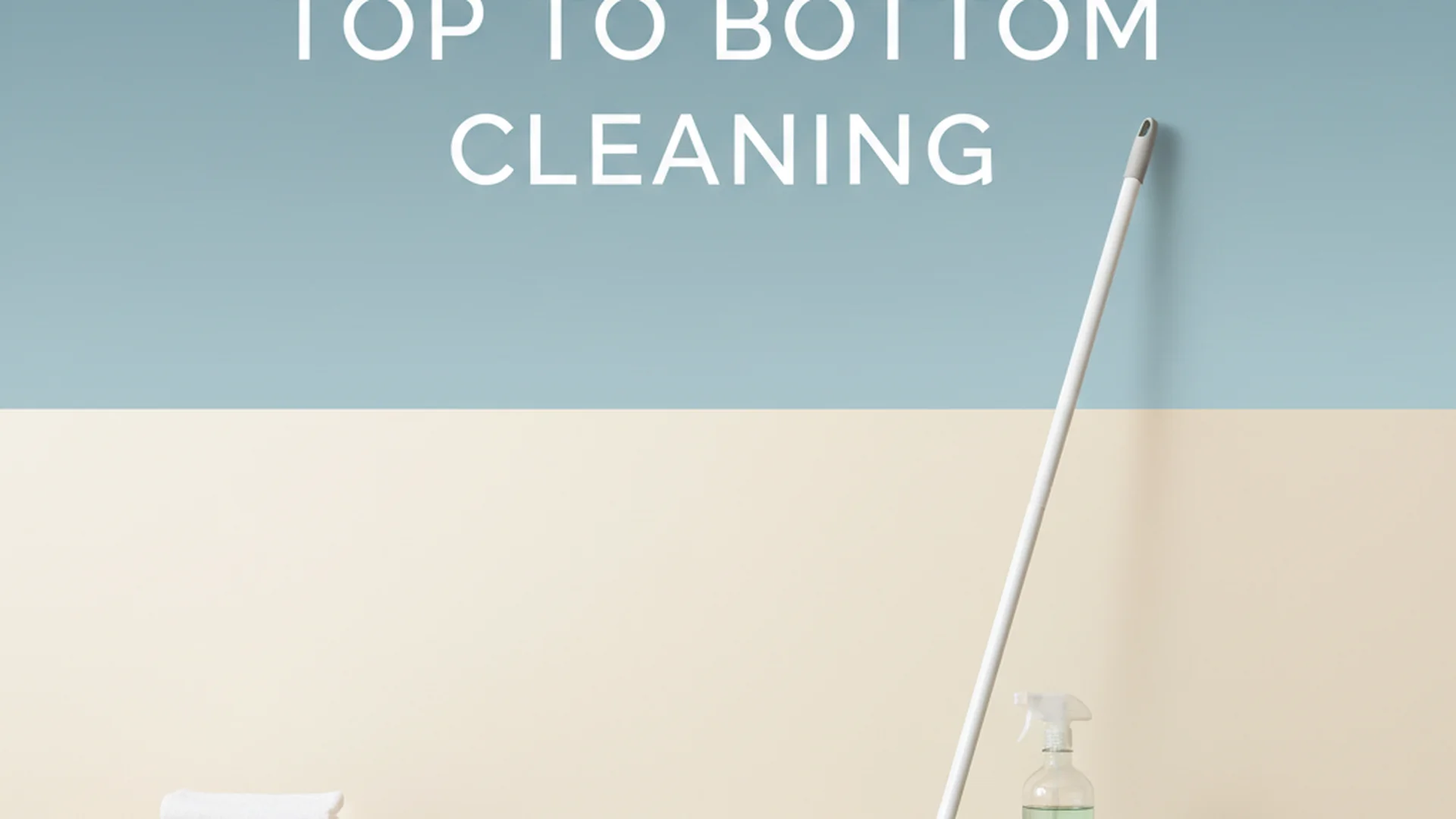
Have you ever spent an entire afternoon scrubbing your floors, only to look up and notice a cobweb in the corner? You reach up to sweep it away, and suddenly, a shower of dust descends onto your freshly mopped tile. This frustrating scenario is exactly why top to bottom cleaning is not just a suggestion—it is a fundamental law of professional home maintenance. By understanding the physics of gravity and the mechanics of dust distribution, you can transform your cleaning routine from a repetitive cycle into a streamlined, high-efficiency process.
In this comprehensive top to bottom cleaning guide, we will explore why this method is the gold standard for professionals and how you can implement it to save time, reduce effort, and significantly improve your home’s air quality.
Top to Bottom Cleaning Explained: The Science of Gravity
At its core, top to bottom cleaning is rooted in basic physics. Every particle of dust, pet dander, and microscopic debris in your home is subject to gravity. When you disturb a surface—whether by dusting a bookshelf or wiping a ceiling fan—the particles that don't stick to your cloth don't just disappear; they fall.
If you start your cleaning routine at the floor level (the "bottom") and work your way up, you are effectively cleaning the same surfaces multiple times. Every time you move to a higher tier, you deposit "new" dust onto the areas you just finished. Professional cleaning services utilize the top-to-bottom method to maximize efficiency, with data showing that systematic cleaning can reduce "backtracking" time by up to 20–30% compared to randomized cleaning.
Success: By following gravity rather than fighting it, you ensure that every minute spent cleaning contributes to a finished product, rather than a redo.
The Professional Cleaning Arsenal for 2025
Before diving into the step-by-step process, you must have the right tools. In 2025, the industry has shifted away from disposable paper products toward sustainable, high-performance materials.
Microfiber is King
Forget the feather duster or the roll of paper towels. Microfiber cloths are engineered with a positive charge that literally "grabs" and holds dust rather than just pushing it into the air. This is essential for a true top-to-bottom clean because it prevents the dust from floating to another surface before you can capture it.
HEPA-Filter Vacuums
As we move into 2026, the focus on Indoor Air Quality (IAQ) has reached an all-time high. A vacuum with a High-Efficiency Particulate Air (HEPA) filter is mandatory. Standard vacuums often exhaust fine dust particles back into the room, defeating the purpose of your hard work.
The "Dry to Wet" Principle
One of the most important rules in any top to bottom cleaning guide is to perform all "dry" tasks before "wet" tasks. Dusting and sweeping should always precede spraying and mopping. Adding moisture to a dusty surface creates "mud," which is significantly harder to remove and often leaves unsightly streaks.
Tip: Always use a dry microfiber cloth to remove the bulk of the dust before applying any liquid cleaner to a surface.
Your Step-by-Step Top to Bottom Cleaning Guide
To ensure you don't miss a single spot, professionals recommend working clockwise around a room, starting at the entrance and moving from the ceiling down to the floor.
Phase 1: The High Reaches (The Top)
Begin where the walls meet the ceiling. Use a long-handled duster or a vacuum attachment to clear:
- Corner Cobwebs: These often hide in plain sight but harbor significant amounts of dust.
- Ceiling Fans: This is a critical step. Dust accumulates on the top of the blades; if you don't clean this first, the moment you turn the fan on, it will "snow" dust across your entire room.
- Light Fixtures: Wipe down the tops of recessed lighting and chandeliers.
- HVAC Vents: In 2025, cleaning vents is considered a standard part of deep cleaning to maintain healthy indoor air.
Phase 2: The Mid-Level (Walls and Surfaces)
Once the ceiling is clear, move your focus to the eye-level elements:
- Door Frames and Picture Frames: These are often "invisible" tops that people skip. Over time, they develop a thick layer of grease-bound dust.
- Window Treatments: Dust the tops of blinds and the curtain rods.
- Shelving and Furniture: Work from the top shelf down to the bottom shelf.
Tip: Use an "S" motion when wiping surfaces. Circular motions tend to redeposit dirt, whereas the "S" pattern pulls the grime toward you and off the surface entirely.
Phase 3: The Low-Level (Baseboards and Underneath)
Now that the dust has been knocked down from the higher levels, it's time to focus on the areas near the floor:
- Furniture Movement: For a true deep clean, you must move the furniture. This allows you to reach the "bottom" that is usually hidden.
- Baseboards: Use a damp microfiber cloth to wipe away the dust that has settled here from your Phase 1 and 2 work.
- Outlets and Switch Plates: Wipe these down with a disinfectant, as they are high-touch areas.
Phase 4: The Floor (The Final Step)
The very last thing you do in any room is the floor. Vacuuming and mopping are the "sealants" of your cleaning session. By waiting until the end, you ensure that you capture every single particle that fell during the previous phases.
| Cleaning Stage | Primary Tasks | Why It Matters |
|---|---|---|
| The High Reach | Fans, Vents, Cobwebs | Prevents "dust snow" on lower levels |
| The Mid-Level | Frames, Shelves, Tables | Captures the majority of visible allergens |
| The Low-Level | Baseboards, Under Furniture | Reaches hidden buildup and pet dander |
| The Floor | Vacuuming, Mopping | The final collection of all fallen debris |
Real-World Examples of Top to Bottom Efficiency
Example 1: The Kitchen Grease-Dust Trap
In kitchens, dust often mixes with airborne cooking oils to create a sticky "grease-dust" layer. If you clean your countertops first and then attempt to scrub the tops of your kitchen cabinets, that sticky debris will fall onto your clean counters. By starting at the cabinet tops and using a degreaser with a 10-minute dwell time, you allow the chemicals to do the work before wiping the mess downward.
Example 2: The Ceiling Fan "Dust Bomb"
Imagine a living room with a plush rug. If you vacuum the rug and then clean the ceiling fan, the thick layer of dust on the fan blades will settle deep into the fibers of the rug. You would then need to vacuum a second time. Starting with the fan (using the pillowcase method to trap dust) ensures the rug only needs one pass.
Example 3: The "Under-the-Couch" Void
Many homeowners skip moving the sofa during a regular clean. However, during a top-to-bottom session, moving the sofa reveals the "bottom" of the room. This area often acts as a wind tunnel for dust bunnies. Cleaning this last, after dusting the bookshelves behind the sofa, ensures the room is truly sanitized.
Modern Trends: Top to Bottom Cleaning in 2025–2026
The cleaning landscape is evolving. While the physics of gravity remains the same, the technology and priorities of homeowners have shifted.
- Sustainability as Standard: Over 72% of consumers now prioritize biodegradable, non-toxic cleaners. In 2025, a deep clean is as much about removing chemical residues as it is about removing dirt.
- Aromatherapeutic Cleaning: "Wellness-focused" cleaning is a rising trend. Professional sessions now often incorporate essential oils like eucalyptus or lavender to improve the emotional environment of the home during the deep clean.
- AI and Smart Scheduling: Many modern households are utilizing AI-powered apps to track when "high-dust" areas (like vents and fan blades) were last serviced, creating a dynamic schedule that ensures the "top" of the house never gets too dirty.
- Robotic Integration: While humans handle the precision of the "top" and "mid" levels, smart robotic mops are being integrated to handle the "bottom" (the floors) once the human cleaner has finished the higher tasks.
Note: Even with robotic help, the sequence remains the same. Do not run your robot vacuum until you have finished dusting the shelves!
Common Mistakes to Avoid
Even with a top to bottom cleaning guide in hand, it is easy to fall into old habits. Here are the most common pitfalls:
- The "Vacuum-First" Fallacy: It is tempting to vacuum first because it makes the room look instantly better. Resist the urge. Vacuuming first is the most common way to double your workload.
- Over-Spraying: Using too much product doesn't make things cleaner; it creates a sticky residue that actually attracts more dust. A light mist is all you need.
- The "Vinegar for Everything" Myth: While vinegar is a great eco-friendly tool, it is highly acidic. Never use it on natural stone (granite/marble) or certain wood finishes, as it can etch the surface and cause permanent damage.
- Using Dirty Tools: If you use the same microfiber cloth for the whole house, you aren't cleaning; you're just relocating germs. Swap cloths between rooms, especially when moving from the bathroom to the kitchen.
- Ignoring Dwell Time: Many disinfectants require 5–10 minutes of contact time to actually kill bacteria. If you spray and wipe immediately, you are only removing surface dirt, not sanitizing.
Warning: Never mix bleach with ammonia-based cleaners (like many window cleaners), as this creates toxic chloramine gas.
Frequently Asked Questions
Should I dust or vacuum first?
Where exactly is "the top"?
How often should I do a "top to bottom" deep clean?
Do I need to move all my furniture?
What is the best way to clean a ceiling fan without making a mess?
Conclusion
Mastering the art of top to bottom cleaning is more than just a chore—it’s an investment in your home’s longevity and your family's health. By working with the laws of gravity, utilizing modern microfiber technology, and following a systematic clockwise path, you can achieve a level of cleanliness that was previously reserved for professional crews.
As we move into 2026, the focus on indoor air quality and sustainable practices makes this methodical approach more relevant than ever. Remember: start high, work dry before wet, and always end with the floor. Your home will not only look cleaner, but it will also stay cleaner for longer.
Success: Adopting a top-to-bottom strategy can reduce your total cleaning time by nearly a third, giving you more time to enjoy your spotless environment.
Cleaning that keeps score
Every task earns points, every streak multiplies them, and Premium adds a household leaderboard plus a monthly Dustagorgon to beat.
- Free forever
- 30 badges to earn
- Up to 6 in a household
No card needed. Set up your rooms in a couple of minutes.