In this article
What you’ll learn
- Use a physical timer to bypass "perfectionist paralysis" and the brain's fear center.
- Focus on clearing the floor and flat surfaces rather than deep cleaning or organizing.
- Modern 2025/2026 trends include AI-guided clutter triage and silent walking cleanups.
We have all been there: you walk into a room, see the mountain of laundry, the scattered toys, and the mail piled high on the coffee table, and you immediately turn around and walk back out. This "shutdown" response isn’t laziness; it is a neurological reaction to overwhelm. However, there is a simple solution that is taking the home maintenance world by storm in 2025. It is called the 5 minute room rescue, and it is designed to help you reclaim your space without the burnout of a marathon cleaning session.
The 5 minute room rescue is more than just a quick tidy-up; it is a strategic strike against chaos. By setting a hard limit on your effort, you trick your brain into bypass the "activation energy" barrier that usually keeps us stuck on the couch. Whether you are a busy parent, a remote worker, or someone struggling with "perfectionist paralysis," understanding how to use the 5 minute room rescue effectively can be the difference between a home that feels like a sanctuary and one that feels like a source of constant stress.
The Philosophy: Where the Rescue Began
To understand the 5 minute room rescue explained in its full context, we have to look back at its origins. The technique was popularized by Marla Cilley, famously known as "The FlyLady." In her seminal work, Sink Reflections, Cilley addressed "Sidetracked Home Executives"—people who found themselves overwhelmed by the sheer volume of household maintenance.
Cilley recognized that the biggest enemy of a clean home isn't dirt; it's the "all-or-nothing" mentality. Perfectionists often believe that if they can't deep clean the baseboards and steam the carpets, there is no point in picking up the socks. The 5-minute rescue was born as a way to "rescue" a room from the brink of disaster, making it functional enough to live in until a deeper clean could occur.
In 2025, this philosophy has evolved. We are no longer just fighting physical clutter; we are fighting the mental clutter of a digital-first world. The rescue has become a cornerstone of modern "micro-habit" movements, emphasizing that five minutes of focused effort is mathematically and psychologically superior to zero minutes of avoidance.
The Science of the Five-Minute Sprint
Why does such a short window of time work so effectively? It comes down to how we respond to overwhelm. When we look at a messy room, our brain’s amygdala—the fear center—often perceives the clutter as a threat or an impossible mountain. This triggers a "freeze" response.
By committing to only five minutes, you essentially "quiet" the amygdala. The brain realizes that five minutes is not a threat. It is a manageable, finite period. And once you actually start a task—the "activation" phase—the perceived difficulty drops away almost immediately.
Success: People who use the 5-minute rescue stick with it far more reliably than those waiting for a free weekend to clean.
There is also a physical dimension: the more objects packed into a space, the more keyed-up living in it tends to make you feel. By performing a quick rescue, you aren't just tidying a room; you are literally lowering your physiological stress levels.
How to Use 5 Minute Room Rescue: A Step-by-Step Guide
If you want to master this technique, you must follow the protocol. It is not about how much you do; it is about how you do it.
Step 1: Set the "Boss" Timer
You must use a physical timer. This could be your phone, a kitchen egg timer, or a smart speaker like Alexa. This creates a "sprint" mentality. When the timer is ticking, your brain switches into a different mode—one of efficiency rather than rumination.
Step 2: Identify the "Hot Spot"
A "Hot Spot" is an area that attracts clutter like a magnet. It’s the entryway bench, the kitchen island, or that one chair in the bedroom. For a 5-minute rescue, pick the one room or area that is currently causing you the most mental friction.
Step 3: Clear the Path (The Floor First)
Always start with the floor. A room isn't "rescued" until you can safely walk through it. Pick up shoes, toys, or laundry. Don't worry about where they go perfectly yet—just get them off the walking path.
Step 4: Clear Flat Surfaces
Once the floor is safe, move to the tables or counters. Clear the "surface noise." Put the remote back on the stand, stack the magazines, and move dirty dishes to the kitchen.
Step 5: The "Put-Away" Basket
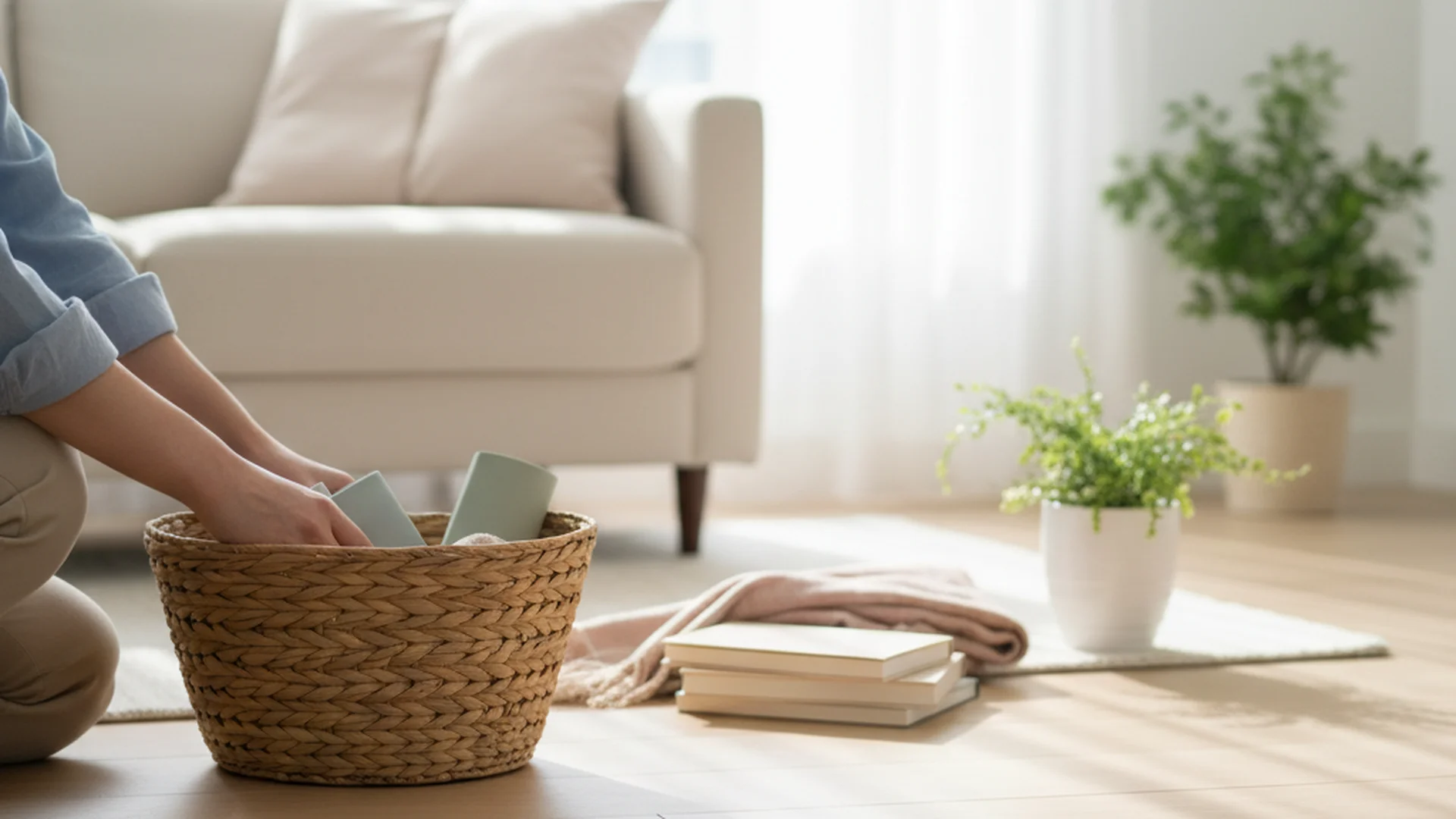
Keep a basket with you. If you find something that belongs in another room, do not leave the room to put it away. That is "sidetracking." Place it in the basket and only deal with it after the timer goes off.
Tip: If you find an item and don't know where it goes, don't agonize over it. Put it in a "To-Be-Decided" basket and keep moving. Momentum is more important than perfect placement.
2025 and 2026 Trends: The Modern Rescue
The 5 minute room rescue has seen a massive resurgence in 2025 due to several new lifestyle and technology trends.
AI-Guided Triage
Many homeowners are now using AI tools to help them decide where to start. By taking a quick photo of a messy room and asking an AI (like ChatGPT or Gemini) to "Identify the three most impactful things I can move in 5 minutes," users remove the "decision fatigue" that often stalls cleaning efforts.
The "Silent Walking" Cleanup
A trend emerging in late 2025 is the "Silent Rescue." While many people prefer upbeat music, the silent rescue involves performing the 5-minute sprint in total silence. This turns the cleaning into a mindfulness practice, allowing the person to process the day's sensory overload while physically restoring their environment.
The Remote Work "Transition Ritual"
With the continued rise of work-from-home culture in 2026, the "5-Minute Office Rescue" has become a viral ritual. At 5:00 PM, workers spend exactly five minutes clearing their desks and filing papers. This serves as a "cognitive threshold," helping the brain transition from "work mode" into "home mode."
| Feature | 5-Minute Room Rescue | Deep Cleaning | Organizing |
|---|---|---|---|
| Goal | Functionality/Sanity | Hygiene/Detail | Systems/Storage |
| Time | 5 Minutes | 2-4 Hours | 1-3 Hours |
| Focus | Surfaces & Floors | Scrubbing/Dusting | Categorizing |
| Tool | Timer & Trash Bag | Mops/Chemicals | Bins/Labels |
Real-World Examples of the Rescue in Action
Example 1: The "Guest is Coming" Entryway
Imagine you get a text that a friend is dropping by in ten minutes. Your entryway is a disaster zone of shoes, mail, and umbrellas.
- Minute 1-2: Kick all shoes into the closet or line them up neatly against the wall.
- Minute 3: Scoop all mail into a single neat pile and place it in a drawer or basket.
- Minute 4: Hang up stray coats.
- Minute 5: Use a damp cloth to wipe the main console table.
- Result: The "first impression" of your home is saved.
Example 2: The Living Room "Reset"
After a long evening of movies and snacks, the living room is covered in blankets and crumbs.
- Minute 1-2: Fold blankets and fluff pillows.
- Minute 3: Collect all trash (wrappers, tissues) in a trash bag.
- Minute 4: Move all dishes to the kitchen sink.
- Minute 5: Straighten the coffee table books and remotes.
- Result: You wake up the next morning to a peaceful room rather than last night's chaos.
Example 3: The 5-Minute Office Rescue (Remote Worker)
Your desk is buried under sticky notes, coffee mugs, and tangled chargers.
- Minute 1: Toss old sticky notes and trash.
- Minute 2: Take mugs/plates to the kitchen.
- Minute 3: Coil cables and move them to the side.
- Minute 4: Stack notebooks and pens.
- Minute 5: Wipe down the keyboard and mouse.
- Result: Your brain effectively "closes" the workday.
Warning: Do not start "organizing" during a rescue. If you start color-coding your bookshelf or alphabetizing your spice rack, you have failed the rescue. Rescue is for clearing; organizing is for another time.
Common Mistakes to Avoid
Even though it’s only five minutes, it is easy to do it "wrong." Here are the pitfalls that can turn a 5-minute win into a 2-hour frustration:
- The Organizing Trap: As mentioned, trying to find a "permanent home" for every item will kill your momentum. Just get it out of the way or into a "to-be-sorted" bin.
- The Sentimental Slide: If you pick up an old photo or a letter and start reading it, the rescue is over. You must remain clinical and fast.
- The Trail of Mess: This happens when you pick up an item, walk it to another room, see a mess there, and start cleaning that room. Note: Stay in the target room until the timer rings.
- Neglecting the Timer: Thinking "I'll just do it until I'm done" is a recipe for burnout. The 5-minute limit is what makes the habit sustainable.
Note: The goal isn't to finish the room; it’s to rescue it from total chaos. Stopping when the bell rings is a victory, even if the room isn't perfect.
Frequently Asked Questions
Which room should I start with?
What if I can't finish the room in 5 minutes?
Do I need special tools for a rescue?
Is this the same as deep cleaning?
Can I do multiple 5-minute rescues a day?
Conclusion
The 5 minute room rescue is the ultimate antidote to the modern epidemic of overwhelm. By leveraging the power of a timer and understanding the psychology of "activation energy," you can maintain a functional, stress-free home even during your busiest seasons. Whether you are using AI to triage your mess or practicing a "silent walking" cleanup, the core principle remains the same: five minutes of focused effort can change the entire energy of your home.
Don't wait for a "free Saturday" that may never come. Your home doesn't need a miracle; it needs five minutes.
Success: Consistency beats intensity every time. A daily 5-minute rescue adds up to over 30 hours of cleaning and decluttering per year!
Cleaning that keeps score
Every task earns points, every streak multiplies them, and Premium adds a household leaderboard plus a monthly Dustagorgon to beat.
- Free forever
- 30 badges to earn
- Up to 6 in a household
No card needed. Set up your rooms in a couple of minutes.