In this article
What you’ll learn
- Understand that cleaning is a functional care task, not a moral obligation.
- Use the '5 Things' method to reduce decision fatigue and stop task paralysis.
- Leverage body doubling or AI tools to maintain momentum when energy is low.
Walking into a room filled with clutter, laundry, and dishes can feel like hitting a physical wall. If you find yourself standing in the middle of a mess, unable to move or decide what to do first, you aren't lazy—you are likely experiencing "task paralysis." Learning how to clean house when overwhelmed is less about the actual scrubbing and more about managing your brain’s response to stress. In 2025, with rising levels of burnout and digital fatigue, more people than ever are looking for a functional clean house overwhelmed answer that doesn't involve spending eight hours on their hands and knees.
The Science of Cleaning and Mental Health
There is a profound link between our environments and our neurobiology. Almost everyone reports feeling their best, mentally and physically, when they have a clean home. This isn't just a preference; it’s physiological. A messy environment keeps levels of the stress hormone cortisol elevated, creating a feedback loop where the mess causes stress, and the stress makes it impossible to clean.
Conversely, engaging in chores for just 20 minutes can take a real bite out of anxiety and stress. When you declutter, you aren't just moving objects; you are reducing "visual noise." That makes you noticeably more productive, because your brain no longer has to process the thousands of tiny "reminders" of unfinished work scattered across your surfaces.
Note: Plenty of people find cleaning tasks fundamentally overwhelming. If you feel stuck, you are part of a significant group of people navigating the same challenges.
Where to Start When You Can’t Think
The biggest barrier to cleaning is "decision fatigue." When everything is a mess, every item requires a decision: Should I keep this? Where does it go? Is it dirty or clean? To overcome this, you must remove the decision-making process entirely.
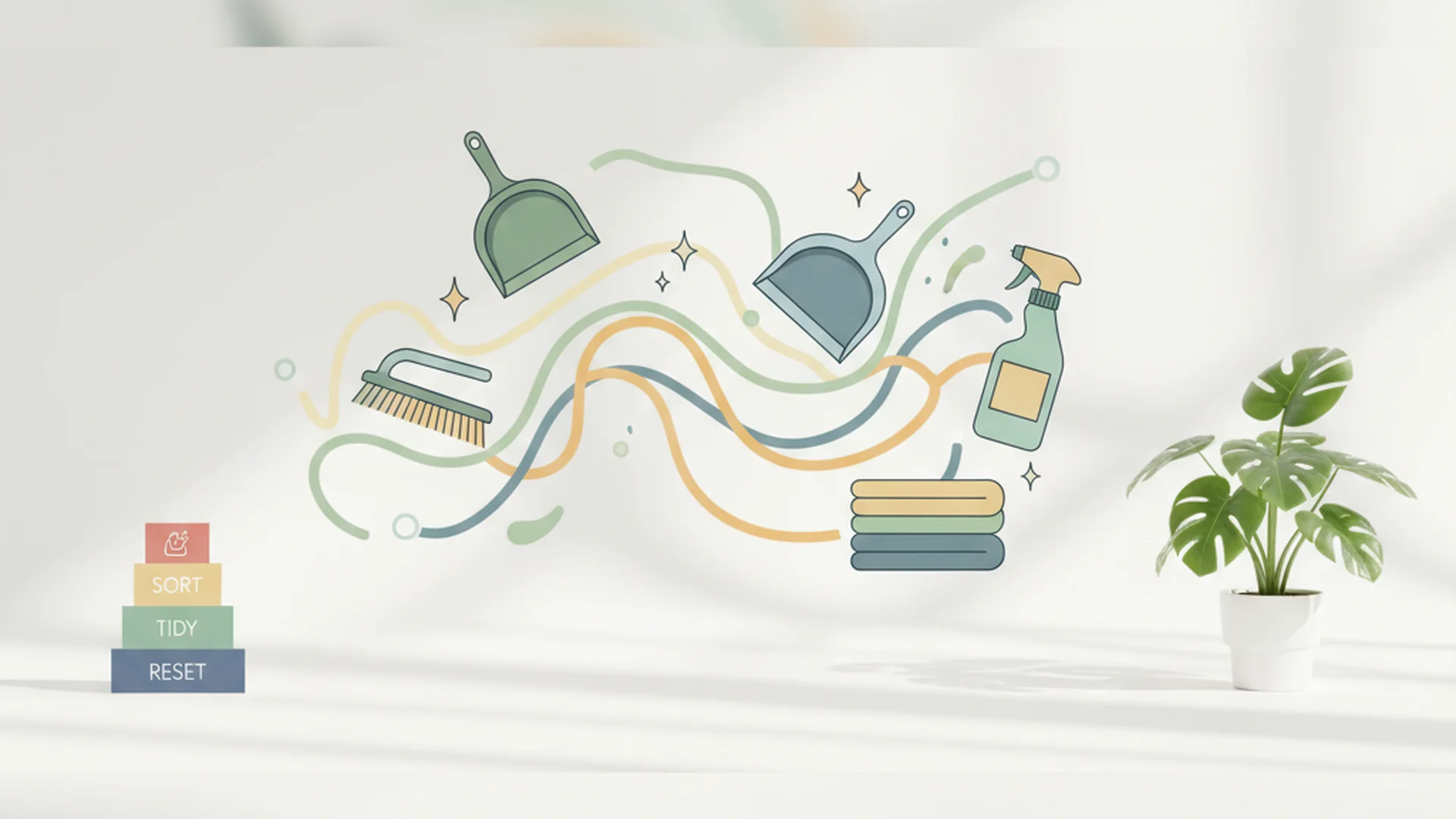
The "5 Things" Tidying Method
Popularized by KC Davis, this method is the gold standard for cleaning when you are at your limit. Instead of looking at a "messy room," look only for these five categories in this exact order:
- Trash: Grab a bag and walk around. Do not look at dishes or laundry. Only pick up trash.
- Dishes: Collect every dish and move them to the kitchen. Don't wash them yet; just get them to the "zone."
- Laundry: Gather every piece of clothing and put it in a basket or a pile.
- Things that have a place: Pick up items you know exactly where they go and put them there.
- Things that don’t have a place: Put these in a single box to be dealt with later.
Tip: By focusing only on one category at a time, you prevent "sideways cleaning"—the act of starting one task, getting distracted by another, and finishing neither.
The "Visible Floor" Strategy
If the 5 Things method still feels like too much, focus on the "visible floor." Clear a path from the door to the center of the room. This provides immediate visual relief and physical space to move, which can lower your heart rate and make the remaining tasks feel manageable.
Real-World Examples of Overcoming Overwhelm
Example 1: The Burnout Recovery
Sarah, a corporate professional, found herself unable to clean for three weeks following a high-stress project. Her clean house overwhelmed answer was the "20/10 Rule." She set a timer for 20 minutes of work followed by a mandatory 10-minute rest. By breaking the "all-or-nothing" mentality, she cleaned her entire kitchen over four 20-minute bursts on a Saturday, rather than waiting for a "free day" that never came.
Example 2: The ADHD "Body Doubling" Hack
Mark, who struggles with executive dysfunction, used "body doubling" to tackle his living room. He called a friend on FaceTime. The friend didn't help clean; they just sat there and chatted while Mark worked. This external presence helped Mark stay grounded in the task and prevented him from wandering off to organize his bookshelf instead of vacuuming.
Example 3: The "Spoonie" Low-Energy Approach
Elena, living with a chronic illness, used "low-energy hacks" to maintain her home during a flare-up. She used a long-handled grabber to pick up floor clutter without bending over and sat on a rolling stool to unload the dishwasher. By treating cleaning as a physical energy management task rather than a workout, she kept her home functional without crashing.
Success: Small, consistent wins are better than one massive cleaning session that leaves you exhausted for a week.
2025 Trends: AI and Mindful Cleaning
The landscape of home maintenance is changing. In 2025, we are seeing a shift away from "hustle cleaning" toward more sustainable, tech-integrated methods.
- AI and Automation: Apps like Tody or RoutineFlow are now using algorithms to tell you exactly what to do next. This removes the "choice" element of cleaning, which is often where overwhelm begins.
- The Dopamine Menu: People are creating "menus" of high-impact, 5-minute tasks (like wiping a mirror or clearing one drawer). Completing these provides an immediate hit of satisfaction that can fuel longer sessions.
- Mindful Cleaning: There is a growing trend of turning chores into a sensory, meditative practice. Using aromatherapy-infused cleaners (like lemon or eucalyptus) and noise-canceling headphones can turn a stressful chore into a "mental reset" period.
Warning: Never mix cleaning chemicals, such as bleach and ammonia, even when you are in a rush to finish.
Common Mistakes to Avoid
When we are overwhelmed, we often fall into traps that make the mess worse or the stress higher.
- Decluttering while cleaning: This is the most common mistake. Trying to decide if you should donate a shirt while you are in the middle of a "trash sweep" will stop your momentum. Keep a "Donation Bag" and toss things in without overthinking. Deal with the bag another day.
- Cleaning from the floor up: Professionals always clean top-to-bottom. Dust and crumbs fall. If you clean the floor first, you will just have to do it again after you wipe the counters or dust the shelves.
- Buying more organizers to fix a mess: You cannot organize your way out of having too much stuff. "Inventory Reduction" has to come first. Discarding is more effective than buying more plastic bins.
- The "All-or-Nothing" Mentality: Thinking you need a full 8-hour day to clean leads to paralysis. Most overwhelming messes can be 80% improved with three 15-minute bursts throughout the day.
| Mistake | Consequence | Better Alternative |
|---|---|---|
| Sideways Cleaning | Nothing gets finished | Stick to one category (e.g., only dishes) |
| Starting with Floors | Re-dirtying the floor | Clean surfaces, then floors last |
| Over-organizing | Clutter just moves around | Inventory reduction (discarding) |
Frequently Asked Questions
Where do I even start when the whole house is a mess?
How can I clean my house in one hour when I’m overwhelmed?
Does a messy house cause depression or does depression cause a messy house?
How do I stop feeling guilty about my messy home?
Conclusion
Cleaning your house when you are overwhelmed isn't about perfection; it’s about "functional enough." By using the 5 Things method, breaking tasks into 20-minute chunks, and avoiding the trap of "sideways cleaning," you can reclaim your space without sacrificing your mental health. Remember that your home is a place to live, not a museum, and every small step you take is a win for your well-being.
Success: By implementing just one of these strategies—like the trash sweep—you can take a real bite out of your environmental stress in mere minutes.
Cleaning that keeps score
Every task earns points, every streak multiplies them, and Premium adds a household leaderboard plus a monthly Dustagorgon to beat.
- Free forever
- 30 badges to earn
- Up to 6 in a household
No card needed. Set up your rooms in a couple of minutes.