In this article
What you’ll learn
- Use Parkinson’s Law to limit cleaning time and boost focus.
- Prioritize high-impact areas like counters and floors for visual wins.
- Implement the 'Caddy Method' to eliminate distractions and downtime.
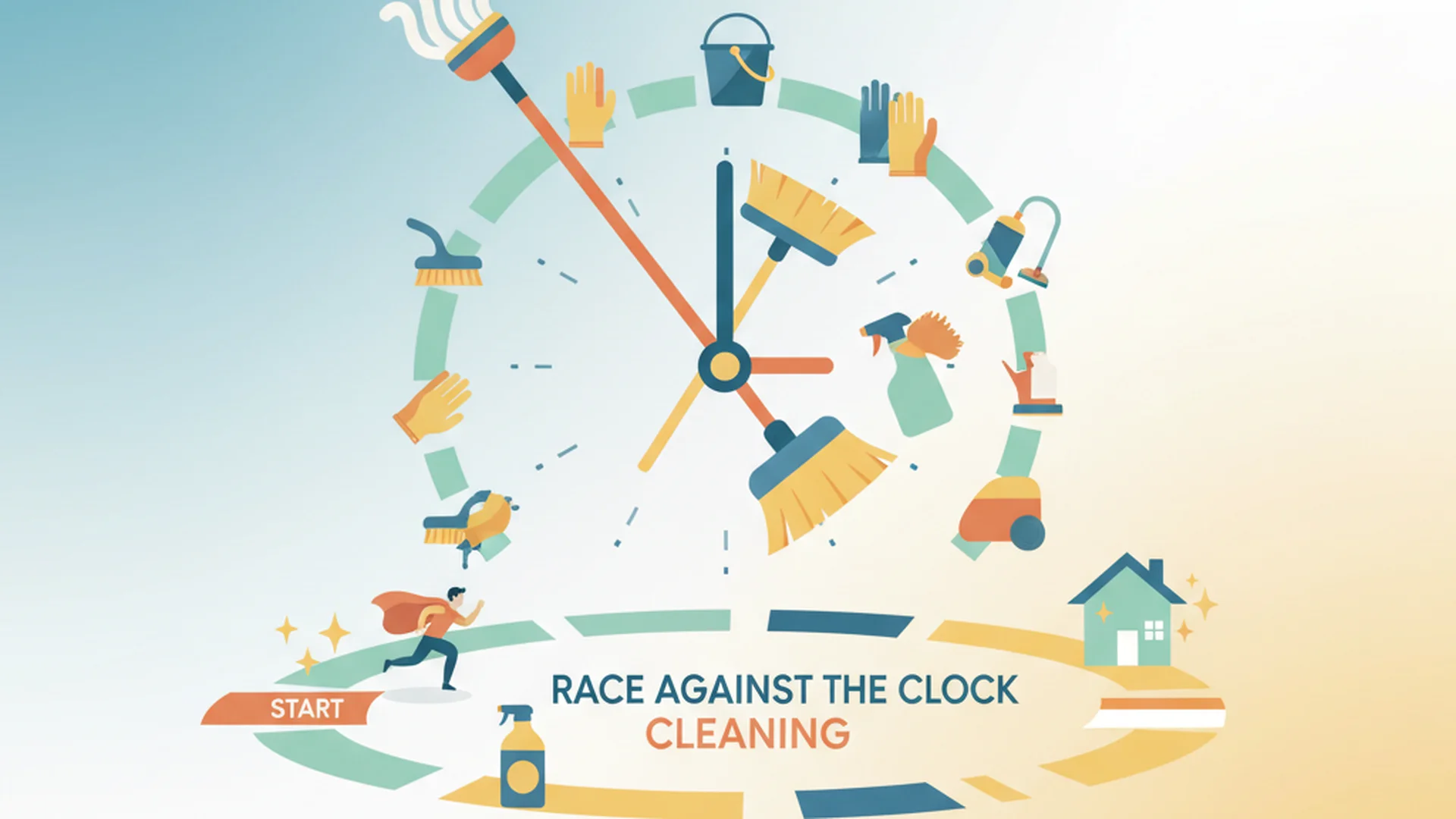
In today’s fast-paced world, finding a full day to deep-clean your home feels like an impossible luxury. Most of us are "time-poor," juggling professional responsibilities with personal lives, leaving our living spaces to fall into a state of "clutter-induced anxiety." However, a revolutionary approach known as race clock cleaning is changing the way we maintain our homes. By turning a chore into a high-intensity interval training (HIIT) session for your house, you can reclaim your environment in mere minutes.
Research from UCLA’s Center on Everyday Lives of Families (CELF) has proven that high clutter density correlates directly with elevated cortisol levels in women. By learning how to race clock cleaning effectively, you aren't just tidying a room; you are actively lowering your stress hormones and improving your mental well-being through focused, timed bursts of productivity.
The Psychology of the Cleaning Sprint
Why does setting a timer make us more efficient? The answer lies in Parkinson’s Law, which states that "work expands to fill the time available for its completion." If you give yourself all Saturday to clean the kitchen, it will take all Saturday. If you set a timer for 15 minutes, your brain shifts into a "sprint" state, prioritizing essential tasks over perfectionism.
Beyond the psychological boost, there is a physical payoff. According to Healthline, vigorous speed cleaning—scrubbing, moving light furniture, and rapid vacuuming—can burn between 170 and 300 calories per hour. It is a "double win" for your fitness and your home care.
Success: Racing the clock provides an immediate dopamine hit once the timer goes off and the room is visibly transformed, reinforcing the habit for the next day.
The 15-Minute Blueprint: A Whole-House Race
When you are performing a race clock cleaning, you need a plan. You cannot wander aimlessly. Here is how a professional consultant breaks down a 15-minute whole-house "Micro-Reset."
Phase 1: The Kitchen Clear (4 Minutes)
The kitchen is the heart of the home and usually the biggest source of visual clutter.
- Load the dishwasher: Don't worry about perfect tetris-style loading; just get the dirty dishes off the counter.
- Clear the counters: Move everything that doesn't belong to its designated room (or put it in a "transit basket" to be dealt with later).
- Wipe and Shine: A quick spray and wipe of the main island or counter surface.
Phase 2: The Living Room Reset (4 Minutes)
Focus on the "Big Three" visual wins:
- The Sofa: Fluff the pillows and fold the throw blanket.
- The Floor: A quick "high-traffic" vacuum or sweep. Don't move the sofa; just hit the middle.
- Surfaces: Stack magazines, put away remote controls, and clear coffee table rings.
Phase 3: The Bathroom Blitz (4 Minutes)
This is where "dwell time" becomes your best friend.
- Spray Everything: Spray the mirror, sink, and toilet immediately.
- Tidy: While the cleaner sits, put away toiletries and hang towels.
- Wipe: Start with the mirror (highest point) and end with the toilet rim.
Phase 4: The Final Lap (3 Minutes)
Spend the last three minutes doing a "walk-through." Return items from your transit basket to their proper rooms and take the trash out.
Note: This method is about "surface and sanitation," not deep organization. Save the junk drawer for another day.
Pro Strategies for Winning the Race
To truly master race clock cleaning ideas, you need to adopt the habits of professional cleaners. These three strategies will shave minutes off your time and improve your results.
The "Caddy" Method
Experts at The Spruce recommend never leaving a room to fetch a tool. Every time you walk to the laundry room for a different spray, you lose 30 seconds and gain a distraction (like a blinking light on the dryer or a rogue sock). Carry all your essentials—a multi-purpose cleaner, a glass cleaner, and three microfiber cloths—in a wearable apron or a portable bucket.
Top-Down, Left-to-Right
Never clean floor-to-ceiling. Always start at the highest point (shelves or top of the fridge) and work your way down. This ensures that any dust disturbed falls onto surfaces you haven't cleaned yet. Move around the room in one consistent direction—clockwise or counter-clockwise—so you never have to wonder, "Did I already wipe that?"
The Dwell Time Secret
One of the biggest mistakes in speed cleaning is the "spray and immediate wipe."
Warning: Wiping surfaces without letting the cleaner sit (dwell time) means the chemicals haven't had time to kill bacteria or break down grime. Always spray the bathroom or kitchen first, let it sit for 2 minutes while you tidy, then come back to wipe.
2025–2026 Trends: Gamifying Your Chores
As we move into 2026, the concept of race clock cleaning has evolved into a digital subculture. It’s no longer just a chore; it’s a competitive sport.
Gamification Apps
Apps like Tody and Sweepy have introduced "Race Modes." Users can set personal bests for cleaning the bathroom or compete against friends in a "Clean-Off." These apps provide progress bars and "experience points," turning a boring task into a game.
AI-Generated Cleaning Sprints
New AI assistants and smart home hubs now offer "Clean-with-Me" audio guides. You can tell your smart speaker, "Start a 10-minute kitchen race," and it will provide real-time instructions: "You have 60 seconds left for the counters... move to the floors in 3, 2, 1!"
The "Micro-Reset" Philosophy
The trend for 2026 is moving away from the "Saturday Morning Deep Clean." Instead, homeowners are embracing "Micro-Resets"—3-minute races performed after every meal or activity. This keeps the home in a constant state of "ready," so you are never more than 10 minutes away from a guest-ready house.
| Activity | Traditional Time | Race Clock Time | Efficiency Gain |
|---|---|---|---|
| Kitchen Clean | 45 min | 15 min | 66% |
| Living Room Tidy | 20 min | 5 min | 75% |
| Bathroom Refresh | 30 min | 10 min | 66% |
| Daily Dusting | 15 min | 3 min | 80% |
Real-World Examples of Race Clock Cleaning
Example 1: The "One-Song" Sprint
A popular trend on social media (Clean-Tok) involves picking a high-energy 3-minute song. You must finish tidying the entire living room before the song ends. This is perfect for parents trying to teach children how to clean quickly and joyfully.
Example 2: The "Commercial Break" Challenge
If you’re watching a live event or a show, use the 2-3 minute commercial breaks to "race" against a specific task, such as emptying the dishwasher or clearing the hallway of shoes.
Example 3: The Guest-is-Parking Scramble
We’ve all been there: a friend calls and says, "I'm 5 minutes away." The "race clock" mindset allows you to prioritize the "Big Three" (Clear counters, vacuumed floors, made bed) to give the illusion of a pristine home in record time.
Common Mistakes to Avoid
- The "Perfect" Trap: Stopping to organize a bookshelf or a junk drawer during a race. If it takes more than 30 seconds, it's not part of the race.
- The "Dry-Wipe" Error: Wiping a dusty surface with a dry cloth just moves the dust around. Always use a damp microfiber for maximum pick-up.
- Over-Cleaning One Spot: Spending 10 minutes on a single stubborn stain on the stovetop. If it doesn't come off in 30 seconds, move on and address it during a deep-clean session later.
- Distraction Sinks: Having the TV on or checking your phone mid-race. Put your phone on "Do Not Disturb" and focus entirely on the clock.
Tip: Use a wearable timer or a loud kitchen timer rather than your phone. It keeps the "ticking" sound present, which maintains your sense of urgency.
Frequently Asked Questions
Is speed cleaning actually effective, or does it just hide the mess?
How long should a cleaning race be?
What tools do I need for a cleaning race?
How do I motivate myself to start when I’m exhausted?
Conclusion
The race clock cleaning method is more than just a way to tidy up—it's a lifestyle shift that prioritizes your time and mental health. By embracing the sprint, using the right tools, and avoiding the trap of perfectionism, you can keep your home sparkling without sacrificing your entire weekend.
Success: By implementing just one 15-minute "Race Against the Clock" per day, you can reduce your total weekly cleaning time by up to 50%, leaving you more time for what truly matters.
Cleaning that keeps score
Every task earns points, every streak multiplies them, and Premium adds a household leaderboard plus a monthly Dustagorgon to beat.
- Free forever
- 30 badges to earn
- Up to 6 in a household
No card needed. Set up your rooms in a couple of minutes.