In this article
What you’ll learn
- Deep clean once a week for standard households; 2–3 times for large families.
- Flush with the lid down to prevent the "toilet plume" from spreading bacteria.
- Practice the "dwell time" rule by letting cleaners sit for 10 minutes.
For many homeowners, the bathroom is the most dreaded room to maintain. Yet, understanding exactly how often to clean toilet surfaces is critical for maintaining a healthy home environment. We often view the toilet as a simple utility, but biologically, it is a complex ecosystem, and the bowl harbours an enormous bacterial population. To keep your family safe from pathogens like E. coli and Salmonella, finding the right how often clean toilet answer depends on your household size and daily habits.
The Science of Bathroom Hygiene
To understand why frequency matters, we must look at the microscopic reality of our bathrooms. It isn't just about visible stains; it’s about what you can’t see.
The "Toilet Plume" Effect
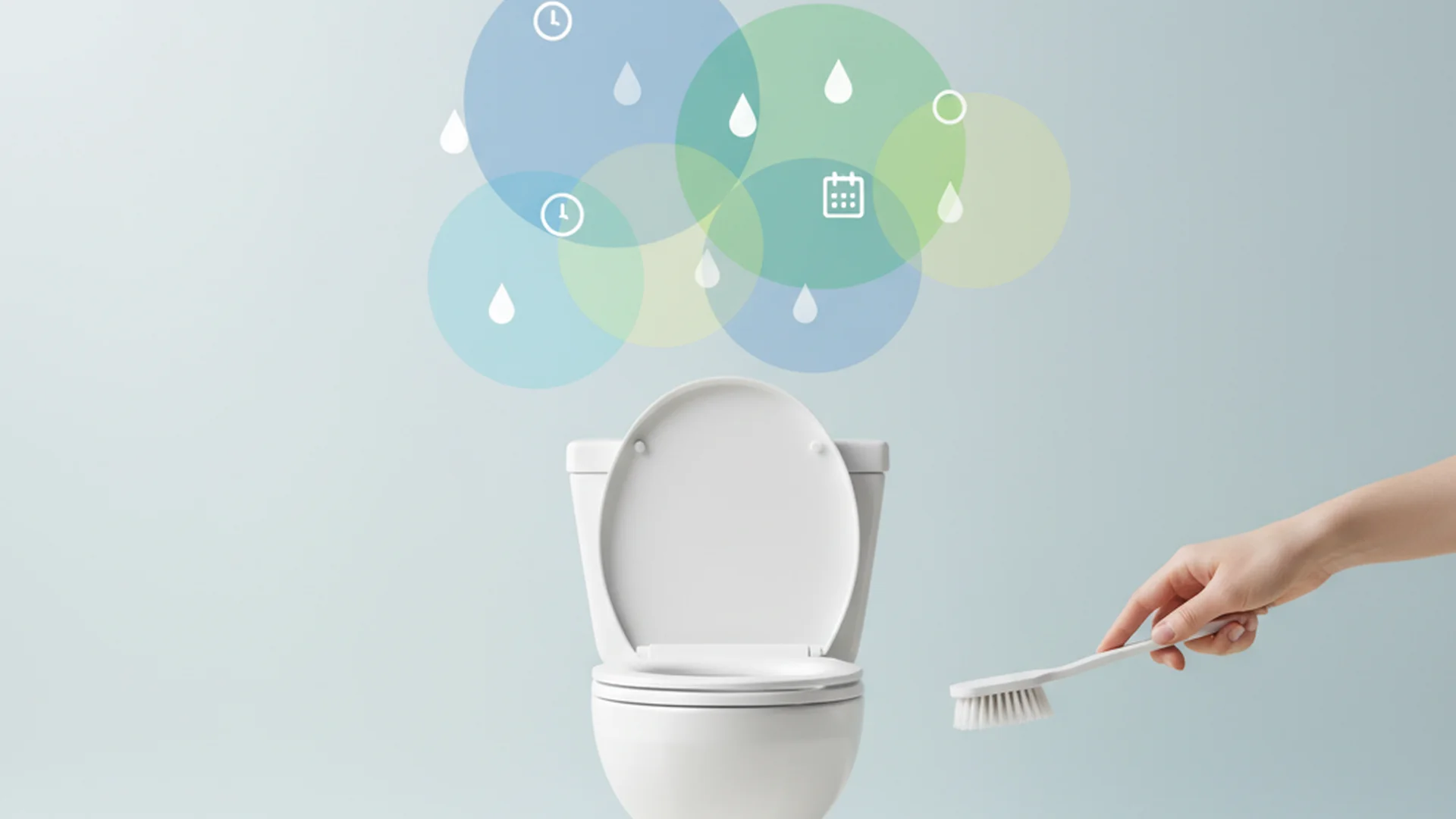
When you flush a toilet with the lid open, it creates what is known as a "toilet plume." A single flush sends thousands of aerosolized droplets into the air. These microscopic droplets can travel several feet and remain suspended for hours, eventually settling on your towels, soap dispensers, and even your toothbrush.
Bacterial Density
It isn't just the bowl that poses a risk. The toilet seat can host a wide variety of germs, and the design of the fixture itself affects how far they travel. Open, exposed designs aerosolize far more than modern enclosed or bidet-style models, which is a reminder that as our fixtures evolve, so must our cleaning standards.
Warning: Bathrooms are an easy room to let slide, and stretching the gap between cleans increases the risk of household cross-contamination.
Determining Your Cleaning Schedule
While "once a week" is the standard advice, the real how often clean toilet answer is more nuanced.
| Household Type | Deep Clean Frequency | Spot Cleaning Frequency |
|---|---|---|
| Single Occupant | Once a week | As needed |
| Family of 2-3 | Once a week | 1-2 times a week |
| Family of 4+ | 2–3 times a week | Daily |
| Households with Sick Residents | Daily | Every use (high-touch) |
Scenario 1: The Busy Family Household
Consider the Thompson family: two adults and three young children. In a high-traffic home like this, a single weekly clean is insufficient. With children often touching surfaces and the high volume of flushes, bacteria accumulate rapidly. For the Thompsons, a deep clean every Monday and Thursday, combined with daily wipes of the flush handle and seat, is the gold standard.
Scenario 2: The Modern "Smart" Home
In 2026, many homes are upgrading to "Wellness Hub" toilets. These models often include UV-C self-sanitization. If you own a high-end model like the Kohler Numi 2.0, your frequency for manual scrubbing may decrease because the integrated UV light disinfects the wand and bowl after every use. However, the exterior—the base and the handle—still requires weekly manual attention.
Scenario 3: The Urban Professional
For a single professional living in a studio apartment, a thorough deep clean once every Sunday is usually "enough." Since the usage volume is low, the primary concern shifts from bacterial load to mineral buildup and "pink mold" (Serratia marcescens) which thrives in damp, still environments.
Tip: If you notice a pinkish ring forming at the water line, that is Serratia marcescens. It feeds on phosphorus and fatty substances (like soap residue) and should be cleaned immediately to prevent respiratory irritation.
Expert Best Practices for 2025
Cleaning smarter is just as important as cleaning often. Follow these professional protocols to ensure your efforts aren't wasted.
The "Dwell Time" Rule
One of the most common mistakes is "spray and wipe." Most disinfectants require a specific "contact time" to effectively kill pathogens. Apply your cleaner and let it sit for 5–10 minutes before you start scrubbing. This allows the chemicals to break down the biofilm protecting the bacteria.
The Top-to-Bottom Strategy
To prevent cross-contamination, always start at the highest point. Clean the tank, then the flush handle (the most-touched part), then the exterior lid, and finally the bowl and base. This ensures that any drips from the top are cleaned as you move downward.
The Brush Hygiene Protocol
Storing a wet toilet brush in a holder creates a "bacteria soup." After scrubbing the bowl, wedge the brush handle under the toilet seat so the bristles hang over the bowl. Let it drip-dry for 10 minutes before putting it back in the holder.
Note: Running an exhaust fan during and after cleaning improves ventilation and helps clear airborne bacteria from the room.
Common Mistakes to Avoid
Even well-intentioned cleaners can make errors that compromise safety or damage their fixtures.
- Mixing Chemicals: NEVER mix bleach with ammonia or acidic cleaners like vinegar. This reaction produces toxic chloramine gas, which can be lethal if inhaled in a confined space like a bathroom.
- Using the "Same Sponge": This is the fastest way to spread E. coli. Dedicate specific sponges or microfiber cloths to the toilet and never use them on the sink or mirror.
- Ignoring the Base: Dust, hair, and "overspray" accumulate at the base of the toilet and the floor surrounding it. If ignored, this becomes a breeding ground for odors.
- Overusing Product: Using half a bottle of cleaner doesn't make the toilet "doubly clean." It leaves a sticky residue that actually attracts more dust and grime.
- Lemon Juice on Rubber: While natural cleaners are popular in 2025, the citric acid in lemon juice can degrade the rubber seals and gaskets inside your toilet tank over time, leading to leaks.
Success: Switching to eco-enzymatic or probiotic cleaners is a growing trend for 2025–2026. These cleaners contain "good" bacteria that continue to consume organic matter long after you’ve finished wiping down the surfaces.
2025–2026 Trends in Toilet Maintenance
The way we clean is being reshaped by technology. We are seeing a significant shift toward "touchless" environments. Motion-activated lids and touchless flush sensors are no longer luxury items; they are becoming standard in residential remodels. This reduces the number of high-touch surfaces, directly impacting how often you need to perform "spot" cleans.
Furthermore, the rise of "Smart Wellness" toilets allows users to track usage patterns via apps. Some systems will even send a notification to your smartphone when the integrated sensors detect a buildup of biofilm, taking the guesswork out of your cleaning schedule.
Frequently Asked Questions
How often is "enough" for a standard household?
Do I need to clean the toilet daily?
What are the signs I need to clean immediately?
Can I use bleach in every clean?
Is a toilet brush really necessary?
Conclusion
Determining how often to clean toilet surfaces isn't just about aesthetics; it's a vital part of household health. By implementing a consistent weekly deep clean, respecting "dwell time," and adopting modern hygiene habits like closing the lid before you flush, you can drastically reduce the bacterial load in your home. Whether you are using traditional methods or the latest 2026 "wellness" technology, consistency is the key to a safe and fresh bathroom.
Cleaning that keeps score
Every task earns points, every streak multiplies them, and Premium adds a household leaderboard plus a monthly Dustagorgon to beat.
- Free forever
- 30 badges to earn
- Up to 6 in a household
No card needed. Set up your rooms in a couple of minutes.