In this article
What you’ll learn
- Housework is morally neutral; a messy home does not reflect your character.
- Traditional cleaning methods often fail neurodivergent brains due to high "friction."
- Using systems like the "5 Things" method and body doubling can bypass executive blocks.
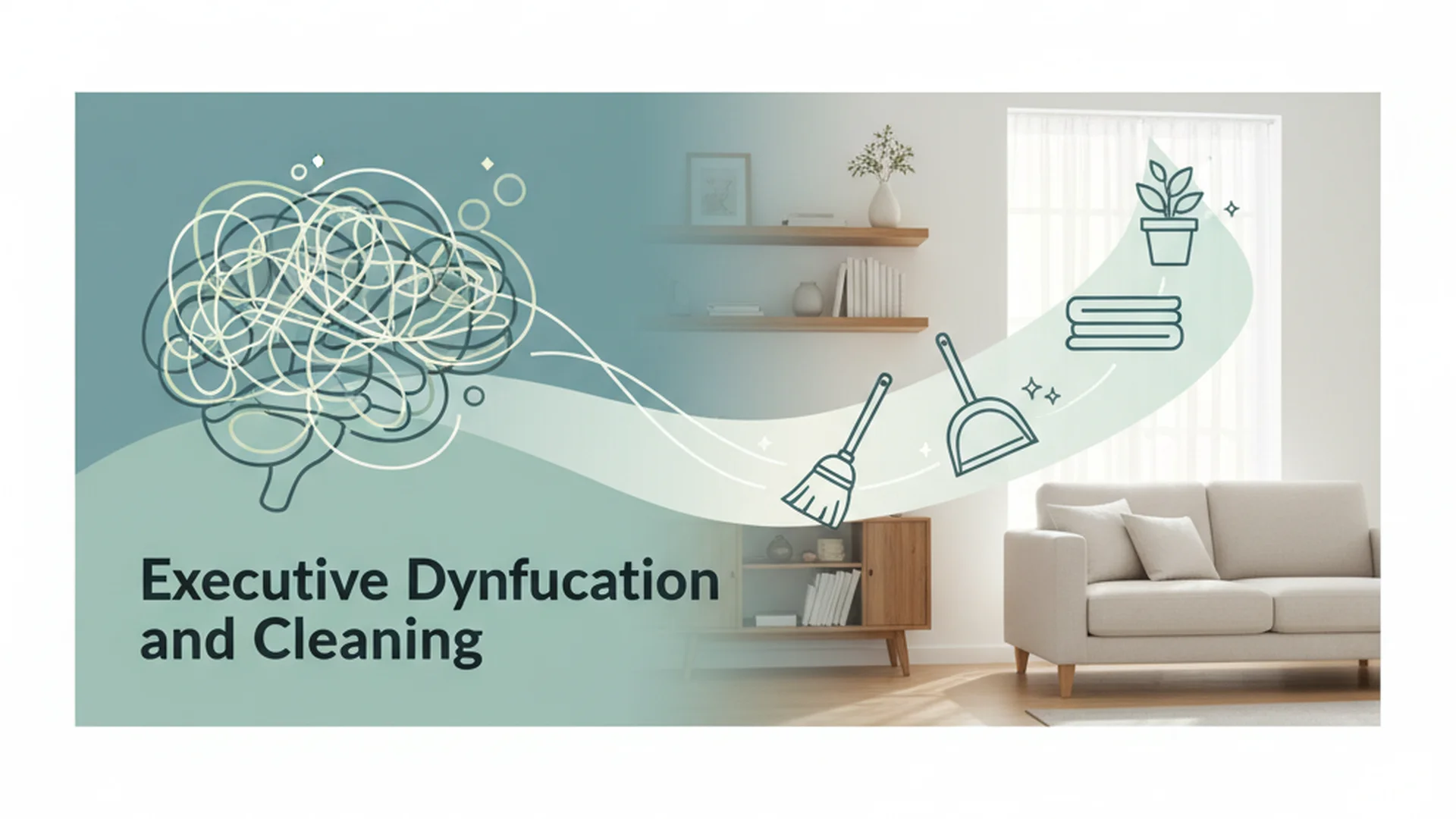
If you have ever stared at a pile of laundry for three hours, desperately wanting to move but feeling physically tethered to your chair, you aren’t lazy. You are likely experiencing a neurological block. For millions of people living with ADHD, Autism, or depression, executive dysfunction cleaning is not just a chore—it is a complex cognitive battle. Unlike the neurotypical experience of "just doing it," those with executive dysfunction (ED) face a "starter motor" that simply won't turn over, leading to a state often called ADHD paralysis.
Understanding that your brain’s "air traffic control" center is temporarily offline is the first step toward reclaiming your space. This guide will move beyond the standard "just buy a planner" advice and dive into the science-backed, low-friction strategies that actually work for neurodivergent minds in 2025.
Understanding the "Air Traffic Control" of Your Brain
To find effective executive dysfunction cleaning help, we must first understand what is happening inside the prefrontal cortex. Think of this part of your brain as the air traffic controller of a busy airport. It is responsible for sequencing tasks, managing time, and regulating focus.
When you look at a messy kitchen, a neurotypical brain sees "clean the kitchen." A brain with executive dysfunction sees 458 individual data points: the crusty spoon, the overflowing bin, the misplaced mail, the sticky counter, and the empty soap dispenser. Without a functional air traffic controller to prioritize these "planes," they all try to land at once, leading to a complete system shutdown.
The Impact of Neurodivergence
Significant executive function impairments are extremely common among people with ADHD. It is also a core challenge for those with Autism Spectrum Disorder (ASD), where cognitive flexibility is often limited. When you add the "brain fog" associated with Major Depressive Disorder or chronic burnout, the simple act of washing a dish can feel as taxing as running a marathon.
Note: Executive dysfunction is a physical reality in the brain, often linked to dopamine regulation. It is not a character flaw or a lack of discipline.
The 5 Things Tidying Method: A Game Changer
One of the most effective executive dysfunction cleaning tips popularized by creator KC Davis is the "5 Things" method. This strategy is designed to eliminate decision fatigue—the primary enemy of the neurodivergent cleaner. Instead of looking at a room as a whole, you only look for five specific categories.
How to Execute the 5 Things Method:
- Trash: Move through the room and only pick up things that go in the bin. Do not look at anything else.
- Laundry: Only pick up clothes. Put them in a pile or a basket. Do not start the wash yet.
- Dishes: Collect every dish and take them to the kitchen. Do not wash them yet.
- Things that have a place: Items that belong in this room and have a designated home. Put them away.
- Things that don’t have a place: Put these in a "purgatory" basket to be dealt with later.
Success: By limiting your focus to these five categories, you bypass the "What do I do next?" spiral that leads to paralysis.
Low-Friction Systems for a Functional Home
Traditional organization often adds "friction"—the number of steps required to complete a task. For someone with ED, a system that requires you to open a cupboard, pull out a bin, remove a lid, and fold an item is a system destined to fail.
| Traditional Method | Low-Friction Alternative | Why It Works |
|---|---|---|
| Folding and Drawer Filing | Open Bins/Hooks | Eliminates the "folding" step, which is a high-effort task. |
| Centralized Cleaning Closet | Point-of-Use Storage | Keeps supplies where they are used, preventing "distraction transit." |
| "All or Nothing" Deep Clean | "Junebugging" | Allows you to wander and return to a central "anchor" task. |
| Strict Daily Schedules | Energy-Based To-Do Lists | Matches the task to your current cognitive capacity. |
Real-World Example: Sarah’s No-Fold Laundry
Sarah, a graphic designer with ADHD, found that she could never keep her bedroom floor clear because she hated folding laundry. She replaced her dresser with a series of open, labeled baskets. Now, clean socks go in the "Socks" bin, and shirts go in the "Tops" bin. By removing the "folding" requirement, she reduced the friction of the task, and her floor has remained clear for six months.
Tip: Store your bathroom cleaner in the bathroom and your glass cleaner near the mirrors. The fewer rooms you have to walk through to find a tool, the less likely you are to get distracted by a new project.
Leveraging 2025 Technology and Trends
The landscape of executive dysfunction cleaning help has changed dramatically with the rise of AI and the "Gentle Cleaning" movement. We are moving away from the "hustle" culture of the 2010s and toward a more "prosthetic" approach to household management.
AI-Driven Task Decomposition
In 2025, tools like Goblin.tools and specialized AI assistants have become essential for neurodivergent individuals. These tools take a vague command like "Clean the Kitchen" and break it down into micro-steps:
- Clear the left counter.
- Put the detergent in the dishwasher.
- Find a clean sponge.
- Wipe the sink.
This "Task Decomposition" removes the mental load of planning, allowing you to simply follow the list.
Sensory-Aware Cleaning
Many people avoid cleaning because it is a sensory nightmare. The roar of the vacuum, the smell of bleach, and the feeling of wet food can cause sensory overload.
- Noise-Canceling Headphones: Use these to block out the "aggressive" sounds of appliances.
- Gloves: Essential for those who find the texture of dishwater or cleaning chemicals distressing.
- Unscented Products: Switch to natural or low-scent cleaners to avoid "scent fatigue."
Warning: Sensory overload can mimic executive dysfunction. If you are feeling "irritable" or "on edge" while cleaning, check your sensory environment first.
The Power of Body Doubling
Body doubling is a productivity strategy where you work on a task alongside another person. This person doesn't even have to help you clean; their mere presence acts as a "social anchor," keeping your brain in "work mode."
How to Body Double in 2025:
- Virtual Body Doubling: Join a "Clean With Me" livestream on TikTok or YouTube.
- Focusmate: Use apps that pair you with a stranger over video for a 50-minute work session.
- The "Phone Friend": Call a friend and put them on speaker while you both do chores in your respective homes.
Real-World Example: The "Kitchen Call"
Mark, who struggles with the "dishes-to-counter-to-stove" sequence, started a weekly "Kitchen Call" with his brother. They don't talk about cleaning; they just chat about sports while Mark's brother stays on the line until Mark confirms the dishes are in the machine. The external presence prevents Mark from wandering off to start a different project.
Common Mistakes to Avoid
When navigating executive dysfunction cleaning, certain "common sense" approaches can actually backfire.
- Relying on Motivation: Motivation is a feeling that comes and goes. Executive function is a cognitive process. You cannot wait to "feel like" cleaning. Instead, rely on external triggers like timers or body doubles.
- The "All-or-Nothing" Mindset: Thinking you must clean the whole house or it doesn't count. In reality, washing three forks is better than washing zero forks.
- Using Shame as a Stimulant: Berating yourself for being "lazy" actually triggers the amygdala (the fear center), which further shuts down the prefrontal cortex. You cannot shame yourself into being productive.
- Ignoring the "Transition Cost": The hardest part of cleaning is the transition from "not cleaning" to "cleaning." Acknowledge that the first 5 minutes will be the most difficult part of the entire process.
Note: If you find yourself "doom scrolling" instead of cleaning, your brain is likely seeking the dopamine it needs to initiate a task. Try a "dopamine snack"—like a 5-minute dance to a favorite song—to jumpstart your system.
Frequently Asked Questions
Why can I be productive at work but unable to clean my house?
Is it laziness or executive dysfunction?
Where do I start when everything is a mess?
Why does my house get messy again so fast?
Conclusion: Cleaning as Self-Care, Not a Moral Obligation
The most important thing to remember about executive dysfunction cleaning is that your home exists to serve you; you do not exist to serve your home. A sink full of dishes is not a sign of a failed life; it is a sign that you were busy, tired, or struggling with a neurological block.
By adopting "gentle cleaning" habits, reducing the friction in your environment, and utilizing 2025 tools like AI task decomposition and virtual body doubling, you can create a space that supports your mental health rather than draining it. Start small, be kind to yourself, and remember: anything worth doing is worth doing poorly.
Success: Moving from a mindset of "shame" to a mindset of "functional support" is the ultimate win in managing executive dysfunction.
Cleaning that keeps score
Every task earns points, every streak multiplies them, and Premium adds a household leaderboard plus a monthly Dustagorgon to beat.
- Free forever
- 30 badges to earn
- Up to 6 in a household
No card needed. Set up your rooms in a couple of minutes.